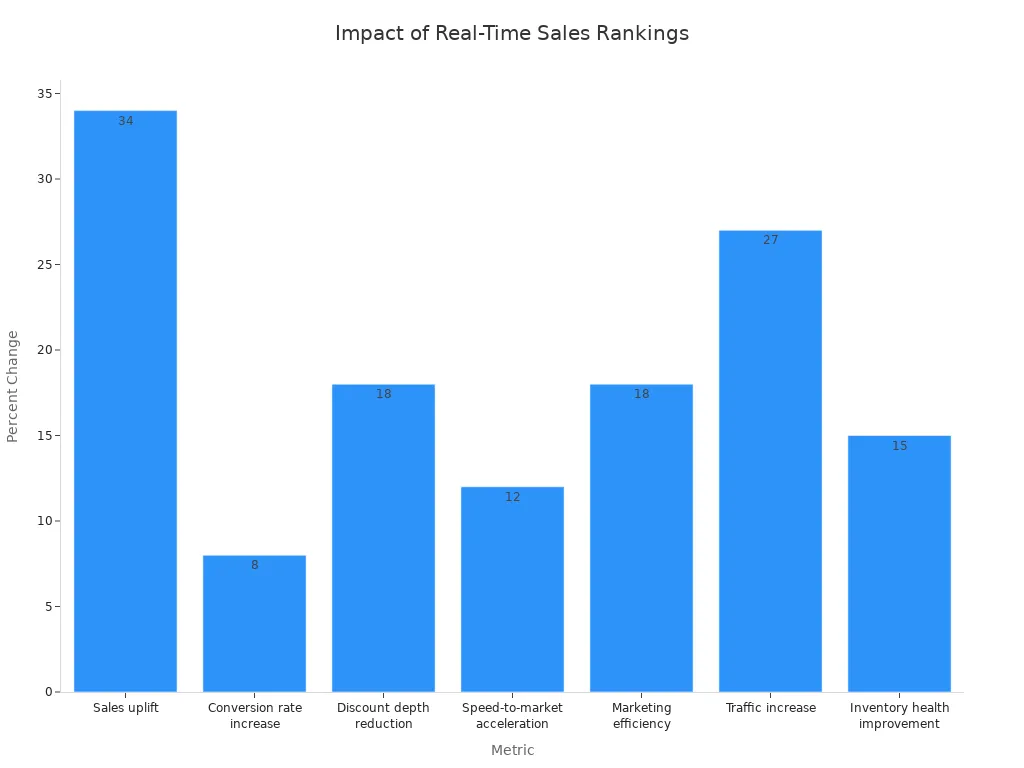
You can unlock immediate retail success by leveraging real-time sales rankings on digital price tags. Moda, a leading fashion brand, saw a 34% sales uplift in core categories and an 8% conversion rate increase within six months, as shown below:
| Metric | Result/Impact |
|---|---|
| Sales uplift | 34% increase in core categories within 6 months |
| Conversion rate increase | 8% uplift on products tagged with badges |
| Discount depth reduction | 18% decrease due to better inventory/pricing |
| Speed-to-market acceleration | 12% faster launch for viral items |
| Marketing efficiency | 18% increase in click-through rates on banners |
| Traffic increase | 27% more visits to targeted category landing page |
| Inventory health improvement | ~15% reduction in end-of-season discount stock |
Digital price tags drive digital acceleration and streamline your operations. You benefit from automated price changes, labor cost reduction, and faster restocking. Electronic Shelf Labels, ESL Gateway AP, and ESL Price Tag solutions in Esl Retail ensure pricing accuracy, instant promotions, and enhanced customer engagement.
Understanding Real-Time Sales Rankings and Digital Price Tags
What Are Real-Time Sales Rankings?
Definition and core concept
You can use real-time sales rankings to see which products perform best at any given moment. This approach gives you immediate visibility into sales trends, letting you respond quickly to changes in demand. Real-time sales rankings differ from traditional reporting because you receive up-to-the-minute, location-specific data. This enables you to make fast, informed decisions that drive sales and improve customer satisfaction.
How sales data is collected and updated
Retailers collect sales data through point-of-sale systems and inventory management platforms. These systems track every transaction and update sales figures instantly. You benefit from this process because it allows for real-time updates on product performance. Unlike traditional methods, which rely on delayed and generalized reports, real-time analytics deliver immediate insights. You can detect issues like stockouts or sudden demand spikes and act before they impact your bottom line.
Tip: Real-time analytics help you avoid losses from out-of-stock situations by enabling dynamic adjustments in inventory and marketing.
What Are Digital Shelf Labels and Digital Price Tags?
Overview of electronic shelf labels
Digital shelf labels, also known as electronic shelf labels, replace paper price tags with digital displays. You can find these labels in supermarkets, convenience stores, and specialty retailers. They connect to a central server, which allows you to manage prices and promotions remotely. Leading companies such as SES-imagotag, Pricer AB, and Samsung provide these solutions, supporting omnichannel retailing and price consistency.
Key features and capabilities
Digital shelf labels offer several advanced features:
- E-paper, LCD, LED, and color display options for clear visibility
- Wi-Fi or Bluetooth Low Energy connectivity for seamless communication
- Long battery life, with some models using solar power
- Smart ESLs that integrate IoT and AI for enhanced functionality
- Customizable designs, including barcode scanning and branding
You gain operational efficiency and cost savings by automating price changes and reducing manual labor. Digital price tags also support dynamic pricing and promotional strategies, improving both accuracy and customer engagement.
How Real-Time Sales Rankings and Digital Price Tags Work Together
Integration of sales data with digital displays
You can integrate real-time sales rankings with digital price tags to create a powerful retail tool. By connecting sales data to digital shelf labels, you display up-to-date product rankings, pricing, and promotions directly on the shelf. AI-driven analytics platforms, such as those from Bright Insights and VusionGroup, enable you to track sales performance and competitor pricing in real time. This integration lets you adjust prices, manage inventory, and personalize promotions based on live data.
Real-world examples in retail environments
Retailers like Best Buy have rolled out electronic shelf labels across hundreds of stores. This move improved pricing accuracy, reduced labor costs, and enhanced the customer experience by showing real-time inventory status and product information. Grocery chains and fashion retailers also use digital price tags to enable real-time updates and operational efficiencies. These deployments demonstrate how you can transform your retail operations by combining real-time sales rankings with digital shelf labels.
Key Advantages of Real-Time Sales Rankings on Digital Shelf Labels
Dynamic Pricing and Real-Time Pricing Strategies
Real-time price adjustments based on sales performance
You can transform your retail operations by leveraging real-time pricing and dynamic pricing strategies. When you connect live sales data to digital shelf labels, you gain the ability to make instant price changes based on actual product performance. This approach allows you to respond to demand fluctuations, competitor pricing, and inventory levels with precision.
Retailers use dynamic and predictive pricing models that analyze data from point-of-sale systems, inventory, and even foot traffic. Automated systems, such as electronic shelf labels, enable you to update prices across your store network in seconds. For example, you might lower prices on perishable goods nearing expiration or increase prices on trending items during peak hours. Predictive pricing helps you anticipate demand spikes, such as for seasonal products or weather-related events.
By adopting real-time pricing, you ensure that your pricing strategies remain competitive and relevant, driving both revenue and customer satisfaction.
The impact of dynamic pricing strategies is clear:
| Metric | Result | Description |
|---|---|---|
| Revenue Increase | 12% | Achieved within the first year of implementing dynamic pricing based on real-time sales data. |
| Profit Margin Improvement | 8% | Resulted from optimized pricing and reduced inventory costs. |
| Customer Retention Increase | 15% | Due to personalized promotions and competitive pricing enabled by dynamic pricing strategy. |
You can see that dynamic pricing and real-time pricing strategies deliver measurable improvements in revenue, profit margins, and customer loyalty.
- 55% of retailers plan to adopt AI-driven dynamic pricing by 2025.
- Expected benefits include a 10% boost in profits and a 13% increase in sales.
- Tools like LeewayHertz and VisionX enable real-time data analysis and competitor monitoring, facilitating dynamic pricing adjustments.
A North American retailer implemented dynamic pricing and experienced a 6% increase in overall revenue and a 10% increase in profitability within six months. This real-world example demonstrates the power of real-time pricing and dynamic pricing strategies in retail.
Automated promotional strategies
You can automate your promotion optimization by integrating real-time sales rankings with digital shelf labels. Automated systems trigger promotions based on live sales data, inventory status, or specific events. For instance, you can launch a flash promotion when a product’s sales slow down or activate a discount for items approaching expiration.
Dynamic pricing and promotion optimization work together to maximize sales and minimize waste. Automated promotion optimization ensures that your offers are always relevant and timely, increasing the likelihood of customer engagement. You can also use real-time pricing to test different promotional strategies, refining your approach based on immediate feedback from sales data.
Tip: Automated promotion optimization reduces manual effort, eliminates pricing errors, and ensures that your promotions align with current market conditions.
Enhanced Customer Experience with Digital Price Tags
Transparent product popularity rankings
Digital price tags and digital shelf labels provide shoppers with transparent, real-time information about product popularity. When you display real-time sales rankings or customer ratings directly on the shelf, you help customers make informed decisions quickly. This transparency builds trust and reduces uncertainty, especially for new or high-value products.
A scientific study published on ScienceDirect found that digital price tags enhance consumer trust in retail settings. Consumers perceive digital price tags as more trustworthy, especially when the digital format matches the product attributes. This increased trust reduces skepticism about pricing information and improves the overall customer experience.
Digital price tags also ensure price consistency across channels, which reassures customers and fosters loyalty. When you synchronize pricing between online and physical stores, you create a seamless shopping experience that meets modern consumer expectations.
Personalized shopping recommendations
You can use digital shelf labels to deliver personalized shopping recommendations at the point of sale. By analyzing real-time sales rankings and customer preferences, you can highlight bestsellers, suggest complementary products, or promote limited-time offers. This level of personalization increases customer engagement and drives higher conversion rates.
Digital price tags can display dynamic content, such as ratings, reviews, or tailored promotions, based on shopper behavior and inventory status. Automated promotion optimization ensures that recommendations remain relevant and timely, enhancing the shopping journey.
According to the STORIS blog, digital price tags reduce manual pricing errors and provide richer product information, including interactive promotions and personalized recommendations. This approach increases customer engagement and satisfaction, while freeing staff to focus on service.
Note: Digital shelf labels improve pricing accuracy and transparency, which reduces customer frustration and builds long-term trust.
Data-Driven Inventory Management Using Real-Time Sales Rankings
Optimizing stock levels with live sales data
You can achieve significant optimization in inventory management by using real-time sales rankings and digital shelf labels. Live sales data enables you to forecast demand accurately, automate replenishment, and maintain optimal stock levels across all locations. AI-powered analytics convert raw data into actionable insights, allowing you to make smarter, faster decisions.
| Improvement Area | Observed Benefit | Quantified Impact |
|---|---|---|
| Stock Accuracy | Enhanced accuracy through AI-powered forecasting | 20–30% improvement |
| Out-of-Stock Incidents | Reduction via real-time analytics dashboards | Up to 25% reduction |
| Overstock/Understock Losses | Reduced losses through IoT real-time tracking | Up to 30% reduction |
| Carrying Costs | Lowered by automated reordering and forecasting | Significant reduction (exact % N/A) |
| Order Accuracy & Fulfillment | Faster and more accurate order processing | N/A |
You benefit from improved inventory accuracy, lower holding costs, and fewer stockouts. Predictive analytics and demand forecasting help you avoid excess inventory and reduce waste.
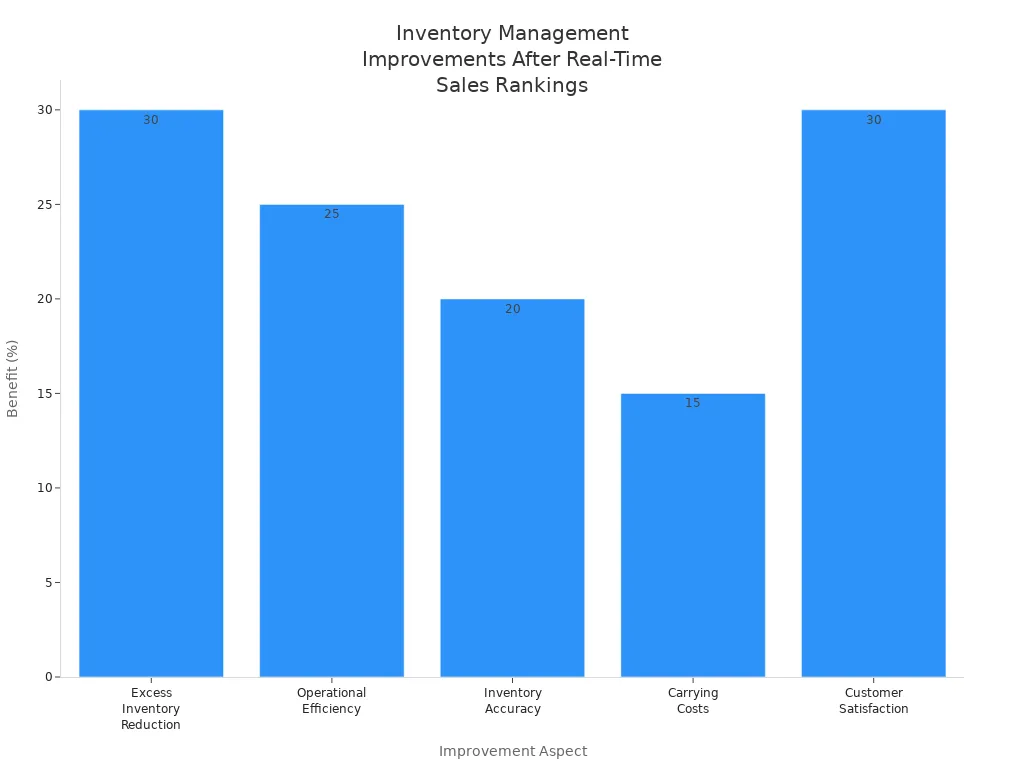
- Improved inventory accuracy by reducing human error and maintaining reliable stock levels.
- Lower holding costs and fewer stockouts through predictive analytics and demand forecasting.
- Streamlined inventory management via automated replenishment workflows.
- Greater supply chain visibility allows proactive management of disruptions and demand fluctuations.
- Boosted customer satisfaction due to accurate demand forecasting and efficient order fulfillment.
Reducing out-of-stocks and overstock situations
Digital shelf labels play a crucial role in reducing both out-of-stock and overstock situations. You can monitor stock levels in real time and automate reordering, ensuring that shelves remain well-stocked with the right products. LED indicators on digital price tags alert staff to restocking needs, expiration dates, and reordering requirements.
- Digital shelf labels integrate with inventory management systems to provide real-time stock data.
- Remote updates of product information improve responsiveness to market changes and competitor pricing.
- Enhanced monitoring of perishable items helps reduce waste and holding costs.
- The system’s responsiveness and accuracy optimize stock levels, preventing both stockouts and overstock.
By minimizing manual price changes, digital shelf labels reduce pricing errors and contribute to accurate inventory management. Continuous monitoring and automatic updates improve customer satisfaction by ensuring product availability and reducing waste.
With real-time pricing and promotion optimization, you can maintain optimal inventory levels, reduce costs, and deliver a superior shopping experience.
Operational Efficiency with Digital Shelf Labels
Streamlining manual price updates
You can transform your store operations by adopting digital shelf labels. Traditional price updates require employees to print, walk the aisles, and replace paper tags. This process consumes valuable time and often leads to inconsistencies. When you use digital shelf labels, you automate price changes across your entire store in minutes. Store managers can update thousands of price tags instantly through a centralized POS system. This approach eliminates the need for manual intervention and ensures that every shelf displays accurate, up-to-date information.
- Employees spend 80% less time updating price tags after switching to digital shelf labels.
- A retailer completed 1,400 price changes in under 10 minutes, compared to four days with manual methods.
- Digital shelf labels synchronize with inventory databases, enabling automatic price adjustments and restocking alerts.
You gain the flexibility to implement dynamic pricing strategies with ease. When you connect your digital shelf labels to real-time sales data, you can adjust prices dynamically based on demand, competitor activity, or inventory levels. This dynamic approach allows you to respond quickly to market changes and optimize your pricing for maximum profitability.
Tip: Digital shelf labels eliminate expenses related to paper labels, printers, and ink, further streamlining your operations.
Reducing labor costs and errors
You achieve significant cost savings when you move from manual processes to digital shelf labels. Employees no longer spend hours on repetitive tasks, freeing them to focus on customer service and shelf replenishment. This shift boosts productivity and improves the overall shopping experience.
The following table highlights the impact of digital shelf labels on labor costs and pricing errors:
| Aspect | Manual Process | ESL System Impact |
|---|---|---|
| Labor hours per week | 50 hours | Nearly eliminated |
| Labor cost per year | $39,000 | $0 (labor savings) |
| Energy costs | $10,000 | Reduced due to energy-efficient displays |
| Pricing error losses | $5,000 | Nearly eliminated |
| Total annual losses | $54,000 | $0 (total savings) |
| ESL system cost | N/A | $100,000 (one-time) |
| ROI | N/A | 54% annually |
| Payback period | N/A | Approximately 1.85 years |
Digital shelf labels reduce human pricing errors by up to 20%. You ensure pricing consistency between the shelf and the POS system, minimizing customer disputes and lost revenue. Employees can now focus on higher-value activities, such as assisting shoppers or optimizing product displays.
- Store managers can update prices for thousands of products in minutes, supporting dynamic pricing and promotional campaigns.
- Centralized stock information simplifies inventory management, enabling remote handling of ordering, returns, and fulfillment.
- Dynamic pricing becomes a practical reality, allowing you to implement localized and time-sensitive offers without additional labor.
You benefit from a streamlined workflow, reduced material costs, and improved accuracy. Digital shelf labels support your dynamic pricing goals and help you maintain a competitive edge in a fast-paced retail environment.
Practical Steps for Implementing Real-Time Sales Rankings on Digital Price Tags
Assessing Readiness and Setting Goals
Evaluating current systems and infrastructure
You should begin by evaluating your current retail systems. Review your point-of-sale (POS), inventory management, and ecommerce platforms. Check if these systems can support integration with digital price tags and real-time pricing tools. Look for compatibility, scalability, and the ability to handle future upgrades. If your infrastructure is outdated, consider upgrading to platforms that support seamless data exchange and automation.
Tip: A future-proof system ensures that you can adapt quickly as your business grows or as new pricing tools become available.
Defining success metrics
Set clear goals before you launch digital price tags. Define what success looks like for your business. You might track metrics such as sales uplift, reduction in pricing errors, improved inventory accuracy, or faster price update cycles. Use these metrics to measure the impact of your new system and guide future improvements.
| Success Metric | Example Goal |
|---|---|
| Sales uplift | 10% increase in 6 months |
| Pricing error reduction | 90% fewer errors |
| Inventory accuracy | 95%+ stock accuracy |
| Price update speed | <5 minutes per store update |
Integrating Digital Shelf Labels with Existing Retail Systems
Connecting POS, inventory, and digital tag platforms
To achieve seamless integration, follow these best practices:
- Choose POS and ecommerce platforms that are compatible with digital price tags and support business growth.
- Use APIs or pre-built connectors to link your systems, enabling real-time or scheduled data synchronization.
- Configure synchronization settings carefully to resolve data conflicts and maintain accurate sales and inventory data.
- Test the integration by running sample transactions and simulating different scenarios.
- Monitor system performance continuously to catch and fix issues quickly.
- Update and maintain your integrated systems regularly to keep up with new sales channels and technology changes.
This approach ensures that your digital price tags always display accurate prices and sales rankings.
Ensuring data accuracy and security
You must prioritize data accuracy and security when integrating digital price tags. Set up protocols to verify that pricing tools and inventory data match across all platforms. Use secure connections and access controls to protect sensitive information. Regular audits and monitoring help you maintain system reliability and customer trust.
Staff Training and Change Management for Digital Price Tags
Educating employees on new workflows
Effective staff training is essential for a smooth transition. Provide hands-on sessions covering software navigation, troubleshooting, and best practices for updating prices with digital price tags. Focus on the user-friendly interface to reduce errors and boost efficiency.
- Include onboarding programs to help staff leverage the benefits of digital price tags from day one.
- Offer refresher courses as new features or pricing tools roll out.
Encouraging adoption and feedback
Encourage your team to embrace the new technology. Create open channels for feedback and suggestions. Recognize early adopters and share success stories to motivate others. Smooth implementation through effective training minimizes downtime and accelerates the advantages of digital price tags.
Note: Ongoing support and open communication help your staff feel confident and invested in the new system.
Best Practices for Deploying Real-Time Sales Rankings
Piloting in select stores or departments
You should start your real-time sales rankings journey with a pilot program. Select a few stores or departments that represent your broader retail environment. This approach lets you test the integration of digital price tags and real-time data without disrupting your entire operation. You can identify technical challenges early, such as connecting digital price tags to legacy POS or inventory systems. Many retailers discover that older systems struggle to support modern AI-driven pricing and promotion optimization. By piloting, you gain valuable insights into system compatibility and can work with vendors to modernize your data architecture or use middleware for smoother integration.
During the pilot, focus on data quality and accuracy. Inaccurate or outdated data can lead to incorrect pricing, failed promotion optimization, and inventory issues. Validate your data inputs, standardize collection methods, and conduct regular audits. This ensures that your digital price tags display correct sales rankings and promotion details at all times.
You also need to prepare your staff for new workflows. Employees may resist change or struggle with new technology. Provide hands-on training and use digital adoption tools to help your team adjust. Encourage feedback and recognize staff who champion the new system. This builds confidence and ensures a smoother rollout when you expand beyond the pilot phase.
Tip: Use clear signage or QR codes to explain real-time pricing and promotion methods to customers. This transparency builds trust and helps shoppers understand the benefits of dynamic promotion optimization.
Monitoring performance and iterating
Once your pilot is live, you must monitor performance closely. Track key metrics such as sales uplift, inventory accuracy, and the effectiveness of each promotion. Real-time dashboards help you spot anomalies, such as sudden price swings or inventory mismatches. Set price limits to prevent drastic changes that could confuse customers or erode trust.
Continuous monitoring allows you to refine your promotion optimization strategies. You can test different types of promotions, measure customer response, and adjust your approach based on live data. This iterative process ensures that your AI-driven pricing and promotion efforts remain effective and relevant.
You should also address data security and compliance throughout the process. Protect sensitive information with encrypted communication and multi-factor authentication. Regularly update your systems to guard against new threats.
A phased rollout, supported by ongoing optimization, helps you balance automation with human oversight. You can expand your deployment with confidence, knowing that your real-time sales rankings and promotion optimization deliver measurable results.
Note: Strong data governance and continuous staff engagement are essential for long-term success with digital price tags and real-time promotion strategies.
Overcoming Challenges and Considerations for Digital Price Tags
Investment and ROI Analysis for Digital Shelf Labels
Upfront costs vs. long-term benefits
When you consider digital price tags, you must weigh the initial investment against the long-term value. Upfront costs include purchasing hardware such as digital displays and scanners, installing infrastructure, and integrating with your retail systems. You also need to budget for software licensing fees, which may be bundled or charged monthly. Installation and setup costs can vary, especially if you choose professional services for large deployments. Ongoing expenses include maintenance, battery replacement, software updates, and staff training.
- Hardware and infrastructure purchases
- Customization and integration with existing systems
- Installation and setup (self-install or professional)
- Software licensing (monthly or annual)
- Maintenance, repairs, and battery replacement
- Staff training and long-term support
Despite these costs, you gain significant benefits. Digital shelf labels reduce labor and print expenses, automate price updates, and support sustainability by cutting paper waste. You also improve operational efficiency and customer experience.
Calculating return on investment
You can expect a strong ROI from digital shelf labels. The market is growing rapidly, with a CAGR over 17%, showing retailer confidence. Many retailers achieve ROI within 12 to 36 months, especially when combining digital shelf labels with price optimization software. Key ROI drivers include:
- Labor cost reductions by automating price updates, saving hundreds of hours each month
- Improved price accuracy, reducing errors and regulatory penalties
- Real-time pricing updates that enable dynamic pricing and promotions
- Revenue per square foot increases up to 20% after adoption
- Operational efficiencies such as faster promotional resets and omnichannel price alignment
Retailers in high-volume or promotion-heavy environments see the fastest returns. While initial costs may seem high, the savings and agility you gain justify the investment.
Legal and Compliance Issues with Real-Time Pricing
Pricing transparency regulations
You must comply with regulations when using real-time pricing. Dynamic pricing can raise concerns about fairness, especially for essential goods during high demand. Regulatory bodies like the FTC monitor for price gouging and unfair price discrimination. You need to inform customers about how you use their data in pricing decisions and provide clear privacy notices.
| Legal/Compliance Issue | Description | Best Practice/Consideration |
|---|---|---|
| Data Privacy | Compliance with data protection laws for personalized pricing. | Obtain lawful basis for data collection; provide clear privacy notices. |
| Transparency | Informing consumers about data use in pricing decisions. | Ensure clear communication to customers. |
| Dynamic Pricing & Fairness | Avoiding unfair price discrimination and price gouging. | Audit pricing algorithms for fairness and compliance. |
| Competition Law | Risks of algorithmic collusion and market power abuse. | Engage legal experts to ensure compliance. |
| Employment Law | Labor impacts from automation. | Consult with employees/unions and provide retraining. |
| Intellectual Property & Licensing | Proper licensing of ESL software and pricing algorithms. | Conduct due diligence on licenses and clarify IP ownership. |
Data privacy and security concerns
Real-time pricing systems often use customer data for personalized offers. You must protect this data and comply with privacy laws. The use of facial recognition or profiling can lead to privacy violations and legal consequences. The FTC investigates surveillance-based pricing practices, so you need robust data security and transparent policies. Regular audits and clear communication help you maintain trust and avoid regulatory issues.
Technical Challenges in Implementing Digital Price Tags
System compatibility and integration hurdles
You may face technical challenges when implementing digital price tags. Ensuring reliable wireless connectivity is essential, whether you use 2.4GHz, Bluetooth, or Wi-Fi. Seamless integration with your warehouse management and POS systems is critical for real-time pricing accuracy. Durability matters, especially in environments with temperature changes or heavy handling. You must also manage battery life and ensure display readability under different lighting conditions.
- Select robust e-ink shelf labels with long-lasting batteries
- Conduct pilot programs to identify and resolve issues before full deployment
- Provide tailored training and technical support
- Assess your store layout to optimize tag placement
- Use secure, encrypted communication protocols
Ongoing maintenance and support
You need a plan for ongoing maintenance and support. Regular battery replacement, especially for color and LCD displays, keeps your system running smoothly. Software updates and technical troubleshooting are necessary to maintain real-time pricing accuracy. Staff training ensures your team can handle new workflows and system updates. Choosing scalable and flexible digital shelf tag systems helps you grow and adapt as your business evolves.
Tip: Addressing technical, legal, and operational challenges early ensures your real-time pricing strategy delivers maximum value and compliance.
Measuring Success and Continuous Improvement with Real-Time Sales Rankings
Key Performance Indicators (KPIs) for Digital Shelf Labels
Sales uplift and conversion rates
You need to track the right KPIs to measure the impact of digital shelf labels and real-time sales rankings. Sales uplift and conversion rates give you direct insight into how these technologies influence shopper behavior. When you monitor sales uplift, you see the percentage increase in sales after deploying digital shelf labels. Conversion rates show how many shoppers who interact with your displays actually make a purchase. These metrics help you understand the effectiveness of your pricing and promotion strategies.
Customer satisfaction metrics
Customer satisfaction metrics provide another layer of insight. You can use surveys, feedback forms, and Net Promoter Scores (NPS) to gauge how shoppers feel about their experience. Fast price updates, accurate information, and clear product rankings all contribute to higher satisfaction. When you see improvements in these metrics, you know your digital shelf label deployment supports a better shopping journey.
| KPI Name | Description | Why It Matters | Benchmark / Impact | Tracking Methods / Tools |
|---|---|---|---|---|
| Time-to-reset | Measures elapsed time between reset directive issuance and execution in-store | Delays cause missed sales opportunities and brand invisibility; fast resets capture shopper attention | Top teams complete resets within 72 hours; legacy processes take longer causing execution gaps | Timestamped logs, mobile photo confirmation, automated validation via retail execution platforms |
| Promo deployment speed | Tracks time from promotional directive to full in-store execution | Delays reduce sales lift, erode retailer trust, and waste budget; timing is critical for campaign success | Best teams deploy promotions within days; delays of 3-5 days significantly reduce lift | Automated task routing, mobile alerts, geo-fenced check-ins, “first 48” deployment goals |
| SKU rotation cycle | Frequency of restocking, removing, or replacing SKUs on shelf | Ensures freshness and novelty; static shelves lead to lost revenue and outdated messaging | Frequent rotation for high-velocity SKUs; lagging brands suffer from overstock and stale SKUs | Field reporting, photo documentation, POS alerts, dynamic rotation schedules |
| Time-to-resolution | Time from issue identification to resolution (e.g., out-of-stocks, damaged displays) | Fast fixes prevent sales loss (4% loss from out-of-stocks), preserve brand perception, and improve retailer relations | High-priority issues require rapid resolution; legacy delays are obsolete | Automated alerts, SLA tracking, instant validation, escalation channels |
| Compliance trendlines linked to rep agility | Tracks compliance scores over time against rep task completion speed | Faster reps have higher compliance, build muscle memory, and reduce errors | Reps with sub-48-hour response show 15-25% higher compliance over 90 days | Analytics platforms blending compliance and agility metrics over time |
Tip: Use analytics platforms to track these KPIs and support ongoing optimization of your retail operations.
- Increased productivity and efficiency come from remote price adjustments and LED guidance for associates.
- Improved inventory management and product quality result from AI-powered real-time detection of out-of-stocks and prioritization of replenishment.
- Enhanced on-shelf availability and waste reduction are possible with computer vision technology.
- Data-driven decision making supports optimization and ROI measurement on strategic KPIs.
- Operational cost reduction and sustainability benefits arise when you integrate with your existing store infrastructure.
Leveraging Insights from Real-Time Sales Rankings for Growth
Using data to refine pricing and inventory strategies
You can drive continuous improvement by leveraging insights from real-time sales rankings. Retail analytics and continuous improvement software help you identify trends, root causes of issues, and opportunities for optimization. When you analyze sales and consumer data, you forecast demand more accurately and adjust inventory based on seasons, holidays, or special events. This approach enables you to refine your pricing strategies, personalize customer experiences, and optimize product assortments.
Retailers use descriptive, diagnostic, predictive, and prescriptive analytics to enhance their operations. Predictive analytics allows you to anticipate demand and proactively manage inventory. Prescriptive analytics guides your pricing and marketing decisions, ensuring you always act on the most impactful opportunities. This data-driven optimization helps you reduce waste, prevent stockouts, and maximize revenue.
Scaling the solution across multiple locations
Once you establish a successful process in one store, you can scale your solution across multiple locations. Real-time sales rankings and digital shelf labels provide a consistent framework for optimization, regardless of store size or region. Centralized analytics platforms let you monitor performance, track KPIs, and deploy best practices company-wide. As you expand, you foster a culture of innovation and accountability, ensuring every location benefits from continuous improvement.
Note: Scaling your optimization efforts across your retail network supports sustained growth and a strong competitive advantage.
Real-World Success Stories and Industry Trends in Digital Price Tags

Case Study: Walmart’s Implementation of Digital Shelf Labels
Implementation process and outcomes
You can look to Walmart as a leading example of digital shelf label adoption. Walmart rolled out digital shelf labels across thousands of products, transforming how you manage pricing and inventory. The company reduced the time to update shelf prices from two days to just over two minutes. This rapid change allows you to implement price rollbacks and promotions almost instantly. Digital shelf labels also help you reduce human pricing errors, which means fewer customer complaints and less lost revenue.
Walmart’s system includes features like ‘pick to light’ and ‘stock to light.’ These tools guide employees to the right products for restocking and e-commerce order fulfillment. As a result, you improve order accuracy and speed, supporting services like same-day delivery and click-and-collect. The technology also enhances inventory tracking, making it easier for you to manage product supply and avoid stockouts. Walmart expects significant labor cost savings and better use of associate time, as employees can focus on higher-value tasks instead of repetitive price changes.
Digital shelf labels give you a competitive edge by enabling faster, more compliant price changes than your competitors.
Lessons learned and best practices
You can learn several best practices from Walmart’s experience. First, prioritize operational efficiency over just cutting labor costs. Use digital shelf labels to empower your associates, not replace them. Train your team to use features like scannable codes for product information and ‘pick to light’ guidance. This approach helps you improve both customer service and order fulfillment.
Second, focus on dynamic pricing strategies. Real-time pricing lets you respond quickly to demand changes, competitor moves, or inventory shifts. Walmart’s success shows that rapid price adjustments can boost profits and customer satisfaction. Finally, ensure your digital shelf label system integrates with your inventory and e-commerce platforms. This integration supports a seamless omnichannel experience and reduces errors in order picking.
Industry Trends and Future Outlook for Real-Time Pricing
Emerging innovations in digital price tags
You see rapid growth in smart digital price tag adoption, especially in markets with advanced technology. Retailers invest in digital shelf solutions to unify in-store and online pricing, driven by the rise of omnichannel retailing. Consumers now expect transparency and real-time price visibility, which accelerates the shift to digital tags. Sustainability also motivates you to move away from paper labels, as digital tags reduce waste and energy use.
Innovations include e-paper displays, low-power wireless communication, and cloud-based pricing management. You benefit from AI-powered analytics that enable personalized pricing and interactive experiences. Features like QR codes, nutritional info, and product reviews on digital price tags enhance customer engagement. Integration with IoT and store analytics gives you valuable data to optimize store layout, inventory, and marketing.
Predictions for retail technology adoption
You can expect the adoption of real-time pricing and digital price tags to accelerate in the coming years. Declining technology costs will make these solutions accessible for small and medium retailers. Developed markets lead adoption, but emerging markets show strong growth potential as retail modernization continues. Future advancements in AI, IoT, and cloud computing will enable even more personalized pricing and interactive shopping experiences.
You will see more strategic partnerships, user-friendly designs, and robust backend systems. Augmented reality features may soon offer interactive shopping, while enhanced security will prevent theft and unauthorized price changes. As you adopt these technologies, you improve profit margins, inventory turnover, and customer satisfaction, positioning your business for long-term success.
Real-time sales rankings on digital price tags help you boost sales, improve customer engagement, and streamline store operations. You gain pricing accuracy and operational excellence with this technology.
Now is the time to modernize your retail strategy and stay ahead of the competition.
Next steps for maximizing success:
- Implement dynamic pricing strategies like demand-based and inventory-driven pricing.
- Use color-coded digital shelf labels for flexible promotions.
- Automate price updates to cut labor costs and errors.
- Integrate digital tags with mobile apps and IoT sensors.
- Invest in robust management software for real-time updates.
FAQ
What are digital price tags?
Digital price tags use electronic displays to show product prices and information. You can update them remotely through a central system. This technology replaces traditional paper tags and supports real-time pricing and promotions.
How do real-time sales rankings appear on digital shelf labels?
You see real-time sales rankings as badges, numbers, or icons on the digital display. These rankings update automatically based on live sales data. This feature helps you identify bestsellers and trending products instantly.
Can you integrate digital price tags with existing POS systems?
Yes, you can integrate digital price tags with most modern POS and inventory systems. You may need APIs or middleware for seamless data exchange. Always check compatibility before starting your project.
What is the typical ROI for digital shelf label implementation?
You often achieve ROI within 12 to 36 months. Savings come from reduced labor, fewer pricing errors, and improved sales. The exact timeline depends on your store size, product range, and operational complexity.
Are digital price tags secure?
You benefit from strong security features, including encrypted communication and access controls. Regular software updates and audits help protect your pricing and sales data from unauthorized access.
How do digital price tags improve customer experience?
You provide accurate, up-to-date pricing and product information. Shoppers trust your store more when they see transparent sales rankings and consistent prices. Digital tags also support personalized recommendations and promotions.
What maintenance do digital shelf labels require?
You need to replace batteries periodically and update software as needed. Most systems offer long battery life and remote management tools. Routine checks ensure displays remain clear and functional.
Can you use digital price tags for promotions and flash sales?
Yes, you can launch promotions and flash sales instantly. Digital price tags let you schedule or trigger discounts based on real-time sales data. This flexibility helps you respond quickly to market trends.