
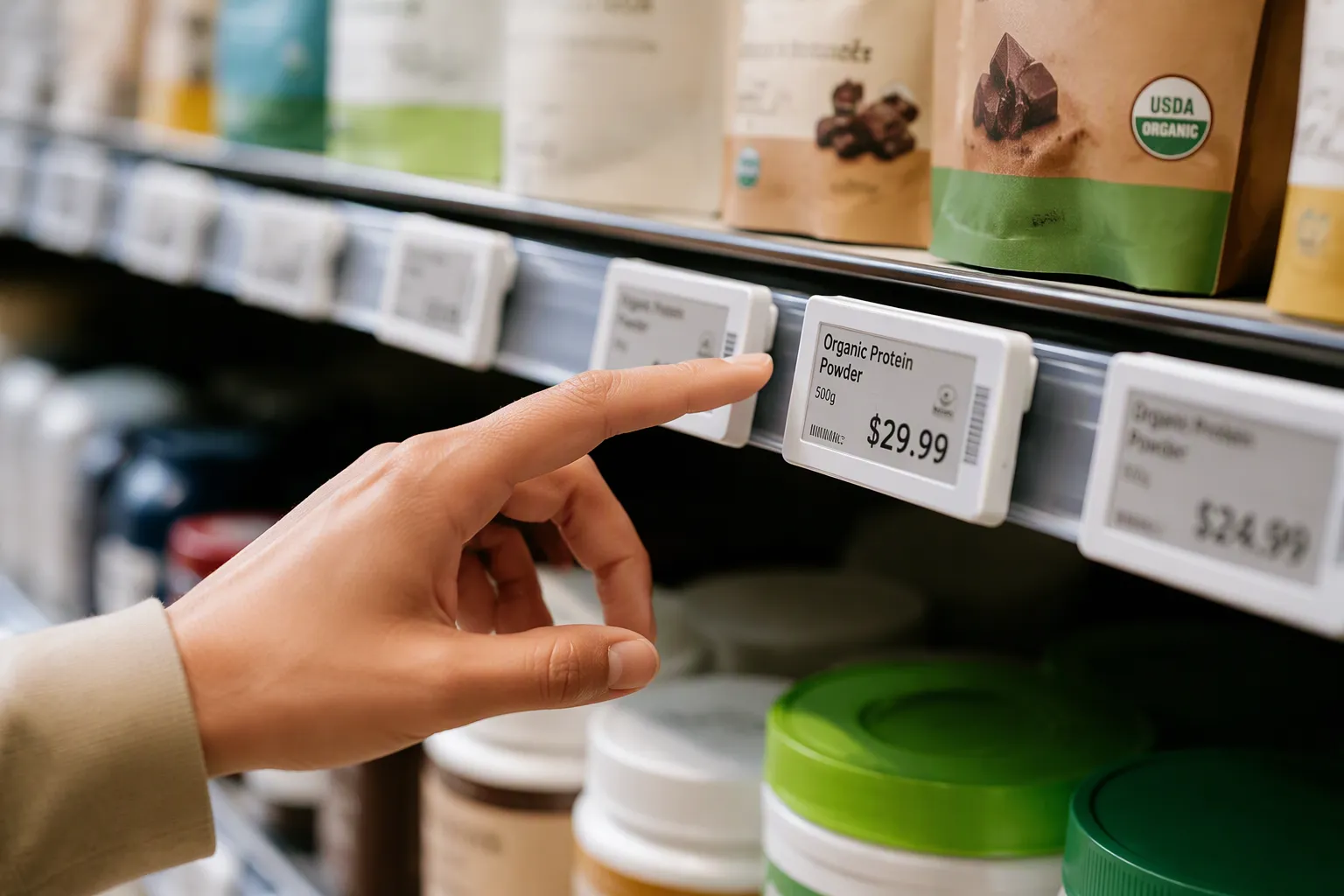
You see an electronic shelf edge label as a digital price tag mounted on the front edge of the retail shelving. These Electronic Shelf Labels display real-time pricing, promotions, and product details. They update wirelessly from a central system. Electronic Shelf Labels work by combining low-power displays, wireless communication, and central software to automate shelf pricing. This eliminates manual price changes and ensures you always see accurate information. The global electronic shelf label market reached USD 1.97 billion in 2025. Electronic Shelf Labels continue to grow rapidly. You can rely on Electronic Shelf Labels for consistent pricing. These Electronic Shelf Labels transform how you manage a digital shelf label system. Electronic Shelf Labels reduce errors on the shelf edge. You benefit from Electronic Shelf Labels every day. These Electronic Shelf Labels represent the future of ESL retail. A single ESL Price Tag updates instantly. The ESL Gateway AP connects each ESL device. You appreciate these digital price displays. ESL technology saves time and money.
How Electronic Shelf Edge Labels Work
You already know that electronic shelf edge labels sit on the front of retail shelving and show prices. The real question is how these devices actually function behind the scenes. Electronic shelf edge labels work through three connected layers: the display that shows the price, the wireless link that carries the data, and the central software that controls everything. Each layer depends on the others. When you understand all three, you understand why electronic shelf edge labels have become a standard tool in modern retail.
Display Technology: E-Paper and LCD
The display is the part you see first. Two main technologies power electronic shelf edge labels today: e-paper and LCD. Each one works differently, and each one suits different retail needs.
E-paper technology uses charged pigment particles suspended in a thin film. An electric field moves these particles to the front or back of the display. The particles form the visible image. This process requires no backlight. The image stays on the screen even after you cut the power. Engineers call this a bistable display. E-ink technology follows the same principle, and you will hear both terms used for the same concept.
LCD screens work in a completely different way. Liquid crystals twist to block or pass light. A backlight or ambient light provides the illumination. The display needs continuous power to hold an image. The first generation of electronic shelf edge labels relied on LCD panels with infrared communication.
The table below compares the two technologies side by side.
| Aspect | LCD (First Generation ESL) | E-Paper (Second Generation ESL) |
|---|---|---|
| Display technology | Liquid crystal display; requires backlight or ambient light to be readable. | Electrophoretic display; uses charged pigment particles suspended in a thin film. Particles migrate to the front or back to show black/white or color, requiring no backlight. |
| Communication | Infrared (IR) communication only. | Infrared (IR) or radio protocols (2.4 GHz, Wi-Fi, ZigBee, proprietary). |
| Power and update | Power is needed continuously to maintain display; updates via IR from a central system. | Ultra-low power – image is retained without power (bistable); updates occur via radio or IR when a new image is sent. |
| Working principle | Liquid crystals twist to block or pass light; a backlight (if present) or ambient light provides illumination. | Positively and negatively charged pigment particles are moved by an electric field to the top or bottom of the display, forming the visible image. |
Battery life tells the same story. E-paper electronic shelf edge labels run for 5 to 10 years on a single battery, even with regular updates. LCD electronic shelf edge labels last only 1 to 2 years before you need a replacement battery. One source notes up to 5 years for LCD, but the gap remains wide. E-paper displays have ultra-low power requirements, which allows digital shelf labels to operate for up to five years or more with typical update frequencies. LCD-based tags require continuous power, so they often last only one to two years before needing a battery replacement, despite offering faster update speed and more vibrant colors.
Visibility under store lighting matters just as much. Reflective e-ink performs well under bright ambient light and near windows. LCD readability varies based on screen brightness, glare, and viewing angle.
Reflective displays usually perform well under bright store lighting and near windows. That matters in grocery stores, pharmacies, and entrance areas, where glare can make some backlit screens difficult to read.
You will find e-paper in most new electronic shelf edge labels for one simple reason. The technology delivers long battery life, clear readability, and low maintenance. LCD still appears in some settings where fast refresh rates and full color matter more than battery life.
Wireless Communication Methods
A display without data is useless. Electronic shelf edge labels need a wireless link to receive new prices and promotions. Several protocols handle this job, and each one carries trade-offs.
Radio Frequency (RF) is the most widely deployed option. RF operates on sub-1 GHz, 2.4 GHz, or 433 MHz bands. Sub-1 GHz signals offer wide coverage and strong penetration through shelves and walls. Most electronic shelf edge labels rely on RF communication because it delivers reliable updates across a large store.
Bluetooth Low Energy (BLE) offers fast, efficient, low-energy transmission. You need no extra transmitters, and BLE integrates easily with existing devices. The shorter range limits BLE to smaller stores or specific zones.
WiFi delivers high-speed, real-time data transfer. It integrates into existing WiFi networks without new infrastructure. WiFi requires more energy, which reduces battery life. Network congestion can also slow processing during peak hours.
Near Field Communications (NFC) works only at close range. NFC is highly energy efficient and supports long battery life. You must physically visit each label to send an update. NFC cannot support real-time updates across a store.
The table below summarizes how each protocol performs.
| Protocol | Key Characteristics | Suitability for Real-Time Updates |
|---|---|---|
| Radio Frequency (RF) | Operates on sub-1 GHz, 2.4 GHz, or 433 MHz; sub-1 GHz offers wide coverage and strong penetration | Most ESLs are based on RF communications, making it a common choice for reliable updates |
| Bluetooth Low Energy (BLE) | Fast, efficient, low energy; no extra transmitters needed; easily integrated with existing devices | Shorter range limits it to smaller stores |
| WiFi | High-speed, real-time data transfer; easy to integrate into existing WiFi networks | Requires more energy, may reduce battery life, and can suffer from congestion or slow processing |
| Near Field Communications (NFC) | Close-proximity communication; highly energy efficient with long battery life | Requires physically visiting each label, so it cannot support real-time updates |
A Wireless Sensor Network (WSN)-based electronic shelf edge label system designs its MAC and router protocols to meet requirements for low power consumption and real-time price updates. Electronic shelf edge labels typically combine e-paper or LCD displays with wireless communication protocols such as Bluetooth Low Energy or proprietary radio. The labels receive updates from a gateway linked to the store’s point-of-sale or inventory management system.
Coverage and capacity determine how many labels one access point can serve. Long-range technologies enable wider coverage without signal degradation, allowing a single access point to manage hundreds of labels efficiently. In practice, a single access point handles more than 10,000 labels. The system updates 20,000 labels in approximately 20 minutes. Indoor coverage reaches 30 to 40 meters from each access point. These numbers explain why electronic shelf edge labels scale to large supermarkets without extra wiring.
Central Software and Price Updates
The central software is the brain of the system. It stores every price, promotion, and product detail. It pushes changes to the labels through the gateways. Without this layer, the hardware cannot function.
The software connects directly to your POS, inventory, and ERP systems. Every price change updates across all channels at once. Real-time sync keeps shelves current with online updates, competitor moves, or regulatory changes. Open APIs let you design custom rules, such as automatically ending a promotion when stock runs low. ComQi’s EnGage system is a content management system for ESLs that supports remote management, proactive detection, remote troubleshooting, and predictive maintenance.
The update process follows a clear sequence.
- A price change is initiated in the central software.
- The system transmits the new data to the target label.
- The e-paper display refreshes to the new price in seconds, making the change nearly instantaneous.
A central ESL system can update more than 10,000 electronic shelf labels in seconds. Simultaneous price pushes at that scale are designed to be near-instantaneous. Each gateway broadcasts wirelessly to ESL labels in its coverage zone. Neuroshop gateways cover up to 15 meters and support up to 2,000 labels simultaneously, with updates reaching labels within seconds of transmission. RF is the most widely deployed protocol in commercial ESL systems. It is reliable, scalable, and purpose-built for high-density retail environments, with updates reaching labels in seconds. A single ESL system can reliably manage tens of thousands of individual tags at once with total accuracy.
The integration layer connects the software platform to existing retail systems for real-time accuracy. This connection enables automated price updates, scheduled promotions, and task management such as restocking alerts sent directly to employee devices. Vusion is identified as the number one leader in ESL, supporting 450 million connected devices across 45,000 stores in 62 countries. Its ESL ecosystem combines cloud management, IoT connectivity, inventory visibility, and shopper engagement within a unified enterprise platform. Vusion integrates with POS, ERP, and merchandising systems, ensuring approved prices, promotions, and markdowns are reflected accurately at the shelf across all locations. It uses a cloud-native architecture, APIs, and centralized orchestration tools to simplify deployment and support both legacy retail environments and modern cloud ecosystems.
Three core functions define how the software manages your digital shelf labels.
- Data Synchronization: The software automatically pulls the latest product and pricing information directly from the connected POS or ERP system, ensuring a single source of truth.
- Template Management: Dynamic templates can be designed and assigned for different products, promotions, or categories, controlling how information is displayed on e-paper tags.
- Wireless Updates: With a single command, price changes, promotional details, and stock information are pushed wirelessly to thousands of labels across the entire store in minutes.
You now see how the three layers connect. The display shows the price. The wireless link carries the data. The central software controls the flow. Together, they make electronic shelf edge labels technology work as a single automated system. Every price change you make in the software reaches the shelf edge in seconds. That speed and accuracy define the value of electronic shelf edge labels for any retail operation.
Key Components of a Digital Shelf Label System

A complete digital shelf label system relies on three core components. Each one plays a distinct role. You need all three for electronic shelf edge labels to function properly. Understanding these parts helps you plan your deployment and budget.
The Electronic Label Hardware
The label itself is the most visible part of any electronic shelf edge labels system. Each unit contains a display, a wireless chip, a battery, and a mounting clip. You attach these electronic shelf edge labels to the front edge of your shelving. The hardware determines your battery life and display clarity. Costs for electronic shelf edge labels range from $8 to $25 per unit. The price depends on size and display technology. Mounting accessories add $2 to $5 per position. These electronic shelf edge labels represent your largest upfront investment.
Gateways and Access Points
Gateways connect your electronic shelf edge labels to the central system. One gateway typically covers 1,000 to 2,500 square feet. You need roughly one gateway per 1,000 to 2,000 square feet for reliable coverage. Each gateway costs $200 to $400. A 1,000 square meter store needs three to four units. These devices transmit price updates to your electronic shelf edge labels. Proper placement prevents dead zones. Your electronic shelf edge labels depend on strong gateway coverage.
Management Software and Integration
The software controls every electronic shelf edge labels system. It syncs with your POS and ERP platforms. You manage all digital shelf labels from one dashboard. Software licensing costs $1.50 to $3.00 per label yearly. A flat per-store fee runs $3,000 to $6,000 annually. Over five years, these costs can equal your hardware investment. Good digital shelf label solutions integrate seamlessly with existing systems. Your electronic shelf edge labels update automatically once connected.
Benefits of Electronic Shelf Labelling
You gain clear advantages when you deploy electronic shelf edge labels across your store. These benefits extend beyond simple price display. They touch compliance, labor, and sales strategy. Each one strengthens your bottom line.
Pricing Accuracy and Compliance
Electronic shelf edge labels eliminate pricing errors at the source. The system updates prices in real time. Shelf, POS, and online prices match instantly. You remove human error from manual tag changes. All price updates flow from a single source. This creates automatic timestamped audit trails. You achieve full traceability across every channel. These electronic shelf edge labels directly support compliance with regulations like Article 6a of the EU Price Reduction Directive. In sectors such as pharmaceuticals, accurate pricing is critical. Electronic shelf edge labels reduce your risk of non-compliance. You maintain confidence that displayed prices are always correct.
Labor and Time Savings
Manual price updates consume enormous staff hours. You can compare the workload directly.
| Method | Weekly Time Spent on Price Updates |
|---|---|
| Manual (paper tags) | Up to 50 hours per week for printing, sorting, and replacing tags |
| Electronic Shelf Labels (ESL) | 60–90% reduction in that workload, freeing associates for other tasks |
Businesses using a comprehensive ESL system report that price updates are completed up to eight times faster than with traditional manual methods. You save roughly 10 hours per week on routine price changes. Price adjustments push instantly across the entire store with just a few clicks via a cloud platform. Your staff can focus on customer service, merchandising, and inventory management instead of replacing paper tags.
Dynamic and Promotional Pricing
Electronic shelf edge labels unlock powerful promotional strategies. You can trigger instant discounts for customers in specific locations. You schedule automated promotions based on demand patterns. Countdown timers on labels drive urgency and boost sales. Flash-sale pricing syncs across all displays without friction. You eliminate checkout confusion entirely. Dynamic markdowns based on inventory automatically discount perishables nearing expiration. You launch seasonal promos across all stores in under an hour without in-store relabeling.
With pricing updates no longer a burden, grocers are also more willing to roll out frequent markdowns, flash sales, and targeted promotions. This creates a powerful win-win scenario: less waste and higher sales, and more timely savings for shoppers on everyday purchases.
You can adjust prices for a flash sale in minutes. You quickly match a competitor’s price without breaking a sweat. These electronic shelf edge labels give you real-time pricing information at your fingertips. You control pricing on shelves with precision. Digital shelf labels deliver real-time updates instantly. Your electronic shelf edge labels become a strategic asset. You respond to market changes faster than ever before.
Digital Shelf Labels in Retail Applications
You will find electronic shelf edge labels across every major retail sector. Each industry uses these systems in different ways. The technology adapts to the unique demands of each environment. You can see how digital shelf labels in retail create value in grocery, electronics, and pharmacy settings.
Grocery and Supermarkets
Grocery stores lead the market for electronic shelf edge labels. According to market research, grocery and supermarkets accounted for an estimated 42% market share in 2026. This makes grocery the dominant segment with the highest adoption rate. You see digital price displays in supermarkets everywhere because these stores face constant price changes. Electronic shelf edge labels help you manage thousands of SKUs without manual updates. These systems also reduce food waste through dynamic pricing.
- Electronic shelf edge labels benefit low-income shoppers while reducing food waste sent to landfills.
- These labels make it easier to apply dynamic discounts to items nearing expiration, such as fresh produce or dairy.
- Previous research indicates that using electronic shelf edge labels may be more effective than organic food waste bans.
- In Europe, dynamic pricing reduces waste and improves access to healthy food rather than for surge pricing.
Electronics and Tech Retail
Electronics retailers need electronic shelf edge labels to display detailed product specifications. You can show processor speed, memory, and warranty details on each digital shelf label. Armor designs and applies LED shelf lighting and electronic shelf labeling as a unified system from the beginning. This coordination reduces visual clutter and makes product displays easier for customers to understand. Patented integrated lighting and display combines LED shelf lighting with electronic shelf edge labels. High-performance reliability features an industry-leading IP68 waterproof and dustproof rating. Turnkey customization capabilities offer flexible options from appearance color to special-size strip screens.
A shopper’s experience at the shelf edge is one of the most critical influences on a purchase decision. Electronic shelf labels provide always-accurate pricing, increased access to real-time promotions and product information, and a more gratifying and cohesive omnichannel experience.
Pharmacies and Health Stores
Pharmacies use electronic shelf edge labels for precise pricing and regulatory compliance. You must display accurate prices on medications and health products. These electronic shelf edge labels reduce your risk of pricing errors. You can update promotional information for vitamins and wellness products instantly. Electronic shelf edge labels help you maintain audit trails for every price change. You meet strict industry regulations with confidence.
Challenges and Future Trends of Electronic Shelf Labels
You face real obstacles when you adopt electronic shelf edge labels. You also gain access to rapidly improving technology. Understanding both sides helps you make a smart decision.
Initial Costs and ROI Considerations
You pay a significant upfront price for electronic shelf edge labels. A mid-sized supermarket with 5,000 to 10,000 SKUs spends $25,000 to $200,000 on label hardware alone. Each electronic shelf edge label costs $5 to $20 per tag. Special sizes reach $100 per unit. You also budget for gateways and base stations at $1,500 to $16,000. Network upgrades add $2,000 to $8,000. Software integration with your POS or ERP system runs $3,000 to $10,000. Technical support and installation cost $2,000 to $8,000. Internal IT labor adds $1,500 to $5,000. Your total initial setup reaches $6,500 to $23,000.
Many small retailers believe electronic shelf edge labels only fit large chains. That objection no longer holds. Scalable solutions now serve stores of all sizes. The French bakery chain Marie Blachère uses electronic shelf edge labels in stores under 1,000 square feet.
The payback period favors you. A conservative scenario with labor savings alone returns your investment in 7.4 months. A moderate scenario with operational savings pays back in 3.2 months. A high scenario with dynamic pricing returns in 2.5 months. Most retail operations achieve full ROI within 12 to 36 months. The industry-wide median payback period sits at 26 months.
Battery Life and Maintenance
Battery performance determines your maintenance burden. Current electronic shelf edge labels deliver impressive longevity.
| Display Type / Scenario | Battery Life | Maintenance Schedule |
|---|---|---|
| Standard black-and-white e-paper screens (prices updated 1–3 times/day) | 5–10 years | Maintenance-free for the battery’s lifespan; no replacements needed |
| High-efficiency e-paper labels (energy harvesting + low-power SoC) | 10–15 years | Maintenance-free; zero-maintenance for solar/light-harvesting models |
| Three- or four-color screens (black, white, red, yellow) | 3–5 years | No replacement required during this period |
| High-efficiency labels in large-scale deployments | 8–10 years | No replacement during equipment depreciation; saves labor and materials |
E-paper display batteries last 5 to 10 years, reducing electronic waste. Some models last 5–10 years on a single battery.
Battery disposal creates a hidden challenge. A large supermarket deploys around 10,000 ESLs. Each battery lasts five years on average. That single store disposes of approximately 2,000 batteries annually. A chain with 500 locations discards about 1 million batteries per year. Energy harvesting solves this problem. One supermarket sought an energy-harvesting digital pricing system using Nexperia PMICs to eliminate disposable batteries while maintaining seamless functionality.
Emerging Innovations and Market Growth
Energy harvesting extends battery life beyond five years. Photovoltaic cells convert indoor ambient lighting into renewable energy. An energy harvesting PMIC converts ambient energy into stable electrical power and supports up to 50 mW. Ultra-fast MPPT uses an embedded hill-climbing algorithm to detect maximum power points in 0.5 seconds. Battery protection and configurability support hard-coding or I2C and remain compatible with batteries, supercapacitors, and hybrid capacitors. A microcontroller and flash memory manage pricing updates and preserve data during power fluctuations. An RF front-end supports Bluetooth, NFC, and Wi-Fi for wireless updates.
These innovations reduce manual intervention and support scalable deployment. Your electronic shelf edge labels become more autonomous over time. You will see automated ESL systems reach full energy autonomy in the coming years. The market continues to expand as costs fall and capabilities rise. Your electronic shelf edge labels represent a long-term investment in operational efficiency. You gain more value from digital shelf labels with every technological advance. The future of ESL technology looks bright for retailers of every size.
Electronic shelf edge labels transform retail operations. These digital price tags automate shelf pricing. Electronic shelf edge labels improve pricing accuracy. They reduce labor costs significantly. Electronic shelf edge labels enable dynamic pricing strategies across retail sectors. You invest upfront in electronic shelf edge labels. Electronic shelf edge labels justify this cost. They deliver operational efficiency. Electronic shelf edge labels become a valuable tool for retailers. You need electronic shelf edge labels for modern success. An electronic shelf label receives updates from your central system. Electronic shelf edge labels display them instantly on low-power screens. This digital shelf label system keeps shelves accurate. Electronic shelf edge labels represent the future of pricing. You gain real value from electronic shelf edge labels.
FAQ
How do electronic shelf edge labels receive price updates?
A central software system sends new prices through gateways. These gateways broadcast wirelessly to each label. The display refreshes in seconds. You never touch a single tag. Electronic shelf edge labels update automatically across your entire store.
What is the difference between e-paper and LCD electronic shelf edge labels?
E-paper uses charged particles and holds an image without power. LCD needs continuous power and a backlight. E-paper electronic shelf edge labels last 5 to 10 years on one battery. LCD versions last only 1 to 2 years.
Can electronic shelf edge labels work with my existing POS system?
Yes. Electronic shelf edge labels connect directly to your POS, ERP, and inventory platforms. Open APIs let you build custom rules. Price changes sync across all channels at once. You keep your current systems and gain automated shelf pricing.
How much do electronic shelf edge labels cost?
Each label costs $5 to $20. Gateways run $200 to $400 per unit. Software licensing adds $1.50 to $3.00 per label yearly. Most retailers recover their investment within 12 to 36 months through labor savings and pricing accuracy.
Do electronic shelf edge labels require frequent battery replacements?
No. Standard black-and-white e-paper labels last 5 to 10 years. Energy-harvesting models extend that to 10 to 15 years. You replace batteries rarely. Electronic shelf edge labels reduce maintenance work and electronic waste significantly.
See Also
Why Electronic Shelf Label Technology Matters So Much Today
A Complete Guide to Digital Shelf Edge Label Systems
How to Switch from Paper to Electronic Shelf Labels
The 2025 Handbook for Electronic Shelf Label Solutions
Understanding Shelf Labels: Their Purpose and How They Function