The Esl Retail landscape is rapidly evolving. Approximately 94% of global retailers plan to implement electronic shelf labels, a technology driving significant market growth. The ESL market is projected to see substantial expansion:
- Forecasts predict an increase of US $2.09 billion between 2024 and 2029.
- This represents a Compound Annual Growth Rate (CAGR) of around 17.2%.
A successful ESL system requires three key elements. These are the physical ESL Price Tag, the communication hardware like an ESL Gateway AP, and a central management software. The right solution for any retail business depends on store size, product variety, and budget. This shift towards ESL in retail improves operational efficiency and pricing accuracy.
Understanding the Core Benefits of ESL in Retail
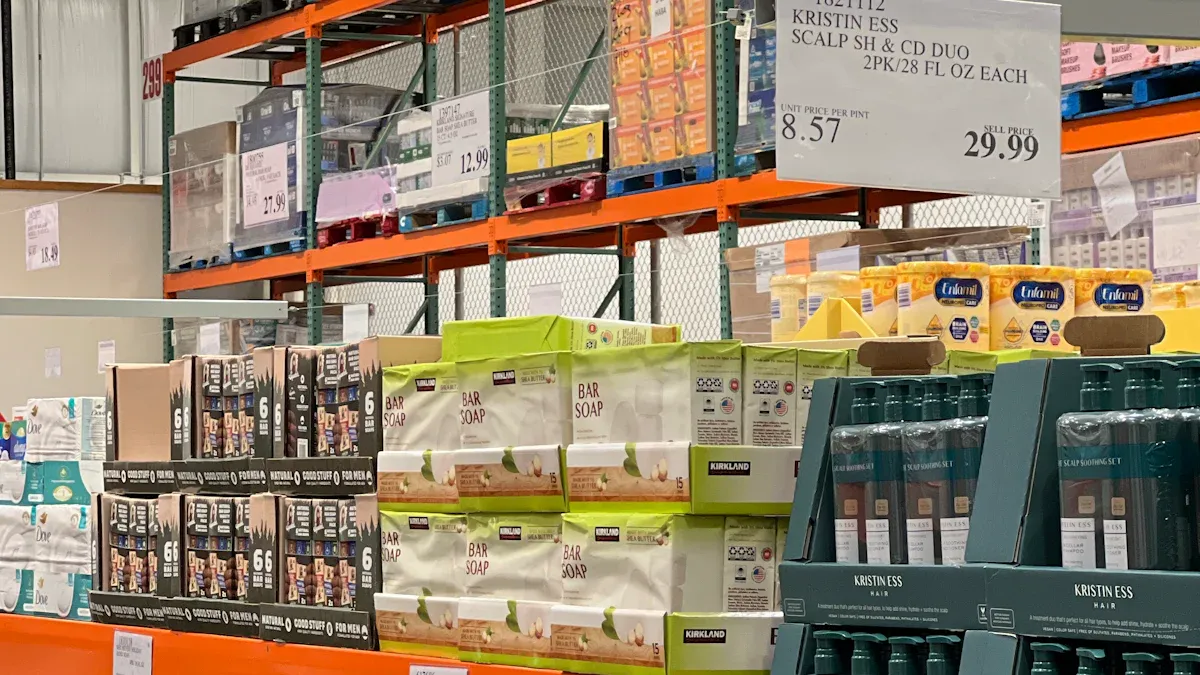
Implementing an ESL system offers transformative advantages for any retail business. These benefits primarily fall into three categories: pricing agility, operational improvements, and a better shopping journey for customers.
Dynamic Pricing and Promotions
Electronic shelf labels empower retailers to execute dynamic pricing strategies in real time. An ESL system allows for immediate price adjustments based on factors like competitor pricing, demand, or inventory levels. This responsiveness provides a significant competitive advantage in markets where price influences consumer decisions. Retailers can optimize pricing to improve sales and directly increase profit margins, turning a static shelf edge into a dynamic sales tool.
Operational Efficiency
The most immediate impact of an ESL is the drastic reduction in labor. Manual price updates are slow and prone to error. Automation changes this entirely.
One retailer, for example, completed 1,400 price changes in under 10 minutes. This same task previously required four days of labor.
On average, employees spend 80% less time on paper tag updates after implementation. This frees staff from tedious tasks, allowing them to focus on higher-value activities like customer service and inventory management. One company, CJ Lang, saved over 45,000 labor hours annually, demonstrating the immense efficiency gains possible.
Enhanced Customer Experience
A modern retail environment must be informative and convenient. ESLs enhance the customer experience by displaying more than just the price. Retailers can show stock levels, nutritional facts, or price-per-weight, giving shoppers the information they need to make confident purchasing decisions. While shelf labeling alone may not always alter buying habits, combining this rich data with other strategies, like promotions on healthier items, can effectively guide consumer choices. This level of detail makes esl in retail a powerful tool for building customer trust and satisfaction.
Choosing the Right Electronic Shelf Labels

Selecting the correct electronic shelf labels is a critical decision that impacts cost, functionality, and long-term maintenance. Retailers must evaluate the core technology of the tags themselves, as the display and communication methods directly influence performance. The market includes a wide range of providers, from established leaders like VusionGroup, SOLUM, and Pricer to specialized firms such as Hanshow and Displaydata Ltd., each offering unique solutions.
Display Technology: E-Paper vs. LCD
The visual component of an ESL is its most prominent feature. The two dominant display technologies are Electronic Paper (E-Paper) and Liquid Crystal Display (LCD). Each offers distinct advantages.
E-Paper displays, also known as electronic ink, are the most common choice for esl in retail. They are bistable, meaning they only consume power when the content on the screen changes. This exceptional energy efficiency allows E-Paper tags to operate for 5 to 10 years on a single battery. Their paper-like appearance provides excellent readability in various lighting conditions.
LCD tags, similar to small digital screens, offer full-color displays and the ability to show dynamic content like videos or animations. However, they require a constant power source to maintain an image, making them less energy-efficient than their E-Paper counterparts.
Tech Tip: A key difference lies in power usage. An E-Paper ESL consumes almost zero power to hold a static image, while an LCD ESL requires continuous energy.
| Specification | E-Paper Display ESLs | LCD ESLs |
|---|---|---|
| Display | Black, white, and a third color (e.g., red, yellow) | Full color, supports animation |
| Power Consumption | Very low; only uses power during updates | Moderate to high; requires constant power |
| Readability | Excellent in bright, ambient light | Good, but can be affected by glare and viewing angles |
| Battery Life | 5-10 years | Requires frequent charging or a wired connection |
The cost of an ESL varies significantly with its size and capabilities. Basic, small E-Paper labels can cost as little as $5, while larger, more complex tags can exceed $20. Retailers should also account for mounting hardware and accessories, which add to the overall investment.
| Model Example | Size | Typical Price Range |
|---|---|---|
| Newton M3 | 2.2” | $8 – $10 |
| Minew Supermarket | 2.9” | $5 – $13 |
| EE-153R | N/A | $10 – $15 |
Communication Protocol: RF vs. IR
An ESL system updates tags wirelessly using a communication protocol. The two main options are Radio Frequency (RF) and Infrared (IR).
RF technology uses radio waves to transmit data from a base station to each ESL. It is a popular choice due to its key advantages:
- Penetration: RF signals can pass through shelves, walls, and other obstacles, ensuring broad coverage across a store.
- Ease of Installation: RF systems are generally straightforward to set up without requiring a direct line of sight to every tag.
However, RF communication is not without its challenges. The shared radio spectrum can lead to interference from other wireless devices, such as Wi-Fi routers or mobile phones. This can potentially disrupt data transmission. Security is another consideration, as RF signals can be intercepted if not properly encrypted.
Infrared (IR) technology, conversely, uses light waves to transmit data. This method requires a direct line of sight between the transmitter and the ESL. While this may seem like a limitation, it offers powerful benefits for certain environments. Because IR signals cannot pass through solid objects, communication is contained within a specific area. This makes the system extremely secure and completely immune to RF interference. For this reason, IR is often the protocol of choice in critical applications like hospitals and advanced manufacturing, where reliability and interference-free operation are paramount.
Ultimately, the choice between RF and IR depends on the specific needs of the retail environment, balancing the need for coverage flexibility against the demand for high security and reliability.
Selecting Your Infrastructure and Software
An electronic shelf label system is more than just the tags on the shelf. The infrastructure and software form the central nervous system of the entire operation. This backend is responsible for sending data to thousands of labels, managing pricing updates, and integrating with other retail systems. A retailer’s choice of hardware and software deployment model will define the system’s scalability, cost, and maintenance requirements.
Communication Hardware: Base Stations and Access Points
Communication hardware, often called base stations or access points (APs), acts as the wireless bridge between the management software and the individual ESL tags. These devices transmit price and product data throughout the store. The number of APs required depends on the store’s size, layout, and potential obstructions.
Modern systems leverage innovations in wireless protocols to maximize reach. Long-range technologies enable wider coverage without signal degradation, allowing a single access point to manage hundreds of labels efficiently. This capability is crucial for large retail or warehouse environments. The specific performance of an AP varies by manufacturer, but typical specifications provide a clear benchmark.
| Feature | Typical Performance |
|---|---|
| Indoor Coverage Radius | 30-40 meters |
| Label Capacity | >10,000 per AP |
| Update Speed | 20,000 labels in ~20 mins |
Some specialized hardware, like the DYESL ESL AP Base Station, offers an extended long-range coverage of up to 150 meters, reducing the number of devices needed for very large spaces.
Installation has become increasingly streamlined. Many modern communicators feature:
- Simple bracket mounting for quick physical setup.
- Power over Ethernet (PoE), which uses a single network cable for both data and power.
- Remote configuration, eliminating the need for manual, on-site adjustments.
This design philosophy means retailers can often avoid store closures or the need for heavy equipment during deployment. For complex installations, vendors typically offer on-site assistance for positioning base stations, testing the system, and providing ongoing maintenance.
The initial investment in an ESL system can be substantial. A significant startup cost often causes ‘sticker shock’ for management teams. For instance, a system with 30,000 tags can approach an initial cost of almost $350,000. Retailers must analyze the total cost, which includes more than just the labels themselves.
| Cost Category | Description | Amount/Range |
|---|---|---|
| Per-unit cost (2023) | Includes infrastructure setup and deployment | $9 – $14 |
| Medium Supermarket | Total cost for approximately 3,500 labels | Exceeding $35,000 |
| Additional Costs | Integration, network setup, staff training | Compounding expenses |
| Long-term Maintenance | Battery replacements, firmware updates | Contributing expenses |
Major retailers like Walmart and Carrefour have collectively invested over $420 million in full-graphic ESL systems, signaling a strong industry commitment despite the high initial outlay.
Management Software: Cloud vs. On-Premise
The management software is the command center for the entire ESL platform. It allows staff to change prices, monitor tag battery levels, and link products to specific labels. The most significant decision regarding software is the deployment model: cloud-based or on-premise.
A cloud-based solution is hosted by the ESL provider and accessed through a web browser. This model, also known as Software-as-a-Service (SaaS), outsources the IT burden of hosting and maintenance. It offers high accessibility, allowing managers to update pricing or monitor stores remotely. Security is a primary consideration for any cloud platform. Leading providers ensure data protection through several measures:
- Compliance and Certification: Adherence to data privacy laws like GDPR and security standards such as ISO 27001 and SOC2.
- Data Protection: Use of advanced encryption for data in transit and at rest to maintain confidentiality.
- Access Control: Implementation of Single Sign-On (SSO) to simplify logins and role-based access controls to ensure users only see relevant data.
- Monitoring: Continuous security monitoring and audit trails that log who accessed data and when.
An on-premise solution involves installing the management software on a retailer’s own servers. This gives the business complete control over its data and system security. It operates independently of internet connectivity, which can be an advantage for stores with unreliable service. However, this model requires a larger upfront investment in server hardware and relies on an internal IT team to handle all software updates, backups, and maintenance.
The right choice depends on a retailer’s budget, IT capabilities, and security posture. Different providers of esl in retail cater to these varying needs.
- Pricer is known for robust, scalable systems suited for large retailers needing real-time updates.
- Displaydata focuses on high-resolution, aesthetic labels popular in fashion and electronics stores.
- GROUPE ATLANTIC offers simple and affordable ESL systems for businesses seeking automation without a major infrastructure overhaul.
Ultimately, a thorough evaluation of these hardware and software options is essential for building a reliable and cost-effective ESL ecosystem.
Key Features and Advanced Functionality
Beyond price changes, modern electronic shelf labels offer advanced features that transform store operations and customer engagement. These capabilities turn a simple display into a powerful data hub for both shoppers and staff. A retailer’s choice of features should align with its specific operational goals.
Tag Durability and Battery Life
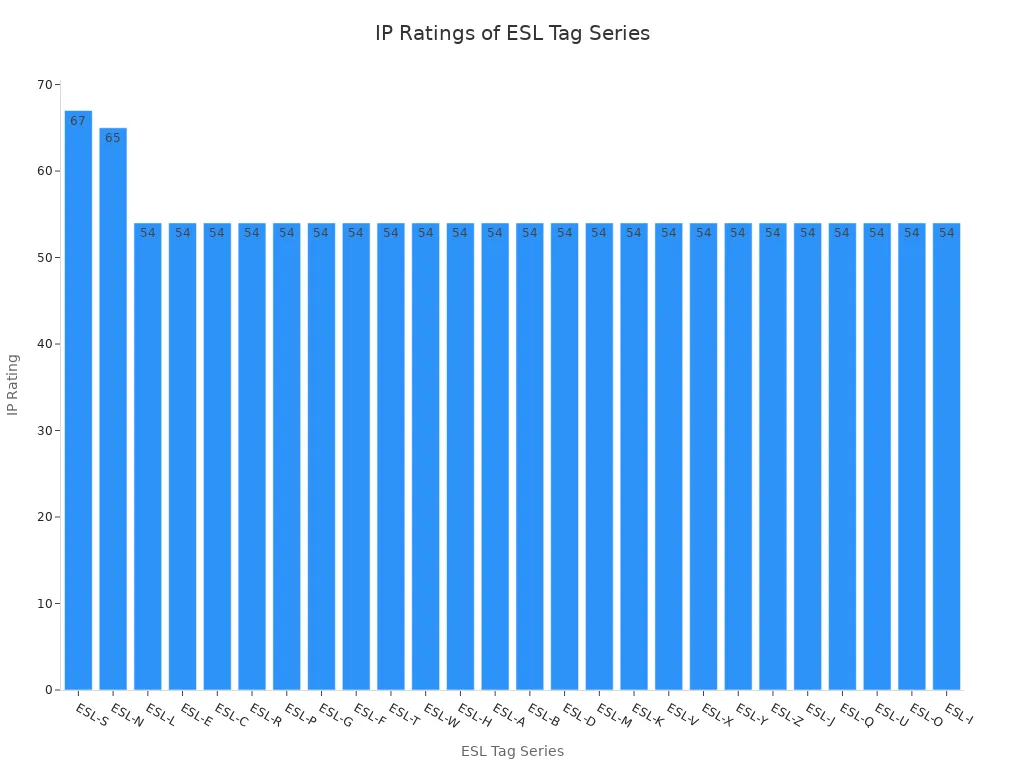
Retail environments demand robust hardware. An esl tag must withstand daily wear, from cleaning sprays to customer interactions. Durability is often measured by an IP (Ingress Protection) rating, which indicates resistance to dust and water.
Most tags for general retail carry an IP54 rating, protecting them from dust and splashes. For more demanding areas, specialized options are available. Tags with an IP65 rating suit humid fresh food sections, while IP67-rated tags are fully waterproof for freezers or outdoor use.
Battery life is equally critical for minimizing maintenance. Thanks to energy-efficient E-Paper technology, most commercial esl units operate for 5 to 7 years. Some advanced models, like the Hanshow Stellar Pro series, can last up to 10 years with two updates per day.
Interactive Features: NFC and QR Codes
An esl can bridge the gap between the physical shelf and the digital world. Many tags now include Near Field Communication (NFC) or display QR codes. These features empower customers to access rich information directly from their smartphones.
- NFC: Shoppers can tap an NFC-enabled tag to instantly pull up detailed product specifications, customer reviews, or even download a digital coupon.
- QR Codes: A quick scan can link a customer to a recipe, a how-to video, or the retailer’s website to purchase an out-of-stock item online.
This interactivity creates a more engaging and informative shopping experience, building customer confidence and driving sales.
Staff-Facing Tools: LED Indicators and Geopositioning
Advanced esl systems also include powerful tools to boost employee productivity. Multi-color LED indicators are a key feature for streamlining in-store tasks.
For online order fulfillment, a “pick-by-light” system uses flashing LEDs to guide associates directly to the correct items, dramatically reducing picking errors and time spent searching aisles.
Geopositioning technology takes this a step further. By tracking the precise location of each tag, the system can automatically verify planogram compliance and alert staff to misplaced products. This ensures shelves are always organized correctly and helps both employees and customers find items quickly.
A successful esl in retail strategy depends on three pillars: the right tags, a robust infrastructure, and powerful software. Before selecting a vendor for your retail environment, it is critical to ask key questions.
- What is the total cost of ownership, including maintenance and battery life?
- How will the system integrate with existing POS and inventory platforms?
- Can the platform scale and adapt to future needs?
Ultimately, a retail business must first assess its unique operational needs to find the perfect solution.
FAQ
How long does it take to implement an ESL system?
Installation time varies based on store size and complexity. A small store might complete the process in a few days. Larger supermarkets could require several weeks. Many vendors offer phased rollouts to minimize disruption to daily operations and avoid store closures during the transition.
Can ESLs integrate with existing retail software?
Yes, integration is a key feature of modern ESL platforms. Most systems use Application Programming Interfaces (APIs) to connect with a retailer’s existing Point of Sale (POS), Enterprise Resource Planning (ERP), and inventory management software. This ensures data consistency across all business tools.
What is the typical Return on Investment (ROI) for ESLs?
Retailers typically see a Return on Investment within 18 to 24 months. The ROI comes from significant labor savings, improved pricing accuracy, and the ability to execute dynamic pricing strategies. Eliminating printing costs for paper labels also contributes to the financial benefits.
How secure is the data transmitted to the ESLs?
ESL providers prioritize data security. (Lock icon) Systems use advanced encryption protocols to protect data during transmission between the central server and the labels. Cloud-based platforms also adhere to strict security standards like ISO 27001 to ensure data integrity and prevent unauthorized access.