
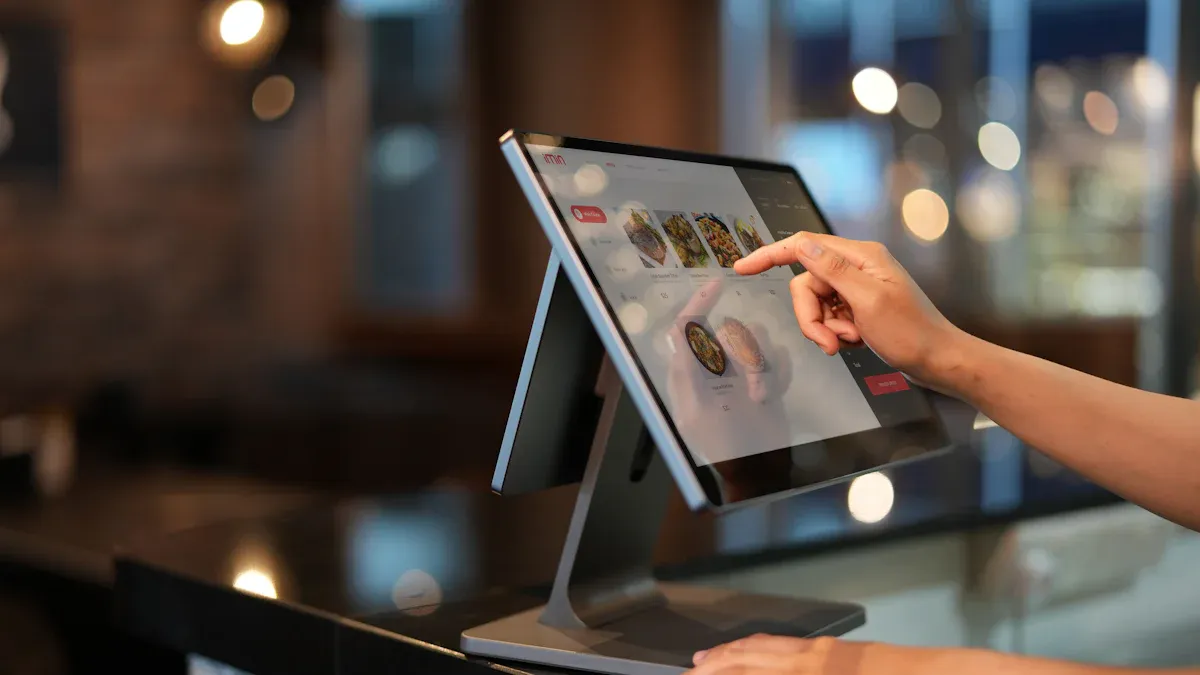
You gain a competitive edge when you leverage advanced POS system technology for real-time price accuracy. With seamless integration between your point of sale, digital price tags, and Electronic Shelf Labels, you enable instant monitoring and correction of pricing errors. Real-time data flow through the ESL Gateway AP and ESL Price Tag ensures every price update reflects across your Esl Retail floor. Integration empowers you to prevent mismatches and anomalies. The results speak for themselves:
| Metric | Impact/Result |
|---|---|
| Revenue Increase | 12% increase within six months |
| Customer Satisfaction Increase | 12% increase in positive reviews |
| Customer Complaints Decrease | 15% decrease |
| Operational Cost Savings | 5% reduction |
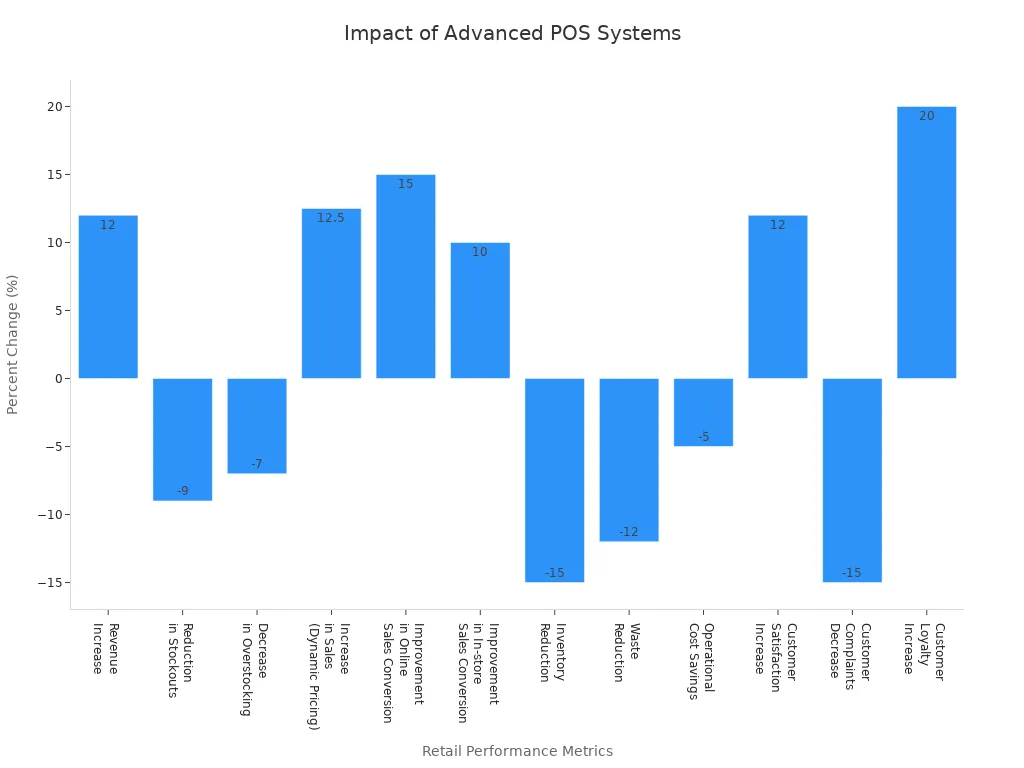
Real-time integration and monitoring help you reduce errors, improve customer trust, and boost operational efficiency.
Electronic Price Tag Anomalies and Pricing Accuracy
Defining Digital Price Tags and Anomalies
Digital price tags have transformed retail pricing. These smart shelf tags display prices and product information on digital screens. You connect them wirelessly to your store’s central database, which allows for automated, real-time price updates. Digital price tags often include features such as promotions, stock information, and QR codes. They replace traditional paper tags, which often cause inconsistencies and errors.
| Concept | Definition and Description |
|---|---|
| Digital Price Tags | Smart shelf tags that display prices and product info on digital screens. They connect wirelessly for real-time updates. |
| Electronic Shelf Labels | Digital price tags used on shelves, enabling instant, synchronized price changes across the store. |
| Pricing Anomalies | Errors or inconsistencies in price display or updates, often caused by manual processes or system mismatches. |
| Key Benefits | Automated updates, reduced human error, compliance, and improved customer trust. |
Common Types of Pricing Errors
You may encounter several types of pricing errors in retail environments:
- Mismatched shelf and POS prices
- Outdated promotional prices remaining after the sale ends
- Incorrect price updates due to manual entry
- Missing or lost price tags
Traditional paper price tags often lead to these errors. Manual replacement takes at least two minutes per tag and has a 6% error rate. Label loss occurs in 2% of cases. These issues create inconsistent pricing between shelf tags and POS systems.
Causes of Inaccurate Price Tags
Manual processes drive most pricing inaccuracies. Employees must update each paper tag by hand, which is time-consuming and error-prone. In contrast, electronic shelf labels automate price updates from a central server. This automation eliminates manual mistakes and ensures synchronization between shelf and POS pricing. For example, Maurer’s Market reduced price change time from four days to less than ten minutes after switching to electronic shelf labels. Employees now spend 80% less time on price updates, which improves pricing accuracy and integrity.
Why Pricing Accuracy Matters
Impact on Retailer Operations
Pricing errors can erode your revenue and efficiency. Even a 0.5% pricing discrepancy can cost a global supermarket chain millions each year. Manual price updates consume valuable labor hours and often result in mistakes. These inefficiencies lead to lost sales, margin erosion, and negative publicity. Digital price tags and electronic shelf labels reduce pricing errors by up to 90%. You gain instant, accurate price changes that synchronize online and in-store pricing. Automated pricing also frees your staff to focus on customer service and inventory management, which boosts productivity and profit margins.
Tip: Investing in digital pricing systems helps you avoid costly operational mistakes and supports long-term profitability.
Customer Trust and Experience
Accurate pricing builds trust with your customers. When prices match at the shelf and checkout, you reduce frustration and foster loyalty. Studies show that perceived pricing fairness increases satisfaction and the likelihood of repeat visits. Digital price tags and electronic shelf labels enable transparent, consistent pricing, which customers value highly. Agile pricing, such as timely discounts, enhances perceived value and satisfaction. Frequent promotions and clear communication encourage customers to return, supporting loyalty and increasing profit margins.
- Digital price tags reduce pricing inaccuracies and discrepancies, fostering trust.
- Transparent pricing encourages customers to browse more and shop beyond essentials.
- Electronic shelf labels enable consistent pricing, which customers appreciate.
- Timely discounts and promotions improve perceived value and satisfaction.
- Clear, fair pricing supports repeat purchases and long-term loyalty.
How POS Systems Monitor Digital Price Tags
Real-Time Synchronization for Accuracy
Wireless Integration and Data Flow
You rely on seamless integration between your point of sale and digital price tags to achieve real-time pricing accuracy. This integration uses secure wireless protocols, such as Bluetooth Core 5.4, operating on stable frequency bands like 433 MHz or 2.4 GHz. These protocols ensure low-latency, encrypted data transmission between your POS system and digital price tags.
Your network infrastructure supports this process with VLAN segmentation and dedicated channels, which maintain reliable communication and prevent interference. You benefit from strong authentication, encryption, and multi-factor authentication, which protect your data and maintain data quality and accuracy.
The integration methods you choose play a critical role in how efficiently your system operates. The following table outlines common integration methods and their features:
| Integration Method | Complexity | Scalability & Flexibility | Key Features and Use Cases |
|---|---|---|---|
| Middleware Integration | Moderate | Moderate to High | Pre-built connectors, real-time sync, data mapping, centralized monitoring |
| RESTful APIs | High | High | Stateless, scalable, cloud/mobile friendly, real-time updates |
| SOAP APIs | High | Moderate to High | Strict security, transaction controls, detailed logging |
| Direct API Integration | High | High | Flexible, real-time data exchange |
| File-Based Interfaces | Low | Low | Simpler, mainly for batch updates |
You see the benefits of real-time integration when your POS system pushes updates instantly to digital price tags. Data mapping ensures that product names, SKUs, prices, promotions, and inventory status remain consistent across all channels. Cloud-based POS platforms, such as Epos Now, Heartland, and Clover, offer automatic real-time updates, while on-premise solutions may require middleware or custom development for similar integration.
Preventing Data Mismatches
You prevent pricing discrepancies by using real-time synchronization. When you update a price in your POS system, the change appears instantly on your digital price tags. This process eliminates manual errors and ensures that customers always see the correct price at checkout.
Real-time integration reduces pricing errors by up to 90%. You no longer need to worry about outdated promotions or mismatched shelf and register prices. Automation supports complex pricing strategies, such as real-time stock level pricing, by updating prices based on inventory changes. This level of integration ensures that your pricing remains accurate and consistent, building trust with your customers.
Note: Real-time synchronization not only improves pricing accuracy but also streamlines your operations by reducing manual label changes and supporting omnichannel pricing strategies.
Automated Detection of Pricing Errors
Exception Reporting and Alerts
You use automated monitoring tools within your POS system to detect pricing errors as soon as they occur. Exception reporting identifies any mismatch between your digital price tags and the central database. When the system detects a discrepancy, it generates an alert for immediate review.
Your POS system employs robotic testing to simulate user interactions, such as barcode scanning, coupon validation, and price overrides. These automated processes test every step of the checkout process, ensuring that each transaction reflects the correct price. You also benefit from AI-driven visual recognition, which verifies product identification and discount application on your digital price tags.
- Robotic testing simulates barcode scans and price overrides.
- AI-driven visual recognition checks product and discount accuracy.
- Automated keyboard and touch input testing eliminates human error.
- Robots simulate complex discount scenarios to ensure correct pricing.
- Price override scenarios are tested for proper system behavior.
These automated processes help you maintain transaction accuracy and quickly resolve any pricing errors before they impact your customers.
AI-Driven Pattern Recognition
You gain a powerful advantage by using ai-driven digital price tags and advanced pattern recognition within your POS system. AI algorithms analyze transaction data in real-time, establishing baseline profiles for normal pricing activity. When the system detects unusual patterns, such as abnormal refund rates or suspicious pricing activities, it flags them for immediate action.
Retailers use supervised and unsupervised machine learning models, including isolation forests and autoencoders, to identify anomalies. These models excel at detecting deviations from expected pricing behavior. Graph-based analysis uncovers collusion patterns between employees and customers, revealing coordinated fraudulent activities.
- AI detects unusual transaction patterns, such as frequent price overrides or abnormal discounts.
- The system monitors transactions to identify suspicious pricing activities.
- Algorithms analyze data to establish baselines and recognize deviations in real-time.
- Real-time detection helps you minimize revenue loss and maintain pricing integrity.
With ai-driven digital price tags, you ensure that your pricing remains accurate, secure, and consistent across all channels. Real-time monitoring and pattern recognition allow you to address pricing errors quickly, protecting both your revenue and your reputation.
Resolving Pricing Errors with POS System Technology
Automated Correction of Digital Price Tags
Instant Price Updates and Rollbacks
You can rely on your POS system to deliver real-time corrections to digital price tags. When a pricing error occurs, the system detects the discrepancy and pushes the correct price to the shelf within seconds. Most electronic price tags update automatically after inventory or market data changes. Cloud-based infrastructures synchronize price updates across multiple stores in under a minute. This rapid response ensures that your customers always see the correct price, whether you manage one location or a nationwide chain.
Automated price updates allow you to maintain consistent pricing throughout your store. If you need to roll back a price due to a mistake or a sudden market shift, the system can revert to the previous value instantly. You avoid the delays and confusion that come with manual corrections. Automated pricing ensures that every product reflects the latest approved price, reducing the risk of lost revenue or customer dissatisfaction.
Note: Automated price updates typically occur within seconds, so you minimize the window for pricing errors to impact your business.
System-Driven Restorations
Your POS system does more than just update prices. It also restores accurate pricing when errors or anomalies occur. If a digital price tag displays an incorrect value, the system identifies the issue and triggers a correction automatically. This process uses real-time data integration to compare shelf prices with the central database. When the system finds a mismatch, it restores the correct price without requiring manual intervention.
Automated pricing corrections reduce reconciliation time by up to 70%. You benefit from fewer errors and faster resolution. The system matches high-volume transactions automatically, which lowers your manual workload and improves accuracy. Real-time integration ensures that every price change, rollback, or restoration happens quickly and consistently across all channels.
Manual Intervention and Oversight
Staff Notifications and Response Protocols
While automated systems handle most pricing corrections, you still need human oversight for complex cases. Your POS system sends real-time notifications to staff when it detects a pricing error that requires manual review. These alerts include details about the affected product, the nature of the discrepancy, and recommended actions.
You can establish clear response protocols for your team. When staff receive a notification, they follow a step-by-step process to investigate and resolve the issue. This approach ensures that you address exceptions quickly and maintain pricing integrity. Automated customer notifications also improve transparency, keeping your team and your customers informed about any changes.
- Staff receive real-time alerts for exceptions.
- Response protocols guide investigation and resolution.
- Automated notifications reduce manual communication efforts.
Audit Trails and Documentation
Audit trails play a critical role in supporting compliance and accountability. Your POS system records every pricing change, correction, and manual intervention with detailed, time-stamped entries. These records help you identify discrepancies, track the source of errors, and monitor employee actions.
Audit trails deter internal fraud by providing transparent documentation of all pricing activities. You can quickly detect unauthorized changes and demonstrate compliance during audits. Maintaining both manual and electronic audit trails ensures that you meet regulatory requirements and support corrective actions when needed.
| Audit Trail Feature | Benefit |
|---|---|
| Time-stamped records | Identify discrepancies and unauthorized actions |
| Employee accountability | Track and address suspicious activities |
| Regulatory compliance | Provide clear records for audits |
| Automated record-keeping | Reduce errors and improve transparency |
Tip: Regularly review your audit trails to detect anomalies and strengthen your pricing controls.
Real-World Examples of Pricing Accuracy in Action
Large Retail Chain POS System Integration
Measurable Results and Improvements
You see the most dramatic impact of POS and digital price tag integration in large retail environments. GreenMart, a grocery chain with 50 stores, implemented AI-powered Electronic Shelf Labels (ESLs) integrated with their POS and inventory systems. This integration enabled dynamic pricing, automated updates, and real-time analytics. The results speak for themselves:
| Aspect | Details |
|---|---|
| Retail Chain | GreenMart, mid-sized grocery chain with 50 stores |
| Technology Integrated | AI-powered ESLs, POS, and inventory systems |
| Key Features | Dynamic pricing, automated updates, real-time analytics |
| Implementation | Pilot in 5 stores, full rollout in 3 months, employee training |
| Pricing Accuracy | 99% reduction in pricing errors, consistent shelf and checkout prices |
| Sales | 15% sales increase in 6 months, 10% revenue increase from AI-driven discounts |
| Operational | Saved 200+ hours/month in manual labor |
| Customer Experience | 80% reduction in pricing complaints, increased engagement via real-time promotions |
| Profit Margins | 20% improvement due to optimized pricing strategies |
| Challenges | Employee resistance, integration complexity, upfront cost |
| Conclusion | Improved pricing accuracy, sales, efficiency, and customer satisfaction |
You notice that digital price tags sync with POS systems for automatic price updates, which ensures real-time pricing accuracy. This integration supports dynamic pricing, such as automatic markdowns on near-expiry products, reducing waste and boosting profit margins. Traditional paper tags cannot match this level of automation or accuracy.
Retailers using modern POS integration report measurable improvements across multiple areas:
| Improvement Area | Measurable Result | Example / Source |
|---|---|---|
| Gross Margin Improvement | 11.3% increase within first quarter | Home improvement retailer using dynamic pricing |
| Profit Margin Enhancement | 14.5% average increase | Retailers using data-driven pricing (Retail Systems Research, 2023) |
| Sales per Labor Hour | 22% improvement | Workforce optimization via POS data (Workforce Institute, 2022) |
| Average Transaction Value | 38% higher with omnichannel POS integration | NRF State of Retail Tech, 2023 |
| Inventory Turnover Speed | 35% faster turnover | Documented operational efficiency gains |
| Training Time Reduction | From weeks to hours | Modern POS systems reducing onboarding time |
| Hardware & Maintenance Costs | Lower costs reported | Shift to mobile and cloud-based POS systems |
| Staff Scheduling Efficiency | Improved scheduling based on traffic data | Department store increased sales per labor hour from $143 to $178 in 3 months |
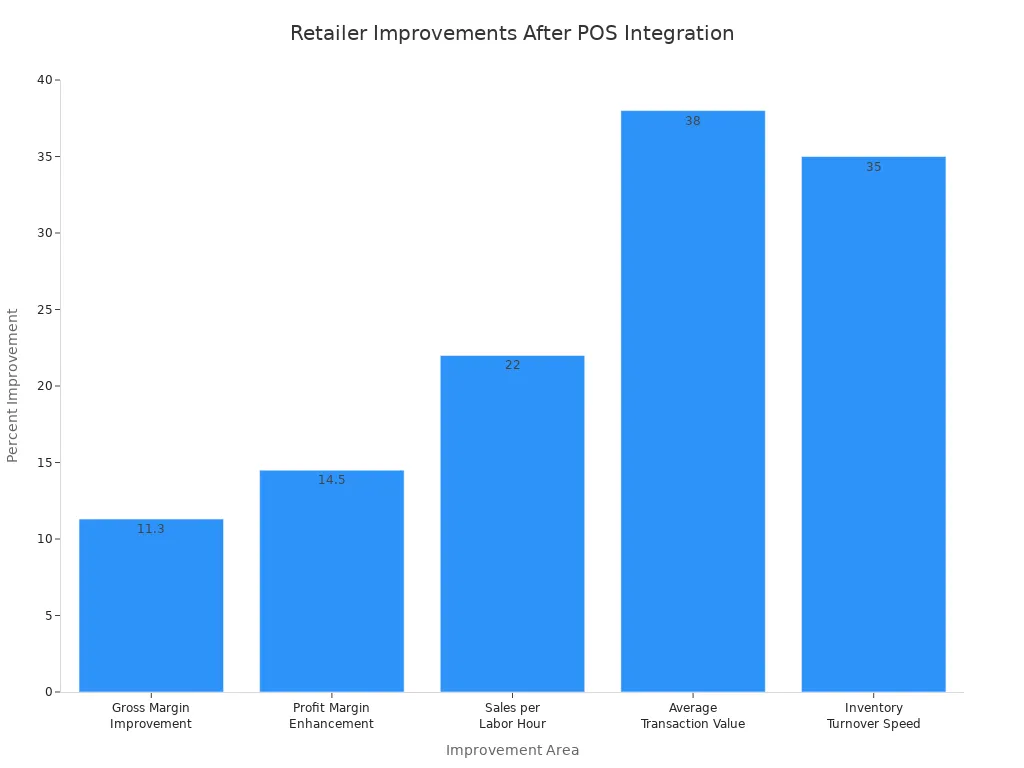
You benefit from faster inventory turnover, higher transaction values, and improved staff scheduling. Modern POS integration also reduces hardware and maintenance costs, making your retail operation more efficient.
Lessons for Multi-Store Operations
You face unique challenges when managing multiple retail locations. Integration complexity and employee resistance often slow adoption. However, you can overcome these hurdles by investing in employee training and clear communication. GreenMart’s experience shows that a phased rollout, starting with pilot stores, helps you identify issues early and refine your approach.
You should focus on:
- Standardizing integration processes across all locations
- Providing ongoing staff training and support
- Using real-time analytics to monitor pricing accuracy and operational efficiency
By following these steps, you ensure consistent pricing and customer experience across your entire retail network.
Small Business Digital Price Tag Success
Overcoming Common Pricing Errors
You do not need to operate a large retail chain to benefit from advanced POS integration. Small businesses have adopted digital price tags and smart POS systems to streamline sales and improve accuracy. You can automate transactions and inventory tracking, reducing manual errors and saving time. Digital price tags eliminate the need for manual label changes, which cuts labor costs and ensures customers always see the correct price.
You gain additional advantages:
- Centralized inventory management with real-time stock visibility
- Seamless integration with e-commerce platforms for omnichannel retail
- Personalized customer experiences through AI-driven recommendations
- Dynamic pricing based on demand or location
You also support sustainability by reducing paper and ink usage, which lowers your operating costs.
Key Takeaways for Independent Retailers
You can draw several lessons from successful digital price tag integration:
| Key Takeaway | Supporting Evidence and Outcome |
|---|---|
| Labor Savings | Digital price tags reduce manual price update time by up to 95%, freeing staff for other tasks. |
| Pricing Accuracy | Automation nearly eliminates manual pricing errors, improving customer trust and reducing complaints. |
| Operational Efficiency | Integration with POS and inventory systems enables real-time price updates and streamlined workflows. |
| Dynamic Pricing | Enables real-time price adjustments based on demand, time, or competitor pricing. |
| Sustainability | Reduced paper and ink waste supports environmental goals. |
| Implementation Considerations | Success depends on staff training, leadership support, and infrastructure readiness. |
| Cost-Benefit | Initial investment is higher, but long-term savings often lead to payback within a few years. |
Tip: You maximize your return on investment by focusing on staff training and infrastructure readiness. Digital price tags offer a compelling value proposition for independent retailers who want to automate updates, reduce workload, and enhance customer satisfaction.
Benefits of POS System and Digital Price Tag Integration
Enhanced Pricing Accuracy and Error Reduction
Minimizing Pricing Errors
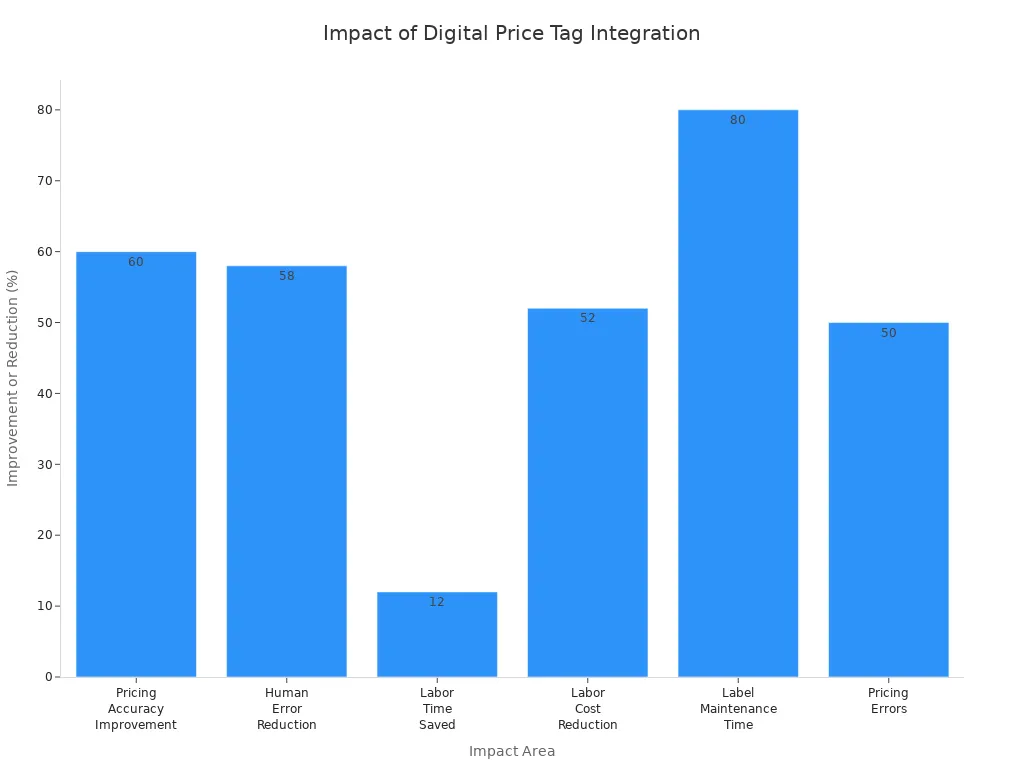
You achieve a new level of pricing accuracy when you integrate your POS system with digital price tags. Automated updates ensure that every price change reflects instantly on the shelf and at checkout. This real-time synchronization eliminates the risk of outdated or mismatched prices. You no longer need to worry about human error during manual updates. In fact, retailers report up to a 60% increase in pricing accuracy and a 58% reduction in errors after adopting digital price tag integration.
| Impact Area | Statistical Evidence |
|---|---|
| Pricing Accuracy Improvement | Up to 60% increase in pricing accuracy |
| Human Error Reduction | 58% reduction in errors related to pricing and inventory |
| Labor Time Saved | Up to 12 hours saved per week per store |
| Labor Cost Reduction | 52% reduction in labor costs for price updates |
| Label Maintenance Time | 80% reduction reported by Carrefour |
| Pricing Errors | 50% fewer pricing errors reported by Carrefour |
You see these improvements reflected in your daily operations. Automated price updates and real-time data flow keep your pricing consistent and accurate across all channels.
Building Customer Trust
Accurate pricing builds trust with your customers. When you provide real-time price visibility, shoppers feel confident that the price they see on the shelf matches what they pay at checkout. This transparency reduces disputes and enhances the overall retail experience. Over 90% accuracy rates from digital price tags help you maintain a reputation for fairness and reliability. As a result, you encourage repeat visits and foster long-term loyalty.
Operational Efficiency and Cost Savings
Streamlining Store Processes
You streamline your store processes by automating price updates and inventory management. Real-time integration ensures that every price change, promotion, or discount appears instantly across your retail floor. You eliminate manual label changes, freeing your staff to focus on customer service and other high-value tasks. Automated stock adjustments and real-time inventory tracking help you avoid overstock and stockouts, improving your bottom line.
- Automates price updates, reducing labor costs
- Enables dynamic pricing strategies and real-time promotions
- Streamlines inventory management with low-stock alerts and automated replenishment
- Improves checkout efficiency by eliminating price discrepancies
Lowering Labor and Compliance Costs
You reduce labor and compliance costs by consolidating pricing tasks and automating updates. Centralized management allows you to update prices across multiple locations with a single action. Retailers report up to 95% labor reduction in price tag updates and significant savings on paper and printing costs. Real-time, enterprise-wide price updates ensure consistent pricing and compliance with regulations.
| Metric/Benefit | Data/Result |
|---|---|
| Labor reduction | 80% reduction reported |
| Pricing accuracy | 100% accuracy achieved |
| Battery life | 5-10 years (indirect cost saving) |
| Carbon footprint | 50% lower (environmental cost saving) |
“Electronic shelf labels have completely transformed our pricing operations. What used to take our staff hours now happens instantly, and our customers always see accurate prices. The ROI was clear within the first few months.” — Mike Naifeh, Store Owner & Operations Manager
Risk Reduction and Regulatory Compliance
Meeting Legal Standards
You meet legal standards more easily with integrated POS and digital price tag solutions. Automated sales tax calculations and accurate record keeping reduce the risk of compliance errors. Your POS system categorizes sales by tax rates and item types, simplifying tax reporting. Real-time data entry and digital storage of transaction records support audit readiness and legal requirements.
- Automated tax calculations minimize errors
- Real-time transaction logging supports accurate tax reporting
- Digital records ensure audit readiness and regulatory compliance
Preventing Financial Losses
You prevent financial losses by maintaining accurate pricing and reducing compliance risks. Real-time integration ensures that every transaction records the correct price and tax amount. Detailed audit trails and automatic updates to tax rates protect your business from penalties and disputes. Security features like data encryption and user access controls safeguard your financial data during audits.
Tip: Consistent, accurate pricing and robust compliance features help you avoid costly fines and protect your reputation in the retail market.
Best Practices for Implementing POS System Monitoring
Selecting the Right POS System for Pricing Accuracy
Essential Features for Digital Price Tag Integration
When you select a POS system for digital price tag integration, you should focus on features that support pricing accuracy and operational efficiency. Look for systems that offer:
- Efficient inventory management, allowing you to update products and prices quickly.
- Real-time updates, so pricing and inventory data synchronize instantly across all channels.
- Seamless integration capabilities with accounting, e-commerce, and digital price tag hardware.
- User-friendly interfaces that reduce errors and speed up staff training.
- Hardware compatibility, ensuring your POS works with current and future devices.
- Scalability to support business growth, including more locations and users.
- Security compliance, such as PCI standards, to protect transaction data.
A system with these features will help you maintain accurate pricing and streamline your retail operations.
Vendor Evaluation and Support
You should align your POS choice with your business needs. Evaluate vendors based on their ability to deliver user-friendly solutions, robust integration, and reliable customer support. Consider how well the system handles barcode scanning, inventory management, and real-time data access. Cloud-based options often provide instant updates and easier scaling. Prioritize vendors who offer comprehensive training and responsive support, as these factors help you maintain system accuracy and uptime.
Staff Training and Change Management
Effective Training Strategies
You need to ensure your staff can use the POS system confidently. Intuitive systems reduce training time and operational costs. Combine clear training sessions with hands-on practice to help staff adapt quickly. Change management programs that include all stakeholders from the start will smooth the transition. Training registers and regular audits help you track progress and minimize errors.
Encouraging System Adoption
You can reduce employee resistance by providing strong organizational support and fair procedures. Foster high-quality relationships between supervisors and staff to encourage positive attitudes toward change. Ongoing communication and public endorsement of successful outcomes help maintain momentum. When staff feel supported, they become more willing to embrace new technology and processes.
Tip: Sustaining change requires continuous support, regular feedback, and recognition of staff commitment.
Ongoing Monitoring and Optimization
Regular System Audits for Accuracy
You should implement advanced monitoring tools to track system performance and ensure pricing accuracy. Regular audits help you identify issues early and maintain data integrity. Automated alerts enable you to detect and resolve problems quickly. Data validation methods, such as batch header checks and checksum verification, further protect your system from errors.
Leveraging Analytics for Continuous Improvement
You can use analysis to optimize your POS system and digital price tag integration. Monitor performance metrics like batch job status, durations, and failures. Employ robust error handling, including automated retries and circuit breakers, to enhance reliability. Performance optimization strategies, such as load balancing and auto-scaling, improve system stability. Proactive network maintenance ensures timely updates and consistent price accuracy. Ongoing analysis supports dynamic pricing and helps you maintain customer trust by delivering accurate, up-to-date information.
Regular monitoring and analysis reduce manual errors and support long-term pricing accuracy.
Future Trends in POS System and Digital Price Tag Technology
AI and IoT Advancements for Pricing Accuracy
Smarter Digital Price Tags
You will see rapid innovation in ai-driven digital price tags as retailers demand greater accuracy and efficiency. These smart tags now synchronize in real-time with your POS system, allowing you to adjust prices instantly based on demand, competitor activity, or promotions. You can automate stock adjustments and optimize ordering, reducing human error and freeing your staff for higher-value tasks.
- Ai-driven digital price tags use e-paper or LCD screens with wireless modules like Bluetooth or Wi-Fi for remote, real-time updates.
- These systems maintain accurate pricing even if your network goes offline, alerting you to connectivity issues.
- You benefit from sustainability, as digital price tags eliminate paper waste and lower operational costs.
- Security features such as encryption and centralized management help you comply with data privacy regulations.
You can also use NFC and QR codes on digital price tags to deliver personalized promotions, increasing customer engagement and supporting dynamic pricing strategies.
Predictive Analytics for Pricing Errors
Ai-driven digital price tags now leverage predictive analytics to forecast demand and optimize stock levels. Machine learning algorithms analyze sales history, customer behavior, and market trends to recommend the best price for each product. You can spot pricing anomalies before they impact your business, ensuring real-time accuracy across all channels.
Integration with cloud-based retail management systems through APIs or middleware ensures seamless data flow. You gain real-time insights into inventory and pricing, which helps you maximize revenue during peak demand and clear inventory during slow periods. Ai-driven solutions support phased implementation, allowing you to pilot new features and continuously improve performance.
Evolving Retail and Customer Expectations
Personalization and Dynamic Pricing
You face rising expectations from customers who want personalized experiences and flexible pricing. Modern POS systems now use ai-driven digital price tags to deliver tailored promotions and dynamic pricing strategies. For example, you can offer discounts based on customer loyalty, location, or real-time demand. Mobile apps and digital tools let you engage shoppers with location-based offers and product recommendations.
| Aspect | Description |
|---|---|
| AI-Powered Personalization | 60% of POS systems use AI for tailored promotions and predictive inventory management. |
| Mobile POS | Enables checkout anywhere, reducing wait times and improving service. |
| Loyalty Programs Integration | Real-time updates and personalized rewards boost engagement and retention. |
You can unify online, in-store, and social media sales, creating a seamless shopping experience. Real-time pricing and inventory synchronization support omnichannel retail, helping you meet customer needs wherever they shop.
Transparency and Trust in Pricing
You build trust by providing transparent, accurate pricing at every touchpoint. Customers expect prices to match from shelf to checkout, whether they pay in-store or online. Ai-driven digital price tags and modern POS systems deliver real-time updates, reducing disputes and supporting fair pricing.
Customers value transparency and consistency. When you provide real-time price visibility, you strengthen loyalty and encourage repeat visits.
Security enhancements such as end-to-end encryption and PCI DSS compliance protect your data and reassure customers. As contactless payments and social commerce grow, you must ensure your POS system integrates with platforms like Instagram and TikTok for seamless, secure transactions. Integrated POS and ecommerce platforms lead to higher customer retention and faster order fulfillment, helping you stay competitive in a rapidly evolving retail landscape.
You gain a powerful advantage when you integrate advanced POS systems with digital price tags. This combination detects and resolves pricing errors in real time, improving accuracy and building customer trust. Investing in modern POS technology streamlines your operations, reduces errors, and protects sensitive data. To maximize results, follow these steps:
- Integrate digital price tags with inventory and POS systems for real-time updates.
- Prioritize clear, consistent label design.
- Conduct regular audits to ensure accuracy and compliance.
- Use AI-powered analytics and unified commerce platforms to optimize performance.
FAQ
What is a digital price tag, and how does it work with a POS system?
A digital price tag displays product prices electronically. You connect it to your POS system using wireless technology. When you update a price in your POS, the change appears instantly on the shelf tag.
How do advanced POS systems detect pricing errors?
Your POS system monitors price data in real time. It compares shelf prices with the central database. If it finds a mismatch, it sends an alert so you can fix the error quickly.
Can digital price tags help you comply with pricing regulations?
Yes. Digital price tags update automatically from your POS system. This ensures that shelf prices match checkout prices, helping you meet legal standards and avoid fines.
What are the main benefits of integrating digital price tags with your POS system?
You gain:
- Real-time price updates
- Fewer manual errors
- Faster promotions and rollbacks
- Improved customer trust
Automated integration streamlines your operations and boosts accuracy.
How do you handle pricing errors that automation cannot fix?
Your POS system notifies staff when it detects complex errors. You follow clear response protocols to investigate and resolve these issues. Audit trails help you track every action.
Is it difficult to train staff on new POS and digital price tag systems?
Most modern systems use user-friendly interfaces. You provide hands-on training and clear guides. Staff usually adapt quickly, especially with ongoing support and regular practice.
What should you look for when choosing a POS system for pricing accuracy?
Look for:
| Feature | Why It Matters |
|---|---|
| Real-time updates | Ensures instant price changes |
| Integration options | Connects with digital tags |
| Security compliance | Protects transaction data |
| Vendor support | Helps with setup and training |