
You can dramatically improve pricing accuracy and reduce cashier errors by switching to digital price tags and digital shelf labels. These tags use automation to update prices instantly, cutting human error and boosting efficiency. When you connect ESL Price Tag systems or an ESL Gateway AP to your retail operations, you ensure that shelf prices always match checkout prices. Electronic Shelf Labels and Esl Retail solutions deliver a 60% increase in pricing accuracy and a 58% reduction in human error, as shown below:
| Impact Area | Statistical Evidence |
|---|---|
| Pricing Accuracy | 60% increase in pricing accuracy after adopting digital price tags |
| Human Error Reduction | 58% reduction in human error in pricing and inventory marking due to automation |
These benefits give you and your customers greater confidence and faster service.
Why Pricing Errors and Human Error Occur with Traditional Price Tags

Manual Price Updates and Human Error
Mistakes in Changing Paper Price Tags
You face a high risk of mistakes every time you update paper price tags. The price update process requires your staff to check, print, and physically replace tags on the shelves. This manual approach often leads to errors, especially during busy periods or when you run frequent promotions. Even a small oversight can create pricing discrepancies that frustrate both your team and your customers.
Note: Manual price changes in retail stores can take more than 20 hours per week. This time-consuming process increases the chance of human error and makes it difficult to keep prices accurate.
Outdated or Incorrect Shelf Prices
When you rely on paper tags, outdated or incorrect shelf prices become common. Your staff may miss a tag or forget to update it after a price change. As a result, customers see one price on the shelf but get charged another at checkout. This lack of real-time synchronization makes it nearly impossible to maintain accurate pricing during frequent changes.
Price Mismatches and Cashier Errors at Checkout
Discrepancies Between POS and Shelf Prices
You often encounter pricing discrepancies between your point-of-sale (POS) system and the prices displayed on shelf tags. A 2024 audit found that about 24% of retail prices in stores using traditional tags went unchecked. This unchecked rate directly leads to price mismatches at checkout, causing confusion and errors during transactions.
Customer Disputes and Frustration
When customers notice a difference between the shelf price and the checkout price, disputes arise. These situations slow down the checkout process and damage your store’s reputation. Customers lose trust when they experience repeated pricing errors, and your staff must spend extra time resolving these issues.
Labor-Intensive Processes Increase Risk
Time-Consuming Tag Changes
The process of updating paper tags is labor-intensive. Your team must handle each tag individually, which takes significant time and effort. Frequent sales, promotions, and seasonal changes only add to the workload, increasing the risk of errors.
- Manual tag changes require:
- Checking each shelf for outdated tags
- Printing new tags
- Physically replacing tags throughout the store
Higher Staff Workload and Error Rates
As your staff spends more time on repetitive tasks, their workload increases. This higher workload leads to more errors and reduces the time available for customer service or other important duties. The more manual steps involved, the greater the risk of pricing errors and discrepancies.
How Digital Price Tags and Digital Shelf Labels Work

Real-Time Price Synchronization to Reduce Cashier Errors
Integration with POS Systems
You can connect digital price tags directly to your store’s POS and inventory systems. This integration allows you to manage prices from a single platform. When you update a price in your POS, the change automatically syncs to every tag on the sales floor. The system uses secure APIs or FTP to send pricing data to a cloud platform, such as Microsoft Azure. From there, access points in your store wirelessly transmit the new prices to electronic shelf labels. This process ensures real-time price updates, so your shelf prices always match your checkout prices.
Centralized Price Management
Centralized price management gives you full control over your pricing strategy. You can adjust prices for one product or an entire category from your headquarters or any internet-connected device. The system supports both base station network domain mode and Bluetooth wireless communication. In base station mode, a central gateway manages all tags within its range, refreshing data in seconds. Bluetooth mode lets you update prices directly from mobile devices. This structure guarantees stable, secure, and rapid communication for real-time price updates across all your locations.
Automated Storewide Updates Prevent Pricing Errors
Wireless Communication Technology
Digital price tags rely on advanced wireless technology to deliver instant updates. Access points installed throughout your store communicate with hundreds of electronic shelf labels at once. The system uses a hierarchical data flow, moving information from your ERP and POS systems to the cloud, then to base stations, and finally to the tags. This setup enables you to update prices across your entire store within 60 seconds, eliminating the need for manual labor and reducing the risk of human error.
Instant Price Changes for Promotions and Sales
You can launch promotions and sales with just a few clicks. Automated storewide updates ensure that every tag displays the correct price immediately. This real-time pricing capability prevents mismatches between shelf and checkout prices, improving accuracy and consistency. Your staff no longer needs to spend hours replacing paper tags, which frees them to focus on customer service and other important tasks.
Tip: Automated price changes with digital shelf labels help you avoid customer confusion and disputes by keeping all prices accurate and up to date.
User-Friendly Digital Price Tag Interfaces
Simple Setup and Maintenance
Digital price tag interfaces feature intuitive software that makes setup and maintenance straightforward. You can manage prices and product information remotely, reducing the need for physical updates. The centralized database ensures that every tag displays consistent and accurate information, making management easy for your team.
Staff Training and Adoption
You will find that digital price tags are designed for easy adoption. The software offers a user-friendly interface, so your staff can quickly learn how to update prices and manage promotions. Comprehensive training and support help your team use the system effectively. Customization options allow you to tailor the tags to your brand and business needs, further enhancing usability.
With digital shelf labels and electronic shelf labels, you streamline operations, reduce errors, and empower your staff to deliver better service.
Reduce Cashier Errors with Digital Price Tags
Eliminating Manual Input and Human Error
Automated Price Changes
You can reduce cashier errors by removing manual steps from your pricing process. Digital price tags automate price changes, so you no longer need to print or replace paper tags by hand. This automation eliminates common mistakes such as mislabeling items, attaching the wrong tags, or entering incorrect prices. When you update prices through your POS system, the new information appears instantly on every digital tag in your store. This process ensures pricing accuracy and reduces the risk of human errors that often occur during busy periods or large promotions.
- Manual input errors include:
- Mislabeling items
- Attaching the wrong price tags
- Setting incorrect prices
- Entering sales data incorrectly
- Scan errors happen when cashiers scan items incorrectly, often due to distractions or rushing.
- These errors add up and contribute to retail shrinkage and checkout mistakes.
- By using digital price tags, you remove these manual steps and reduce cashier errors across your store.
Fewer Opportunities for Mistakes
Digital price tags give you fewer opportunities for mistakes. You no longer rely on staff to update hundreds of tags during each promotion or price change. The system updates every tag automatically, so you maintain consistent pricing accuracy throughout your store. This approach helps you avoid pricing errors that frustrate customers and slow down checkout lines. You also free up your staff to focus on customer service instead of repetitive tasks.
Ensuring Price Consistency and Preventing Pricing Errors
Synchronization Across All Sales Channels
Digital price tags synchronize prices in real time across all your sales channels. This technology connects your POS, inventory, and online systems, so every price update appears instantly in every location. You prevent discrepancies between shelf and checkout prices, which helps you reduce cashier errors and maintain customer trust.
| Evidence Aspect | Supporting Details |
|---|---|
| Real-time Synchronization | Digital price tags synchronize prices instantly across all stores, ensuring shelf and checkout prices match, preventing discrepancies. |
| Pricing Error Reduction | Retailers report up to 60% reduction in pricing errors and 58% decrease in human errors due to automation. |
| Labor Cost Savings | Automation of price updates reduces labor costs by approximately 80%, eliminating manual price changes. |
| Case Studies | Major retailers like Carrefour and Tesco have experienced 50% fewer pricing errors after adopting digital price tags. |
| Omnichannel Pricing Alignment | Integration with POS and inventory systems ensures consistent pricing across physical and online channels, supporting omnichannel strategies. |
| Audit and Transparency | Automated logging of every price change creates accountability, enabling quick detection and correction of pricing mistakes. |
| Customer Trust | Consistent shelf and checkout prices reduce disputes and increase shopper confidence and loyalty. |
Digital price tags rely on real-time synchronization with your POS and inventory systems. This setup allows you to update prices instantly across all channels, including physical stores and online platforms. Automated records of every price change provide transparency and traceability, so you can detect and correct pricing errors quickly. This level of price visibility supports compliance and builds trust with your customers.
Accurate Pricing for Online and In-Store Purchases
You ensure accurate pricing for both online and in-store purchases when you use digital price tags. The system aligns prices across your website, mobile app, and physical locations. Customers see the same price no matter where they shop, which reduces confusion and prevents pricing errors. This consistency supports your omnichannel strategy and helps you deliver a seamless shopping experience.
Minimizing Customer Disputes at Checkout
Transparent, Up-to-Date Pricing
Digital price tags improve pricing accuracy by making sure shelf prices always match checkout prices. Real-time updates eliminate discrepancies that often cause customer complaints. When customers see clear, accurate prices on the shelf, they feel more confident in your store. You also reduce the number of disputes at checkout, which helps your staff serve customers faster.
- Digital price tags ensure shelf and checkout prices match, reducing human errors.
- Real-time synchronization eliminates discrepancies that lead to customer complaints.
- Dynamic price updates allow you to correct pricing errors quickly and adapt to market changes.
- Enhanced transparency through real-time product and promotional information helps customers make informed decisions.
Faster Resolution of Price Issues
You resolve price issues faster with digital price tags. When a customer questions a price, your staff can check the digital tag and confirm the correct amount instantly. The system’s automated records make it easy to track changes and correct mistakes. This speed reduces wait times at checkout and improves the overall customer experience. Your store gains a reputation for accuracy and reliability, which encourages repeat business.
Operational Benefits of Digital Price Tags for Retailers
Labor Savings and Increased Efficiency
Less Time Spent on Price Changes
You can dramatically reduce the time your team spends updating prices by switching to digital price tags. Manual updates often require hours of repetitive work each week. With electronic shelf labels, you automate this process and eliminate the need for staff to walk the aisles replacing tags. The following table shows how much labor time you can save:
| Retailer/Example | Manual Labor Time Spent Weekly | Labor Time Saved by ESL | Notes |
|---|---|---|---|
| Mid-sized retailer | ~50 hours | Nearly 50 hours | Manual updates fully eliminated |
| Another mid-sized store | ~10 hours | Nearly 10 hours | ESL automates all price tag updates |
| Walmart (Texas store) | ~2 days (approx. 16+ hours) | Reduced to minutes | Price changes that took 2 days now minutes |
“A price change that used to take an associate two days to update now takes only minutes with the new DSL system,” said Daniela Boscan, Walmart Food & Consumable Team Lead. “This efficiency means we can spend more time assisting customers and less time on repetitive tasks.”
Reallocating Staff to Higher-Value Tasks
When you use digital price tags, your staff can focus on higher-value activities. Instead of spending hours on manual updates, your team can assist customers, manage inventory, or improve store displays. This shift increases efficiency and helps you deliver better service. You also reduce the risk of errors that come from repetitive, manual work.
Streamlined Promotions and Sales with Digital Shelf Labels
Instant Price Adjustments for Events
Digital shelf labels let you adjust prices instantly for sales events or promotions. You can synchronize pricing and promotional information in real time with your product database. This eliminates delays and human errors that often occur with manual updates. You gain the flexibility to respond quickly to market changes or competitor pricing.
Easier Management of Seasonal and Flash Sales
You can manage seasonal and flash sales more easily with electronic shelf labels. These tags allow you to automate price changes across your store, saving time and reducing operational costs. Your employees no longer need to print and replace hundreds of tags during busy sales periods. Customers benefit from clear, accurate, and interactive promotional information, which enhances their shopping experience.
- Digital shelf labels enable real-time synchronization of pricing and promotions.
- You can adjust prices remotely based on demand or seasonality.
- Employees spend less time on manual tasks and more time helping customers.
- Customers see accurate, up-to-date promotions on every shelf.
Improved Inventory and Pricing Data
Real-Time Stock and Price Updates
Electronic shelf labels provide real-time updates for both stock levels and pricing. You always know which products need restocking and which prices have changed. This visibility helps you avoid out-of-stock situations and pricing errors. Your retail operations become more efficient and responsive.
Better Data for Business Decisions
With digital price tags, you gain access to accurate data for every product and promotion. The system tracks every price change and inventory update. You can analyze this information to identify trends, optimize pricing strategies, and improve your business decisions. Reliable data supports better planning and drives long-term savings.
Enhancing Customer Experience by Reducing Pricing Errors
Building Trust with Accurate Digital Price Tags
Fewer Surprises at Checkout
You want your customers to feel confident every time they shop. Digital price tags help you achieve this by ensuring that shelf prices always match what appears at checkout. When you automate price and promotion updates, you remove the risk of manual mistakes that can lead to pricing errors. Customers see the correct price on the shelf and at the register, which means no more unexpected surprises during payment. This transparency builds trust and increases customer satisfaction.
- Digital price tags automate updates, reducing errors and labor costs.
- Automation prevents pricing errors that damage trust and lead to lost sales.
- Instant syncing across platforms ensures consistent pricing for every customer.
Enhanced Store Reputation
Accurate digital price tags do more than just reduce cashier errors—they protect your store’s reputation. When you maintain clear and consistent pricing, you show customers that you value honesty and reliability. AI-powered shelf tracking confirms that both standard and promotional prices are visible and accurate. This level of oversight ensures that your store meets pricing standards and avoids compliance issues. As a result, you strengthen your brand and encourage repeat visits, which boosts customer engagement and satisfaction.
Faster, Smoother Checkout with Fewer Cashier Errors
Reduced Wait Times
Digital shelf labels synchronize prices in real time between the shelf and your POS system. This eliminates the need for cashiers to double-check prices or resolve disputes. Transactions move faster because your staff spends less time correcting errors. Customers appreciate shorter lines and a smoother checkout process, which directly improves customer satisfaction.
- Real-time updates mean no manual price checks.
- Customers always see the correct price, minimizing disputes.
- Faster transactions lead to a better overall experience.
Happier Shoppers
When you reduce cashier errors, you create a stress-free environment for your customers. They know they can trust your prices and expect a quick, accurate checkout. This reliability increases customer satisfaction and encourages positive word-of-mouth. Your staff also benefits, as they can focus on customer engagement rather than fixing mistakes.
Tip: A single backend system for both POS and shelf pricing ensures accuracy and reduces errors, making every shopping trip more enjoyable for your customers.
Supporting Omnichannel Consistency with Digital Shelf Labels
Consistent Prices Online and In-Store
Digital shelf labels play a key role in supporting omnichannel consistency. You can update prices instantly across all channels, reducing the risk of discrepancies between online and in-store prices. This real-time synchronization ensures that your customers always receive the same price, no matter where they shop. Consistent pricing supports customer satisfaction and loyalty.
Seamless Customer Journey
By integrating digital shelf labels with your e-commerce and POS systems, you create a seamless customer journey. Customers can move between online and physical stores without confusion or frustration. Features like click-and-collect and personalized promotions become easier to manage, further enhancing customer experience and engagement. This approach not only improves satisfaction but also positions your store as a leader in modern retail.
Cost and ROI of Digital Price Tags for Reducing Cashier Errors
Upfront Investment vs. Long-Term Savings
Initial Costs of Digital Price Tags and Digital Shelf Labels
You should plan for a significant upfront investment when you implement digital price tags and digital shelf labels. The cost depends on your store size, the number of tags, and system complexity. Here is a breakdown of typical costs:
| Cost Component | Description | Typical Cost Range / Example |
|---|---|---|
| Hardware (ESLs) | Electronic shelf labels per tag | $15 to $25 per tag |
| Total Initial Investment | For a mid-sized store including all components | Can exceed $100,000 |
| Software & Licensing | Management software and platform fees | Can match or double hardware costs as scale grows |
| Installation | Setup, network upgrades, ESL holders | Example: $100,000 for installing 10,000 tags |
| Individual Screens | Hardware and installation per screen | $1,000 to $5,000 per screen |
Note: Financing options such as leasing or subscriptions can help you manage upfront costs. Always include both initial and ongoing expenses in your planning.
Ongoing Maintenance and Support
After installation, you will need to budget for ongoing maintenance and support. These costs include software updates, technical support, and occasional hardware replacements. While these expenses are lower than the initial investment, they are essential for keeping your digital price tags and digital shelf labels running smoothly.
Calculating ROI from Fewer Pricing Errors and Human Error
Labor Cost Reductions
Switching to digital price tags can reduce your in-store labor costs by about 20%. Automation of price updates and promotions frees your staff to focus on customer service and store operations. This labor shift not only cuts costs but also helps prevent financial losses caused by manual errors.
Decreased Lost Sales from Pricing Mistakes
You can expect fewer financial losses from pricing mistakes when you use digital shelf labels. Automated, real-time updates ensure that shelf and checkout prices always match. This accuracy reduces customer disputes and prevents lost sales due to pricing errors.
| Cost Aspect | Paper Price Tags (5 Years) | Electronic Shelf Labels (5 Years) |
|---|---|---|
| Initial Investment | $6,000–$30,000 | $187,500 |
| Annual Operational Costs | $9,136,875 | $875,085 |
| Error-Related Losses | $9,000,000 | $900,000 |
| Total Cost of Ownership | $18,163,875 | $1,962,585 |
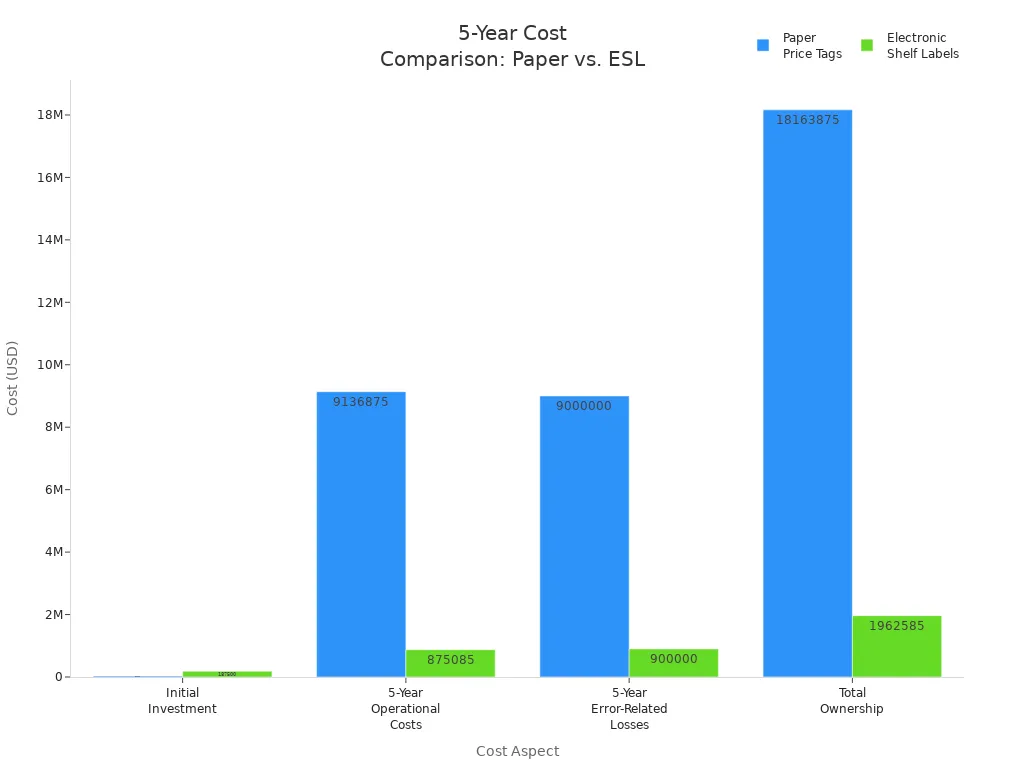
Over five years, your total cost of ownership with digital price tags can be five to ten times lower than with paper tags. The long-term savings from reduced labor and error-related losses far outweigh the initial investment.
Real-World Examples of Digital Price Tag Implementation
Success Stories from Retailers
Many retailers have achieved improved sales and significant long-term savings by adopting digital price tags. They report fewer pricing errors, reduced labor costs, and lower financial losses. These benefits often lead to a payback period of 12 to 18 months.
Lessons Learned
To maximize your ROI, you should:
- Analyze your current pricing workflows before selecting a system.
- Train your staff thoroughly for smooth adoption.
- Start with a pilot test to confirm benefits.
- Roll out the system gradually to manage challenges.
- Maintain strong post-installation support.
- Monitor ROI using compliance metrics and sales data.
- Refine your ROI calculations regularly to capture all savings and losses.
Tip: Avoid incomplete data collection and quantify intangible benefits like customer satisfaction to ensure your ROI calculations reflect the full impact of digital price tags.
Overcoming Implementation Challenges with Digital Price Tags
Staff Training and Change Management
Engaging Employees in the Transition
You play a critical role in the success of your transition to digital price tags. Employees need more than just technical training. You should involve your team early and keep them engaged throughout the process. Identify internal champions who can advocate for the new technology. These advocates help build excitement and address concerns among their peers. Develop a clear communication plan that explains the business case and benefits. When you create a sense of urgency and show how digital price tags improve daily work, you motivate your staff to embrace the change.
Tip: Pilot programs allow your team to test the system, provide feedback, and become comfortable before a full rollout.
Addressing Common Concerns
Your employees may worry about the complexity of new systems or fear job changes. Address these concerns by making the new tools as frictionless as possible. Provide hands-on training and support. Encourage open feedback so you can resolve issues quickly. Align the implementation with your business goals and culture. When you show measurable outcomes, you help your team see the value of digital price tags.
- Common challenges include:
- High initial investment costs
- Concerns about dynamic pricing and transparency
- Privacy and data security issues
- Operational challenges in managing pricing algorithms
You can overcome these by focusing on clear communication, transparency, and continuous support.
Technical Integration to Reduce Cashier Errors
Compatibility with Existing Systems
You need to ensure that digital price tags work seamlessly with your current POS and inventory systems. Compatibility reduces disruptions and helps you maintain pricing accuracy. Choose solutions that support integration with your existing software and hardware. This approach minimizes technical barriers and speeds up the transition to digital.
Support and Troubleshooting
Reliable support is essential during and after implementation. Set up a dedicated support channel for technical issues. Train your IT staff to handle common troubleshooting tasks. Address data security risks by using encrypted communication and secure QR codes. Protect customer privacy by limiting data collection and following best practices for data management.
Note: Transparent dynamic pricing software and clear price history displays help maintain customer trust and avoid confusion.
Scaling Digital Shelf Labels Across Multiple Locations
Rollout Strategies
You should plan your rollout carefully when expanding digital shelf labels to multiple stores. Start with a pilot location to test the system and gather feedback. Use analytics to monitor performance and identify areas for improvement. Collaborate with your retail teams to coordinate promotions and ensure consistent product placement. Leverage planogram software to automate shelf layouts and reduce manual errors.
Monitoring and Optimization
Continuous monitoring helps you optimize your digital price tag strategy. Use real-time analytics to track pricing, promotions, and inventory across all locations. Adjust your approach based on sales trends and customer preferences. Prioritize resources using key performance indicators to maximize efficiency. Regularly update your planograms and digital shelf content to maintain competitiveness and drive sales.
By following these best practices, you can scale digital price tags effectively and maintain high standards across your retail network.
Digital price tags give you a smart way to reduce cashier errors and improve store performance. You automate price accuracy, minimize human error, and deliver real-time updates that boost satisfaction for both your team and your customers.
- You gain flexibility to adjust prices instantly, optimize inventory, and support dynamic promotions.
- Enhanced transparency and detailed product information help customers make informed choices, increasing satisfaction and loyalty.
- Digital price tags also support sustainability by reducing paper waste and labor costs.
FAQ
What are digital price tags?
Digital price tags are electronic displays that show product prices on shelves. You can update them remotely using a central system. This technology replaces paper tags and ensures real-time price accuracy.
How do digital price tags reduce cashier errors?
You eliminate manual price updates with digital price tags. The system synchronizes prices between shelves and checkout. This process removes discrepancies and reduces the risk of human error at the register.
Are digital price tags difficult to install?
You can install digital price tags with minimal disruption. Most systems use wireless communication and integrate with your existing POS. Many providers offer step-by-step setup guides and technical support.
What is the typical ROI for digital price tags?
You often see ROI within 12 to 18 months. Savings come from reduced labor, fewer pricing errors, and improved operational efficiency. The long-term benefits usually outweigh the initial investment.
Can digital price tags support promotions and sales?
Yes, you can update prices for promotions or flash sales instantly. The system allows you to schedule or launch price changes across all shelves with just a few clicks.
How do digital price tags handle security and data privacy?
Digital price tags use encrypted communication to protect pricing data. You control access through secure management platforms. Providers follow industry standards to ensure data privacy and system integrity.
Will staff need special training to use digital price tags?
You will need to train your staff on the new system. Most interfaces are user-friendly. Training sessions and support materials help your team adapt quickly and manage price updates confidently.
What happens if a digital price tag stops working?
If a tag fails, you can replace it easily. Most systems alert you to any issues. You can troubleshoot or swap out the tag without affecting the rest of your pricing network.