
An eink price tag is a small, battery-powered digital display on a store shelf. It uses the same low-power e-ink technology found in e-readers. Its main purpose is to replace traditional paper labels. Stores can update an ESL Price Tag instantly from a central computer using an ESL Gateway AP.
Approximately 25% of Esl Retail businesses had already adopted Electronic Shelf Labels by 2022. This adoption drives significant market growth for e ink price tags.
The global market shows strong upward momentum:
- The market was valued at USD 1.85 billion in 2024.
- Projections estimate it will reach USD 7.54 billion by 2033.
- This represents a compound annual growth rate (CAGR) of 17.4% from 2025 to 2033.
What Exactly Is an Eink Price Tag?
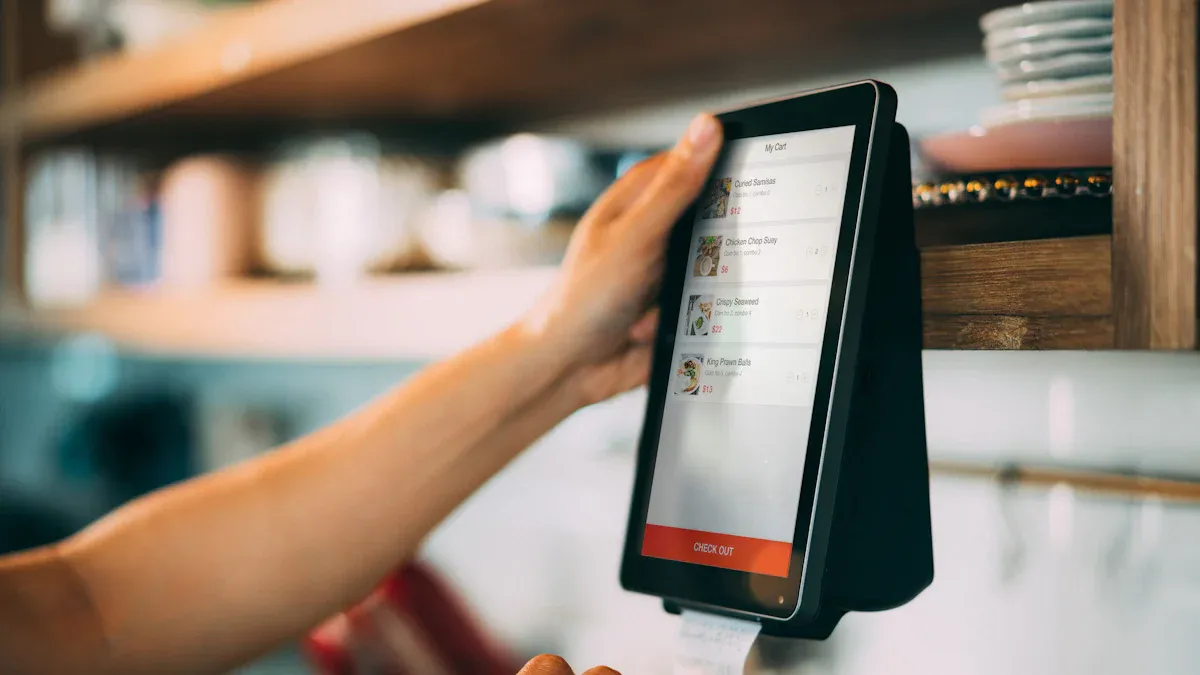
An eink price tag is more than just a digital screen; it is a sophisticated device with three core components working together. These are the digital display panel, a connection to a central management system, and a long-lasting internal power source. Each part plays a critical role in the system’s overall function.
The Digital Display
The most visible component of any electronic shelf label is its digital display. These screens use e-ink technology, which gives them a matte, paper-like appearance that is easy to read even in bright store lighting. This high-contrast, glare-free surface mimics printed paper, reducing eye strain for shoppers. The displays are not limited to simple black and white. Modern e ink price tags offer several color options to highlight promotions and important product information.
Common display configurations include:
- Black, White, and Red (tri-color)
- Black, White, Red, and Yellow (four-color)
- Full multi-color options (like E Ink Spectra™ 6) for vibrant, engaging visuals.
This versatility allows retailers to draw customer attention to sales, new items, or other key details directly on the shelf.
The Central System Connection
The “smart” aspect of electronic shelf labels comes from their connection to a central server. This connection allows a retailer to manage thousands of labels across one or multiple stores from a single point of control. The architecture relies on a Central Management Software (CMS) to orchestrate updates.
The process for updating a price is highly efficient:
- Data Input: An operator inputs new price or product information into the CMS, selecting specific labels or entire groups.
- Synchronization: The software processes this data and prepares it for transmission.
- Transmission: The CMS sends the update wirelessly to communication gateways, which then broadcast the signal to the designated labels.
- Display Update: The labels receive the new data and refresh their screens, a process that takes only seconds.
For this system to work, it must integrate seamlessly with a store’s existing Point of Sale (POS) and Enterprise Resource Planning (ERP) systems. This integration, often handled by middleware, synchronizes the price in the central database with the price on the shelf and at the checkout counter, eliminating discrepancies.
The Power Source
A key advantage of e-ink technology is its extremely low power consumption. The display only draws energy when the image is actively changing. Once information is displayed, it requires zero power to hold the image, whether for a few hours or several weeks. This efficiency gives the devices an exceptionally long battery life. While the lifespan of used e-ink price tags can vary, new units are designed for longevity.
| Manufacturer/Technology | Average Battery Life |
|---|---|
| Standard Digital Price Tags | 3 to 6 years |
| SOLUM’s Newton Platform | Up to 10 years |
| Hanshow Stellar Pro Series | Up to 10 years |
| B-Tag ESLs | Up to 15 years |
These devices typically use small, high-capacity lithium coin cell batteries, similar to those found in car key fobs and watches. Common models like the CR2450 are popular because their small size fits the slim profile of modern labels while providing years of reliable power, reducing maintenance costs and environmental waste compared to paper labels.
How Do E-Ink Price Tags Work?
The functionality of e-ink price tags rests on a sophisticated interplay of display physics, wireless networking, and power management. Each tag operates as a small, independent node within a larger store-wide system. Understanding how these three elements work together reveals the efficiency and reliability of this modern retail technology.
The E-Ink Display Technology
The core of the visual display is e-ink, or electronic ink. This technology creates images without using a backlight, giving it a paper-like appearance. The screen contains millions of tiny microcapsules, each about the width of a human hair.
The process for creating an image is based on a principle called electrophoresis.
- Each microcapsule holds a clear fluid containing positively charged white particles and negatively charged black particles.
- A network of electrodes sits behind the layer of microcapsules.
- When the system applies a negative electric field to a specific spot, the positive white particles move to the top of the microcapsule, making that spot appear white.
- Conversely, a positive electric field pushes the negative black particles to the top, making the spot appear black.
By controlling the electric field across the entire display, the system arranges these black and white particles into text and images. The particles remain in place once positioned, holding the image without any further power. This is how the display on e-ink price tags achieves its crisp, high-contrast look.
The Wireless Communication
Electronic shelf labels receive price and product updates wirelessly from a central server. This communication is managed by gateways or access points installed throughout the store. These gateways act as bridges, relaying signals from the main computer to the individual tags on the shelves.
Retailers use several low-power wireless protocols to ensure reliable communication. Bluetooth Low Energy (BLE) and Zigbee are market leaders, known for their scalability and security in large retail environments. Both protocols support bidirectional communication, allowing tags to send confirmation signals back to the system. While technologies like Wi-Fi are available, their higher power consumption makes them less suitable for battery-operated devices.
The system’s performance depends on its communication range and data speed.
| Metric | Typical Value |
|---|---|
| Communication Rate | Up to 175 kbps |
| Communication Distance | Up to 30-50 meters (unobstructed) |
This setup enables a store to update thousands of labels quickly. However, the lower bandwidth of these radio frequencies is optimized for sending small packets of data, like price changes, rather than complex, high-resolution images.
The Low-Power Advantage
The most significant feature of e-ink technology is its extremely low energy consumption. This efficiency comes from a property called bistability.
A bistable display holds its image without needing a continuous power supply. Power is only drawn when the content on the screen is actively changing. Once the price is updated, the tag consumes virtually zero energy to keep that information visible.
This is a fundamental difference from traditional LCD screens, which require constant power to run a backlight and refresh the pixels on the screen many times per second. The power consumption of an e-ink display is a tiny fraction of an LCD’s. For instance, the energy needed to operate a single LCD panel could power approximately 240 e-paper displays over the same period.
Power is consumed only during two key actions:
- Receiving a wireless signal from the gateway.
- Activating the electric field to rearrange the ink particles for a screen update.
This minimal power draw allows the small, coin-cell batteries inside the tags to last for many years, dramatically reducing maintenance needs and operational costs for retailers.
Why Are Stores Switching to E Ink Price Tags?

Retailers are increasingly adopting e ink price tags to solve critical operational challenges, enhance accuracy, and improve sustainability. This technology offers a powerful solution to the limitations of traditional paper labels, providing a clear return on investment through greater efficiency and reliability.
Ensuring Price Accuracy
Manual pricing is prone to human error, leading to discrepancies between the shelf price and the price at checkout. Electronic shelf labels eliminate this problem by synchronizing all prices with the central database. This ensures customers are always charged the correct amount. The consequences of pricing errors are severe.
Retailers face significant financial repercussions for violating pricing laws. States like California and North Carolina impose fines up to $1,000 and $5,000 per violation, respectively. In one case, a major retailer paid an $850,000 settlement for widespread scanning errors. Beyond fines, these mistakes erode consumer trust and can cause lasting damage to a brand’s reputation.
Improving Store Efficiency
Replacing paper labels is a time-consuming manual task. A typical store may require employees to spend 5-10 hours per week just on price updates. Some retailers, like Naifeh’s Cash Saver, reported saving 50 hours of labor per week after automating the process. By implementing e-ink price tags, stores free up staff to focus on more valuable activities, such as assisting customers and managing inventory. This technology also improves overall operational efficiency in areas like warehousing and enables dynamic pricing strategies, allowing for rapid, store-wide updates that respond to market trends in seconds.
Reducing Paper Waste
Shifting away from paper labels offers significant environmental benefits. Traditional labels generate constant waste, requiring paper, ink, and toner for printing. Digital tags are a sustainable alternative. They drastically reduce paper consumption and eliminate the need for printing supplies. Because the system is controlled centrally and the displays use very little power, it also helps lower a company’s overall carbon footprint. This transition supports green initiatives and promotes more sustainable business operations. 🌎
Key Benefits of the Eink Price Tag System
The adoption of an eink price tag system provides retailers with powerful tools to enhance operations, engage customers, and boost profitability. These benefits extend far beyond simple price automation, transforming the shelf edge into a dynamic point of interaction.
Dynamic Pricing and Promotions
Electronic shelf labels empower retailers to implement dynamic pricing strategies with precision and speed. This capability allows stores to adjust prices in real-time to respond to market conditions, manage inventory, or run targeted promotions. Retailers can execute these strategies instantly across all stores.
- Time-Based Offers: Stores can schedule happy hour specials or end-of-day discounts on perishable items, like baked goods, to reduce waste.
- Inventory Management: Retailers can automatically lower prices on overstocked products or items nearing an expiration date. For example, Hema Fresh used e-ink price tags to cut food waste by 25%.
- Compliance and Accuracy: This automation ensures promotional prices match the checkout system, helping retailers avoid costly fines for pricing discrepancies.
Crystal-Clear Readability
The e-ink display technology offers exceptional readability that mimics traditional paper. Unlike backlit LCD screens, the matte finish of e-paper price tags eliminates glare, making them easy to read in any lighting condition. This ensures a comfortable viewing experience for shoppers. The technology provides a superior viewing angle, which is crucial in a retail environment.
E-ink displays feature a viewing angle of nearly 180°. This ensures customers can clearly read information on tags placed on both the highest and lowest shelves.
This wide viewing angle guarantees that product and price information is always visible and legible, regardless of where the customer is standing.
Displaying More Than Just Price
Modern e ink price tags serve as miniature information hubs. Retailers can display a wealth of data beyond the price, enriching the customer’s shopping journey. This additional information helps shoppers make more informed decisions directly at the shelf. Useful data points include:
- Nutritional facts, allergen warnings, and country of origin.
- Remaining stock levels and price per unit of weight.
- QR codes that link to product reviews, video content, or digital coupons.
By scanning a QR code on an e-ink tag, a customer can instantly access detailed specifications or even complete a purchase through a mobile payment system, creating a seamless and interactive experience.
An eink price tag is a modern, digital replacement for paper labels. It uses low-power e-ink to display prices that update wirelessly. This technology makes pricing more accurate and efficient. A mid-sized retailer can see a return on investment in about 1.85 years, making the system profitable quickly. As a shopper, you can trust the price on the shelf is what you will pay.
The future of e ink price tags points toward even greater integration:
- AI-driven price optimization
- NFC and QR code functionality for engagement
- Full-color displays for vibrant promotions
This evolution transforms the eink price tag from a simple label into a key part of a store’s dynamic merchandising strategy.
FAQ
Are the prices on e-ink tags always correct?
Yes. The system directly links the tag’s price to the store’s central database. This connection ensures the price on the shelf matches the price at the checkout counter. This process eliminates scanning errors and builds consumer confidence.
How long does it take to update a price?
The central system transmits updates wirelessly. A tag receives the new data and refreshes its display within seconds. This speed allows retailers to change thousands of prices across a store almost instantly, ensuring operational agility.
Can customers interact with these tags?
Yes. Many modern tags feature QR codes or Near Field Communication (NFC) technology. Shoppers can use their smartphones to scan these elements. This action links them to product details, online reviews, or exclusive digital coupons.
What happens if a tag’s battery dies?
The e-ink display is bistable, so it holds the last image without power. The tag will show the last price but cannot receive updates. The management system typically flags the low-battery tag for staff to replace it.