Retail advertising is the strategic process of promoting your store and products directly to consumers, aiming to attract shoppers and encourage purchases. This powerful tool connects potential customers with your offerings, providing compelling reasons to choose your business. Effective retail marketing now extends beyond traditional promotions to incorporate advanced in-store technology. For example, an Esl Retail system leverages an ESL Gateway AP to efficiently manage each ESL Price Tag, enabling instant updates and streamlined promotions. The significant investment in this area is evident, with forecasts predicting over $88 billion will be spent on digital retail advertising in the US, underscoring its immense value. The integration of Electronic Shelf Labels is a key component of this modern approach.
Why Is Retail Advertising Crucial for Your Business?
Investing in retail advertising is no longer optional; it is a fundamental pillar for growth in today’s market. You can use it as a strategic asset to achieve several core business objectives, moving your brand from obscurity to a household name. It provides a direct line of communication to the people who matter most: your potential buyers.
It Directly Drives Sales
The primary function of any advertising effort is generating revenue. This strategy is exceptionally effective at driving sales by directly influencing purchasing decisions at critical moments.
Attracting New Customers
Your ads act as your business’s first handshake with new audiences. Effective retail advertising reaches people who may not know your store exists, presenting them with a compelling reason to visit your website or walk through your doors. This initial contact is the first step in converting a stranger into a loyal shopper.
Encouraging Repeat Purchases
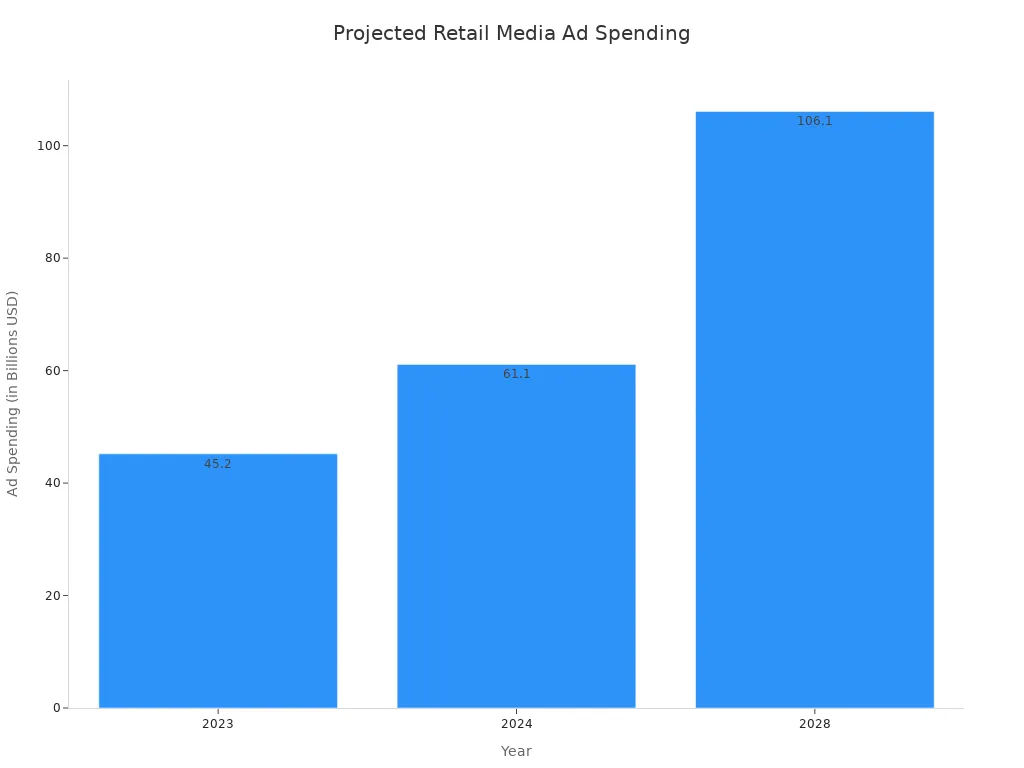
Beyond attracting first-time buyers, advertising helps you retain your existing base. You can use targeted ads to remind past purchasers of your value, announce new products, or offer exclusive loyalty discounts. This keeps your brand top-of-mind and encourages the repeat business that is vital for long-term stability. The financial impact is significant, with retail media spending projected to grow dramatically.
| Metric | 2023 | 2024 (Projected) | 2028 (Projected) |
|---|---|---|---|
| Retail Media Ad Spending | $45.2B | $61.1B | $106.1B |
| Average Return on Ad Spend | $4.50 | – | – |
It Builds Brand Awareness
Consistent advertising does more than just sell products; it builds your brand’s reputation and recall value over time.
Making Your Brand Recognizable
Repetition creates familiarity. When consumers repeatedly see your logo, brand colors, and messaging across different channels, your brand becomes memorable. Research confirms that advertising impressions from various ad types significantly drive growth in brand awareness, making your business a familiar and trusted option.
Establishing Your Store’s Identity
Your advertisements tell a story about your business. You communicate what your brand stands for through the visuals, tone, and offers you choose. Whether you want to be known for affordability, luxury, sustainability, or exceptional service, retail advertising helps you shape that public perception.
It Gives You a Competitive Edge
In a crowded marketplace, you cannot afford to be silent. Advertising allows you to control your narrative and stand out from competitors.
Standing Out in a Crowded Market
Your competitors are already advertising to win over your potential buyers. A smart retail advertising strategy ensures your voice is heard. It carves out your space in the market, preventing your business from being overshadowed.
Highlighting Your Unique Value
What makes your business better or different? Advertising is the perfect platform to showcase your unique selling propositions. You can highlight superior product quality, faster shipping, or a better in-store experience. For example, Best Buy’s comprehensive retail marketing strategy uses everything from SEO and paid ads to social media to connect with each customer and maintain its market leadership.
Pro Tip: Use your ads to answer the question, “Why should a shopper choose me?” Clearly communicating your unique benefits helps you win business and build a loyal following.
It Helps Manage Inventory
Effective advertising is also a powerful tool for inventory control. Beyond attracting customers and building your brand, you can use it to strategically manage the flow of products. This proactive approach helps you maintain healthy stock levels, optimize cash flow, and keep your product offerings fresh and relevant. A smart retail advertising strategy ensures you are not just selling, but selling the right products at the right time.
Promoting Seasonal Items
Your business can use strategic retail advertising to create demand for time-sensitive products. Many retail goods have a limited sales window, and failing to sell them during their peak season can result in significant losses. Advertising builds excitement and urgency, prompting customers to buy before the opportunity is gone.
Consider items with a clear expiration date on their relevance:
- Holiday decorations and themed gifts
- Back-to-school supplies and backpacks
- Summer apparel like swimwear and sandals
- Winter gear such as coats and snow boots
You can run targeted campaigns highlighting these items just before and during their peak season. This ensures you capitalize on natural consumer demand and avoid having a storeroom full of unsold Christmas sweaters in February.
Clearing Out Old Stock
Eventually, every retailer faces the challenge of outdated or slow-moving inventory. This “dead stock” ties up capital and occupies valuable space that could be used for new, more profitable products. This is where targeted campaigns become essential for liquidation. You can turn these items into cash instead of letting them gather dust.
Note: Frame your clearance events positively. Instead of saying “Help us clear old inventory,” use exciting language like “Last Chance Sale!” or “Making Room for New Arrivals!” This creates shopper enthusiasm rather than making products seem undesirable.
A well-planned retail advertising campaign turns potential losses into recovered revenue. Use tactics like flash sales, bundle deals, or deep discounts promoted through email and social media to quickly move end-of-life products. This clears the way for your next wave of inventory and injects cash back into your business.
The Main Types of Retail Advertising
Choosing the right channels is essential for your success. Your options for retail advertising generally fall into three main categories: traditional methods, digital platforms, and the rapidly growing field of retail media advertising. Each category offers unique ways to reach your target audience.
Traditional Advertising Methods
These are the classic, offline methods that have been staples of retail for decades. While digital channels get a lot of attention, traditional advertising can still deliver significant returns with predictable costs.
In-Store Advertising
You can use in-store advertising to influence customers at the point of purchase. This includes everything from window displays and banners to end-cap promotions and digital screens.
Print Advertising
Print involves placing ads in physical publications. You can reach local audiences through newspapers and flyers or target specific interests with magazine ads.
Broadcast Advertising
This category includes television and radio commercials. Broadcast ads reach a broad audience, but it is often difficult to connect a specific ad directly to a sale. Measuring a clear return on investment (ROI) can be a challenge.
| Metric | Traditional Campaigns (2023) |
|---|---|
| Estimated ROI | 1.4x |
| New Customer Acquisition Cost | $68 |
| Measurable Conversions | Limited |
| Campaign Adjustments | None (static) |
Direct Mail
Direct mail sends physical promotional materials to potential customers’ mailboxes. You can use postcards, catalogs, and letters to announce sales or send special offers directly to households in a targeted area.
Digital Advertising Methods
The landscape of digital retail advertising is vast, effective, and projected to account for over 75% of global ad spend by 2025. These methods offer precise targeting and detailed performance metrics.
Social Media Advertising
Platforms like Facebook and Instagram allow you to reach customers with visually engaging ads. You can target users based on demographics, interests, and past behaviors, making it ideal for building brand awareness and driving traffic.
Search Engine Marketing (SEM)
SEM places your ads on search engines like Google. You can capture high-intent customers who are actively searching for products you sell. Automated tools like Google’s Performance Max (PMAX) now help optimize these campaigns, capturing a significant portion of ad spend.
Email Marketing
Email is a direct line to your most engaged customers. You can use it to nurture leads, announce new products, and encourage repeat purchases with exclusive discounts, making it a highly effective retention tool.
The Rise of Retail Media Advertising
One of the most important key trends in retail advertising is the explosion of retail media advertising. This involves brands paying to advertise on a retailer’s own digital platforms.
What Are Retail Media Networks?
A retail media network (RMN) is a platform where a retailer sells ad space on its own website, app, or other digital assets. This form of retail media advertising is booming, with forecasts projecting a compound annual growth rate (CAGR) of over 10% through 2030. The future of retail media advertising is strong, as it allows brands to reach shoppers at the digital point of sale. This powerful approach to retail advertising is reshaping marketing budgets.
Advertising on E-commerce Sites
This is where retail media advertising becomes tangible. You can advertise on major e-commerce sites like Amazon, Walmart, and Target. Brands use these retail advertising techniques to place sponsored products directly in front of purchase-ready audiences. This powerful retail media advertising strategy leverages the retailer’s first-party data for precise targeting. The effectiveness of retail media advertising on these platforms is clear, with Amazon alone seeing a 25% year-over-year growth in ad impressions. As a core part of modern retail advertising, this channel is essential. Understanding retail media advertising is crucial for competitive growth.
How to Build Your First Retail Advertising Strategy
A successful retail advertising campaign doesn’t happen by accident. It is the result of a deliberate and well-researched marketing strategy. Before you launch your first ad, you must lay the groundwork by understanding who you are talking to, what you want to achieve, and where you will deliver your message. This foundational work ensures your efforts are focused, efficient, and effective.
Step 1: Define Your Target Audience
You cannot sell to everyone. The first and most critical step in any retail advertising plan is to identify your ideal customer. Knowing your audience allows you to tailor your messaging, offers, and channel selection to resonate with the people most likely to buy from you.
Who Are You Selling To?
To connect with your audience, you must first understand them on a deeper level. You can start by analyzing your existing customer base and conducting market research. This process involves segmentation, which groups potential buyers based on shared characteristics.
Key methods for defining your audience include:
- Demographic Segmentation: This classifies people by objective data like age, gender, income, and occupation. You can find this data in public resources like the Bureau of Labor Statistics.
- Geographic Segmentation: This defines your market by location, such as city, state, or even neighborhood. It helps you focus your efforts on a specific service area.
- Psychographic Segmentation: This looks at your audience’s lifestyle, values, and interests. It helps you understand their motivations and what they care about.
- Behavioral Segmentation: This examines actual purchasing habits, including brand loyalty, how often they buy, and the benefits they seek from a product.
Pro Tip: Create a detailed buyer persona. Give your ideal customer a name, a job, and a story. For example, you might create ‘Fran First-Time Runner’ to represent a segment of your audience. This makes it easier to imagine you are speaking to a real person.
What Do They Care About?
Once you know who your audience is, you need to figure out what matters to them. This insight is crucial for crafting a message that grabs their attention. You can uncover these details by using a few key techniques.
- Conduct Surveys: Ask your best customers directly about their preferences and pain points.
- Use Social Listening: Monitor conversations on social media to see what topics and brands your audience engages with.
- Analyze Competitors: Look at who your competitors are targeting. Their strategy can reveal valuable information about your shared audience.
By understanding their needs and values, you can position your products as the perfect solution. This customer-centric approach is the cornerstone of effective retail marketing.
Step 2: Set Clear and Simple Goals
After defining your audience, your next step is to decide what you want your retail advertising to accomplish. Vague goals like “increase sales” are not helpful. You need specific, measurable objectives to guide your strategy and evaluate your success.
What Do You Want to Achieve?
Your advertising goals should align directly with your broader business objectives. Are you trying to build brand awareness for a new store, drive foot traffic for a seasonal sale, or increase online conversions? Each goal requires a different approach.
The RACE Framework helps structure goals across the customer journey:
- Reach: Increase brand awareness and website traffic.
- Act: Encourage on-site engagement and lead generation.
- Convert: Drive sales and revenue growth.
- Engage: Build customer loyalty and advocacy.
Choosing a primary goal helps you focus your resources and messaging for maximum impact.
Making Your Goals Measurable
The best way to set actionable goals is to use the SMART framework. This ensures your objectives are well-defined and trackable.
| SMART Criteria | Description | Example |
|---|---|---|
| Specific | Your goal should be clear and detailed. | Increase online sales for our new summer sandal collection. |
| Measurable | You must be able to track progress with data. | Achieve a 15% increase in revenue from the sandal category. |
| Actionable | The goal should lead to a tangible improvement. | The revenue increase will improve overall profitability. |
| Relevant | The goal must align with your business strategy. | This supports our objective to grow our apparel and accessories line. |
| Time-bound | Set a clear deadline for achieving the goal. | Accomplish this within the next 90 days (by the end of Q3). |
Using this framework transforms a vague wish into a concrete plan. A goal like, “Increase online sales for our summer sandal collection by 15% by the end of Q3,” gives you a clear target to aim for and a benchmark to measure your success.
Step 3: Choose the Right Advertising Channels
With your audience and goals defined, it is time to decide where to run your ads. The best channels are the ones where your target audience spends their time and that align with what you want to achieve. Don’t try to be everywhere at once; instead, select one or two channels to start.
Where Does Your Audience Spend Time?
Your audience research from Step 1 is your guide here. If you are targeting young adults, social media platforms like Instagram or TikTok are likely a good bet. If your audience consists of professionals, LinkedIn or email marketing might be more effective.
Note: Think about the context. A person scrolling through social media is in a different mindset than someone actively searching on Google for a product. Your ad should fit the platform and the user’s intent.
Matching Channels to Your Goals
Different channels are better suited for different objectives. Your choice should directly support the goal you set in Step 2.
- For Brand Awareness: To reach a broad audience and make your brand recognizable, consider channels like social media marketing, display advertising on websites, or video ads on YouTube. These platforms are excellent for getting your name and message in front of many people.
- For Direct Sales: To drive immediate purchases or generate leads, focus on channels where user intent is high. Search engine advertising (like Google Ads) is perfect for this, as you are reaching a customer who is already looking for what you sell. Email marketing and targeted social media ads with clear calls-to-action are also highly effective for conversions.
By carefully selecting your channels, you ensure your retail advertising budget is spent efficiently, reaching the right people in the right place with the right message.
Step 4: Craft a Compelling Message
Your message is the heart of your retail advertising. It is what grabs attention, builds interest, and persuades a potential customer to consider your offer. A powerful message goes beyond simply describing your product; it connects with the audience’s needs and desires, making your brand the clear choice.
What Is Your Unique Selling Proposition?
Your Unique Selling Proposition (USP) is the one thing that makes your business better than the competition. It is the core reason a customer should choose you. To find your USP, you need to answer the question: “What do I offer that no one else does?” This could be related to your product, your price, your service, or your brand experience.
A strong USP is specific, memorable, and defensible. Look at how famous brands have defined themselves:
| Company | Unique Selling Proposition (USP) |
|---|---|
| M&Ms | “Melts in your mouth, not in your hand.” |
| FedEx | “When it absolutely, positively has to be there overnight.” |
| Warby Parker | Offers a virtual try-on and ships 5 frames home for free. |
| Hiut Denim Co. | “We make jeans…nothing else.” |
To develop your own USP, analyze your strengths. Do you offer the fastest delivery like Drizly? Do you focus on a single product with exceptional quality like Hiut Denim Co.? Your USP becomes the foundation of your marketing strategy and the central theme of your ad copy.
Focusing on Benefits Over Features
Customers do not buy features; they buy the benefits those features provide. A feature is a factual statement about your product (e.g., “This jacket has a waterproof coating”). A benefit explains how that feature helps the customer (e.g., “Stay dry and comfortable in any downpour”). Your advertising message must translate features into compelling benefits.
You can use proven copywriting formulas to structure your message and ensure it focuses on benefits:
- Problem-Agitate-Solution (PAS): Identify a customer’s problem, explain why it is a bigger issue than they think, and present your product as the perfect solution.
- Attention-Interest-Desire-Action (AIDA): Grab their attention with a bold headline, build interest with intriguing details, create desire by showing the benefits, and then call them to action.
- The Four C’s: Ensure your message is Clear, Concise, Compelling, and Credible. This framework helps you get straight to the point while building trust.
By focusing on the “what’s in it for me” for the customer, your retail advertising becomes far more persuasive.
Step 5: Create a Strong Call-to-Action (CTA)
After you have captured a customer’s interest with a compelling message, you must tell them exactly what to do next. A Call-to-Action (CTA) is an instruction designed to provoke an immediate response. Without a clear CTA, even the best ad will fail to produce results because customers will not know how to proceed.
Tell People What to Do Next
Your CTA should be a short, direct, and action-oriented phrase. It eliminates confusion and guides the user toward your goal, whether that is making a purchase, visiting your store, or signing up for a newsletter.
Pro Tip: Use action-packed verbs that create a sense of urgency and excitement. Instead of a passive word like “Submit,” use dynamic words like “Get,” “Shop,” “Claim,” or “Discover.”
The design of your CTA is just as important as the text. In digital ads, your CTA button should stand out with a contrasting color. While green and orange often perform well, you should test what color works best against your website’s design. The text on the button must also be large and easy to read.
Examples of Effective CTAs
The most effective CTAs are specific to the offer. They tell the user exactly what they will get when they click. Here are a few examples of strong CTAs for different goals:
- To Drive Sales:
Shop Now and Get 20% OffClaim Your Free SampleBuy One, Get One Free
- To Increase Engagement:
Discover Your Perfect StyleTake the QuizDownload Your Free Guide
- To Build Urgency:
Shop the Flash SaleGet It Before It's GoneLast Chance: Offer Ends Tonight!
A powerful CTA bridges the gap between interest and conversion. It is the final, crucial instruction in your ad that turns a passive viewer into an active customer.
Key Strategies for Effective Retail Advertising
Once you have a foundational strategy, you can implement specific tactics to drive results. These key strategies for effective retail advertising help you attract customers, build loyalty, and maximize your budget. You can use them individually or combine them for greater impact.
Promotional Advertising
Promotional advertising uses special offers to stimulate immediate sales. This approach is highly effective because it gives customers a compelling and time-sensitive reason to make a purchase.
Using Discounts and Sales
Discounts are a powerful tool for influencing consumer behavior. Offers like “Buy One, Get One Free” (BOGO) are particularly persuasive. Research shows that 93% of American consumers have used a BOGO deal, and 66% of shoppers prefer it over other discount types. You can use these promotions to move inventory quickly while making customers feel they are getting exceptional value. This form of retail advertising directly boosts sales and can even encourage shoppers to switch brands for a good deal.
Creating Urgency with Limited-Time Offers
Urgency motivates customers to act now rather than later. You can create this feeling with tactics like flash sales or offers that expire soon. Phrases like “Sale Ends Tonight!” or “Limited Stock Available” prompt an immediate response. This strategy taps into the customer’s fear of missing out (FOMO) and is excellent for clearing seasonal items or hitting short-term sales targets.
Local Advertising
Local advertising focuses your efforts on customers in your geographic vicinity. This is essential for brick-and-mortar stores and service-based businesses aiming to build a strong community presence.
Targeting Customers in Your Area
You can connect with your local community by addressing its specific needs and preferences. Simple, creative tactics often work best. For example, you can use a clever sidewalk sign to attract passersby or host a community event like a customer appreciation day. These actions build personal relationships and foster trust, turning neighbors into loyal patrons. This type of retail advertising strengthens your local footprint.
Using Geofencing and Local SEO
You can also use digital tools for precise local targeting.
- Geofencing: This technology allows you to send targeted ads to people’s mobile devices when they enter a specific geographic area, like the neighborhood around your store.
- Local SEO: Optimizing your online presence for local search helps customers find you when they search for terms like “coffee shop near me.”
Co-op Advertising
Cooperative (co-op) advertising is a partnership where a retailer and a manufacturer share the cost of an ad campaign. This strategy makes high-impact retail advertising more affordable.
What Is Cooperative Advertising?
In a co-op arrangement, a brand (like Dove) provides funds to a retailer (like Walmart) to help pay for ads that feature the brand’s products. It is a win-win: the brand gets increased exposure, and you get to run a larger campaign than your budget might otherwise allow.
Partnering with Brands to Share Costs
You can partner with the brands you sell to stretch your marketing dollars. For instance, Dove and Walmart collaborated on the “Real Beauty Campaign,” where ads featured women who bought products at Walmart. This partnership generated massive publicity for both companies. By sharing resources, you can access better ad placements and create more professional campaigns, driving significant growth for your business.
Omnichannel Advertising
Omnichannel advertising moves beyond a multi-channel approach to create a single, unified experience for your shoppers. This strategy places the customer at the very center of your marketing efforts. It ensures that every interaction, whether online or in-store, feels connected and consistent. Your goal is to make the transition between channels so smooth that the shopper barely notices it.
Creating a Seamless Customer Experience
A seamless experience is the hallmark of a successful omnichannel strategy. It means a shopper can browse a product on your Instagram, add it to their cart on your website, and receive a text message about it later without any friction. This consistency builds trust and loyalty. The results of this approach are powerful and directly impact your bottom line.
Brands with strong omnichannel engagement retain an average of 89% of their customers. This stands in stark contrast to the 33% retention rate for companies with weak strategies.
This cohesive journey makes shoppers feel understood and valued, which encourages them to stick with your brand. In fact, omnichannel shoppers have a 30% higher lifetime value compared to those who shop through a single channel. You are not just making a sale; you are building a long-term relationship that pays dividends.
Integrating Online and Offline Channels
True omnichannel success comes from breaking down the walls between your digital and physical worlds. You must make your online and offline channels work together as a team. This integration creates convenience and enhances the overall shopping journey.
Here are a few ways you can integrate your channels:
- Click-and-Collect: Allow shoppers to buy products online and pick them up in your physical store.
- In-Store Returns for Online Purchases: Offer the convenience of returning online orders at a brick-and-mortar location.
- Digital Ads for In-Store Events: Use targeted social media ads to promote a local workshop or sale at your physical store.
Fashion retailer NA-KD provides an excellent example of this strategy in action. The company implemented personalized omnichannel journeys across its website, app, and email notifications. This integrated retail advertising approach led to a remarkable 25% increase in customer lifetime value. By connecting every touchpoint, you create a powerful and cohesive brand experience that drives both sales and loyalty.
Real-World Examples of Effective Retail Advertising

Theory is important, but seeing strategies in action makes them easier to understand. You can learn from how different types of businesses—from small local shops to large national chains—use advertising to achieve their goals. These examples show how a clear strategy and focused execution lead to real results.
Example 1: A Local Coffee Shop
Strategy: Local Social Media Ads
A local coffee shop’s primary goal is to drive foot traffic. You can use local social media ads to reach potential customers who live or work nearby. This approach is cost-effective and highly targeted.
Execution: A Facebook Ad for a BOGO Deal
You can create a simple campaign on Facebook targeting users within a two-mile radius of your shop. The ad itself can feature an attractive image of two lattes with a clear headline: “Buy One, Get One Free This Week!” The ad copy invites people to bring a friend, and the call-to-action is a “Get Directions” button that opens a map to your location. This tactic directly encourages local residents to make an immediate visit.
Example 2: An Online Clothing Boutique
Strategy: Retargeting with Email
For an online store, recovering potentially lost sales is a top priority. You can use email retargeting to re-engage shoppers who have shown interest but did not complete a purchase.
Execution: An Abandoned Cart Discount Email
You can set up an automated email that triggers a few hours after a shopper abandons their cart. This email reminds them of the items they left behind and includes a small, time-sensitive discount to encourage them to finish the purchase. One online boutique, Bloom Living Co., used this exact strategy with great success.
- They used dynamic retargeting to show shoppers the specific products they had considered.
- They targeted cart abandoners with exclusive offers like discounts and free shipping.
- This approach, combined with other targeted ads, helped them increase online sales by 78%.
Example 3: A National Supermarket Chain
Strategy: In-Store and Print Ads
Large supermarkets need to drive high-volume sales across many categories. A classic and effective retail advertising strategy is to combine mass-reach print ads (like weekly circulars) with strategic in-store merchandising.
Execution: A Weekly Circular and End-Cap Display
You can feature your best deals in a weekly circular, which many chains now deliver digitally. Then, you can support those advertised specials in the physical store. For example, if soda is on sale, you create a massive display on an end-cap in a high-traffic aisle. This synergy between the ad and the in-store experience makes it easy for customers to find deals. This data-driven merchandising is proven to work.
Case Study: By optimizing product placements and using promotional displays for seasonal items, some grocery chains have seen sales for those products increase by as much as 30%.
How to Measure the Success of Your Campaigns
You cannot improve what you do not measure. Tracking the performance of your retail advertising campaigns is essential for understanding what works and what does not. This data allows you to refine your strategy, optimize your budget, and maximize your return on investment.
Key Metrics for Physical Stores
For brick-and-mortar locations, success is often measured by how your ads impact in-person behavior.
Foot Traffic
This metric counts the number of people who enter your store. You can measure an increase in foot traffic during a campaign to see if your ads are successfully driving visits.
Sales Lift
Sales lift measures the increase in sales of an advertised product compared to a baseline period. It directly shows how much revenue your ad generated.
Coupon Redemption Rate
This is the percentage of distributed coupons that customers actually use. It is a clear indicator of how compelling your offer was to your target audience.
Key Metrics for Online Stores
Digital campaigns provide a wealth of data. You can track these key metrics to gauge online performance.
Click-Through Rate (CTR)
CTR is the percentage of people who click your ad after seeing it. It helps you understand how well your ad creative and messaging capture attention.
Note: A “good” CTR varies by campaign type. Brand awareness ads have lower CTRs, while highly targeted ads perform better.
Campaign Type Average CTR General eCommerce Display Ads 0.51% Dynamic Product Remarketing 0.2-0.5%+
Conversion Rate
The conversion rate is the percentage of users who complete a desired action, such as making a purchase. This is a critical metric for measuring an ad’s effectiveness at driving sales.
| Industry Sector | Average Conversion Rate |
|---|---|
| Food & Beverage | 4.9% |
| Home & Furniture | 1.4% |
Return on Ad Spend (ROAS)
ROAS measures the total revenue generated for every dollar spent on advertising. It is the ultimate measure of your campaign’s profitability.
The Importance of A/B Testing
A/B testing, or split testing, is the process of comparing two versions of an ad to see which one performs better. It is a powerful tool for data-driven optimization.
Why You Should Test Your Ads
You should test your ads to eliminate guesswork. It allows you to make informed decisions based on real customer behavior. You can test various elements to improve performance, including:
- Headline or Subject Line
- Ad Copy and Content
- Images or Videos
- Call-to-Action (CTA) Button
Starting Small and Scaling What Works
A successful A/B test follows a clear process. You should only change one variable at a time to get accurate results.
- Choose one variable to test, like your CTA button text.
- Create two versions of the ad (A and B), keeping all other elements the same.
- Show each version to a different segment of your audience.
- Analyze the data to see which version achieved a higher conversion rate.
- Implement the winner in your main campaign and start a new test.
This iterative process helps you continuously improve your campaigns and achieve better results over time.
Retail advertising is your direct line to customers, designed to bring them in and encourage a sale. You can launch your first campaign by following a few simple steps.
Your Starting Checklist 📝
- First, understand your target audience.
- Next, craft a clear and compelling message.
- Finally, pick one or two channels to test.
You do not need a massive budget to begin. Successful retail advertising comes from starting small, measuring your results, and learning what works best for your unique business.
FAQ
How much should I spend on retail advertising?
You do not need a large budget to start. Many businesses allocate 5-10% of their revenue to marketing. You can begin with a small, testable budget for one channel, measure the results, and then adjust your spending based on what works for your business.
Which advertising channel is best for my business?
The best channel depends on your audience and goals. You should choose platforms where your target customers spend their time. For example, use local search ads for a physical store or social media ads for an online boutique targeting younger shoppers.
How long does it take to see results from advertising?
Results vary by channel and goal. You might see immediate traffic from a search ad campaign. Brand awareness, however, takes longer to build. You should track your key metrics from the start to monitor progress and understand your campaign’s impact over time.
What is the difference between marketing and advertising?
Marketing is the overall strategy of promoting your business. It includes research, branding, and customer relations. Advertising is a specific component of marketing. It involves paying to place promotional messages on different channels to reach your audience and drive sales.
Can I do retail advertising myself?
Yes, you can manage your own advertising, especially when starting. Digital platforms like Facebook Ads and Google Ads offer user-friendly tools. You should start small, learn the basics, and focus on one or two channels before expanding your efforts.
What is the most common mistake in retail advertising?
The most common mistake is not defining a target audience. Vague advertising that tries to appeal to everyone often connects with no one. You must clearly identify who you are selling to. This ensures your message and budget are used effectively.