

You gain a competitive edge when you use digital price tags that wirelessly sync with your central inventory system. More than 68% of large retailers now rely on electronic shelf price tags and electronic shelf labels, which automate updates and reduce manual errors by 58%. With ESL Gateway AP and ESL Price Tag solutions, you see current inventory quantities right on the shelf. Esl Retail platforms ensure real-time display accuracy, helping you avoid pricing discrepancies and streamline your store operations.
Digital Price Tags and Real-Time Inventory Management
Integration with Inventory Management Systems
Connecting Digital Price Tags to Central Databases
You need a seamless connection between your digital price tags and your central databases to achieve accurate inventory management. Start by assessing your current infrastructure. Not every system supports the same integration protocols, so you must verify compatibility and API availability. Many retailers map their existing workflows to identify integration points and gaps. API-led approaches and middleware solutions help bridge communication between digital price tags, point-of-sale (POS) systems, and inventory management platforms—even if you use legacy software.
Tip: Establishing strong vendor partnerships ensures smooth integration and ongoing support for your electronic shelf price tags.
Technical challenges can arise during this process:
- Compatibility issues may occur if your digital price tags do not support the same data formats as your inventory system.
- Reliable wireless networks are essential. You need stable connections with low latency to avoid delayed or inaccurate updates.
- Data consistency matters. Automated validation rules and regular audits help prevent pricing errors on your electronic shelf price tags.
- Security is critical. Use end-to-end encryption, multi-factor authentication, and secure database connections to protect your data.
Retailers often conduct pilot testing and phased rollouts to manage risks and gather feedback before full deployment. This approach helps you identify and resolve issues early, ensuring your electronic shelf price tags display accurate information from day one.
Automatic Data Synchronization for Inventory Updates
Once you connect your digital price tags to your central database, you can automate data synchronization for inventory updates. Automation reduces manual work and ensures your shelf labels always reflect the latest stock levels. AI-powered digital price tags can link directly to your inventory database, providing real-time stock updates, dynamic pricing, and restocking alerts. This reduces both overstock and stockouts.
You should automate repetitive integration tasks and monitor system performance regularly. Centralized data management, encrypted communication, and multi-factor authentication keep your data secure and synchronized. When you use electronic shelf price tags, you eliminate manual price updates and reduce human error. Businesses report a 90% reduction in pricing errors, which leads to fewer checkout disputes and improved customer trust.
Communication with POS Systems
Real-Time Sales Tracking and Inventory Adjustments
Digital price tags communicate directly with your POS systems to track sales and adjust inventory in real time. When a customer makes a purchase, the POS system instantly updates the inventory database. Your digital price tags then display the new stock level on the shelf. This process ensures that your inventory information remains accurate throughout the day.
- Wireless technologies such as Wi-Fi, Bluetooth, Zigbee, or RFID enable instant stock updates and automated alerts.
- Integration with POS and e-commerce platforms provides unified inventory data, supporting dynamic pricing and faster replenishment.
- Retailers report that inventory accuracy improves from about 65% with manual methods to over 98% after implementing digital price tags.
You should test integration by verifying transaction and inventory synchronization. Regularly monitor system performance and address issues promptly to maintain accuracy.
Instant Updates on Electronic Shelf Price Tags
With digital price tags, you can provide instant updates on your electronic shelf price tags. When your POS system records a sale, the change reflects immediately on the shelf label. This eliminates the need for manual price tag replacement and ensures that customers always see the correct price and stock information.
- Centralized systems automate price updates across thousands of items within minutes.
- Price discrepancies between shelf tags and POS are minimized, reducing customer frustration.
- Your staff can focus more on inventory management instead of manual price tag changes.
Note: Real-time updates on electronic shelf price tags help you respond quickly to demand, promotions, and restocking needs.
By integrating digital price tags with your POS and inventory management systems, you create a seamless, automated environment. This approach improves operational efficiency, reduces errors, and ensures that your customers always have access to accurate, up-to-date information.
Types of Inventory Information Displayed by Digital Price Tags
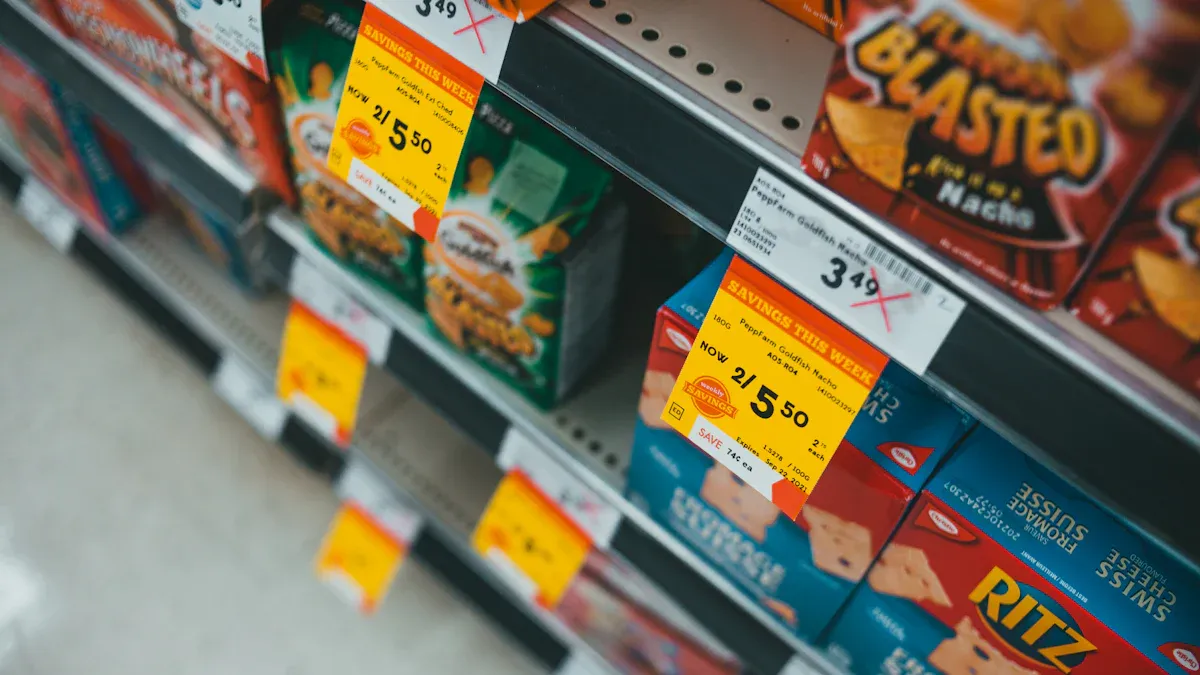
Digital price tags have transformed how you manage and communicate inventory information in retail environments. These devices do more than just show prices—they provide real-time data that supports both staff and customers.
Stock Levels and Quantity on Hand
Displaying Current Inventory Quantities
You can display stock levels directly on electronic shelf price tags, giving customers instant insight into product availability. This feature reduces the need for staff to check inventory manually and helps customers make informed decisions. Electronic shelf labels often show the exact quantity available, including items in the backroom.
- You see real-time updates on the number of items left.
- Customers can view available sizes or variants right on the tag.
- Staff save time by relying on accurate, automated data.
With this visibility, you prevent out-of-stock surprises and streamline the shopping experience.
Out-of-Stock Notifications on Electronic Shelf Price Tags
When a product runs out, electronic shelf price tags immediately display an out-of-stock notification. This automated alert helps you avoid customer frustration and enables staff to respond quickly.
- Tags can show a message such as “Out of Stock” or “Check Online.”
- Some systems display QR codes, allowing customers to order unavailable items online.
- Staff receive automated inventory alerts for restocking.
Low-Stock Alerts and Visual Indicators
Staff-Facing Alerts for Replenishment
You benefit from automated inventory alerts that notify staff when stock is low. Electronic shelf labels can use visual cues, such as blinking LEDs or special icons, to signal the need for replenishment.
- Staff see clear indicators during stocking hours.
- These alerts help prioritize restocking tasks and reduce missed sales.
Customer-Facing Warnings for Low Inventory
Customers also receive warnings when inventory is running low. Electronic shelf price tags can display messages like “Only 2 Left!” or highlight the tag in a different color.
- Shoppers know when supply is limited, encouraging timely purchases.
- This transparency builds trust and improves satisfaction.
Product Availability and Status
In-Store vs. Online Inventory Display
You can display both in-store and online inventory status on digital price tags. This integration ensures customers know if a product is available locally or only through your website.
- Tags may show “Available Online” or “In-Store Only.”
- QR codes or NFC features let customers access more details or place online orders.
Back-in-Stock and Restock Updates
When products return to stock, electronic shelf price tags update instantly. Staff and customers see restock notifications, reducing confusion and missed opportunities.
- Real-time updates keep everyone informed.
- Automated messages eliminate manual communication and speed up response times.
Digital price tags, especially electronic shelf price tags, provide a comprehensive solution to display stock levels, product status, and automated inventory alerts. You gain operational efficiency and deliver a better customer experience by leveraging these advanced features.
Technology Behind Electronic Shelf Price Tags
Wireless Communication Methods for Digital Price Tags
Radio Frequency (RF) Systems in Inventory Management
You rely on robust wireless communication to keep digital price tags functioning smoothly in your store. RF (Radio Frequency) systems have become a standard for large-scale deployments. These systems offer broad coverage and support thousands of tags per base station, making them ideal for supermarkets and hypermarkets. RF technology balances communication distance and data speed, which helps you maintain reliable connections across wide retail spaces. However, you may encounter interference in environments with many electronic devices, so careful network design is essential.
Wi-Fi and Bluetooth Integration for Real-Time Updates
Modern retail environments often use Wi-Fi and Bluetooth Low Energy (BLE) to enhance the performance of digital price tags. BLE stands out for its low power consumption, long communication range, and strong security features. You benefit from stable connections and the ability to upgrade firmware remotely. BLE5.0, for example, provides long battery life—up to five years—and excellent anti-interference, which is crucial in busy stores. Wi-Fi enables seamless integration with your existing infrastructure and supports remote management and analytics, though it may consume more power than RF or BLE.
Tip: Use a combination of gateways, repeaters, and mesh networking to boost reliability and coverage in high-traffic areas.
| Wireless Technology | Usage Context | Key Advantages | Typical Retail Environment |
|---|---|---|---|
| RF (Radio Frequency) | Large-scale deployments | Reliable, cost-effective, broad coverage | Supermarkets, hypermarkets |
| BLE (Bluetooth Low Energy) | Real-time tracking, data sync | Low power, long range, strong security | High-traffic, IoT-enabled stores |
| Wi-Fi | Robust infrastructure | Seamless integration, analytics | Modern retail, malls |
Central Management Software for Inventory Control
Cloud-Based Platforms for Digital Price Tags
You manage digital price tags efficiently with central management software, often hosted on cloud-based platforms. This software lets you update pricing and product information instantly across all your stores, eliminating manual changes. Automated price adjustments keep shelf prices consistent with your POS system, reducing errors. You can implement dynamic pricing strategies, respond quickly to market changes, and push promotions directly to the shelf. Analytics dashboards give you insights into product performance and customer interactions, helping you optimize inventory management.
- Centralized control ensures uniform updates for every digital price tag.
- Wireless transmission (Wi-Fi, BLE, RF) enables instant, disruption-free price changes.
- Integration with POS and inventory systems guarantees synchronization between shelf and checkout.
- Middleware solutions prevent data lag and maintain pricing accuracy.
- AI-powered features adjust prices based on demand and stock, improving turnover.
Data Security and Reliability in Inventory Management
You must prioritize security and reliability when using cloud-based platforms for digital price tags. Data encryption protects information both in transit and at rest. Secure user authentication and access controls prevent unauthorized access. Regular security updates and compliance with regulations like GDPR or CCPA help you avoid legal penalties and build customer trust. High uptime guarantees and low latency ensure your system remains reliable, even during peak hours. Scalability allows you to expand without sacrificing performance.
- Multi-factor authentication and access controls safeguard your system.
- Encryption keeps sensitive data secure.
- Compliance with industry standards maintains trust and legal adherence.
- Continuous monitoring and proactive defenses reduce risks from cyber threats.
Note: Strong security and reliable performance are essential for maintaining customer confidence and supporting your digital transformation.
Operational Benefits of Digital Price Tags for Retailers
Reduced Labor and Automated Inventory Management
Automated Price and Inventory Changes
You gain significant labor savings when you implement digital price tags. Automation allows you to update prices and inventory information across your entire store network almost instantly. Instead of spending days on manual price changes, you can complete the process in minutes. This shift frees your staff from repetitive tasks and lets them focus on customer service and inventory management.
| Retailer / Example | Labor Time Saved / Impact | Additional Details |
|---|---|---|
| Naifeh’s Cash Saver | 50 labor hours saved weekly | Price changes reduced from days to minutes |
| Maurer’s Market | 80% labor time saved | Price update time cut from 4 days to 10 minutes |
| Houchens Food Group | Scaled labor and cost efficiencies | Payback period ~3.5 years |
| Electronics Retailers | Up to 95% labor savings reported | Rapid price updates, dynamic pricing benefits |
You see labor cost reductions of up to 80% related to manual price updates. Automation also supports inventory automation, which further streamlines your operations.
Less Time Spent on Manual Stock Checks
Digital price tags reduce the time your staff spends on manual stock checks. Automation eliminates the need for employees to walk the aisles and update paper labels. Staff can now rely on real-time data from electronic shelf labels, which display current inventory levels and status. This efficiency allows your team to focus on higher-value tasks, such as assisting customers and managing inventory flow.
Automation frees your staff from repetitive manual work, improving morale and productivity.
Improved Accuracy and Fewer Errors
Elimination of Outdated Shelf Labels
You eliminate outdated shelf labels and the errors that come with them. Digital price tags synchronize prices and inventory information across all shelves and checkout points. This real-time synchronization prevents mismatches and ensures that customers always see accurate information.
- Automation of price updates removes the need for manual tag changes.
- Real-time updates ensure consistent and accurate pricing.
- Employees no longer interpret handwritten notes, minimizing mistakes.
Consistent Inventory Information Across Channels
You maintain consistent inventory information across all sales channels. Digital price tags and electronic shelf labels integrate with your POS and inventory systems, supporting compliance and uniform pricing policies. Centralized control allows you to manage product data, pricing, and promotions from one platform.
- Prices synchronize instantly during sales or promotions.
- Automation reduces labor costs and supports improved pricing accuracy.
- Real-time price updates increase customer trust and sales opportunities.
Enhanced Efficiency in Store Operations
Faster Response to Inventory Changes
You respond to inventory changes much faster with digital price tags. The system enables rapid price adjustments and instant updates, even during peak hours. Retailers like Leroy Merlin have managed over 50,000 SKUs more efficiently, reducing labor costs and improving price management. Staff can quickly locate products and guide customers, enhancing service quality.
Streamlined Replenishment with Stock-to-Light Features
Features like ‘Stock to Light’ and ‘Pick to Light’ help your employees identify shelf locations and fulfill online orders with greater accuracy. These tools reduce manual labor and errors associated with traditional paper labels. Digital price tags, integrated with RFID technology, boost inventory accuracy to over 99.9%. You streamline inventory tracking and reduce errors, leading to improved operational efficiency.
Digital price tags transform your store operations by automating routine tasks, reducing errors, and enabling your staff to deliver better service.
Customer Experience Improvements with Digital Price Tags
Accurate Product Availability Information
Confidence in Real-Time Stock Data
You want to trust the information you see while shopping. Digital price tags help you do that by providing real-time updates on product availability. When you walk down an aisle, you see accurate inventory levels and stock status right on the shelf. This transparency comes from direct integration with inventory systems and supply chain communication.
- You receive instant alerts if an item is out of stock.
- Expected restock times appear on the electronic shelf price tags, so you know when to return.
- Technologies like NFC and QR codes let you access live updates and extra product details with your smartphone.
These features give you confidence that the information you see is current. You can make informed decisions without searching for staff or guessing about product availability.
Reduced Frustration from Out-of-Stock Items
Nothing frustrates you more than searching for a product, only to find it missing from the shelf. Digital price tags reduce this problem by showing up-to-date inventory and out-of-stock notifications. When a product runs out, the electronic shelf price tags immediately display a message or a QR code for online ordering.
- You avoid wasted trips and disappointment.
- You see clear information about when products will be back in stock.
- You can check alternative options or order online with a quick scan.
This approach minimizes confusion and helps you plan your shopping more efficiently.
Transparent Shopping Experience
Easy Access to Inventory and Pricing Information
You expect clear and accurate information when you shop. Digital price tags make this possible by displaying real-time pricing, promotions, and product details directly on the shelf. You no longer need to worry about price mismatches at checkout or outdated labels.
- You see nutritional facts, sourcing details, and allergy warnings at a glance.
- Interactive features like QR codes and NFC allow you to compare products, read reviews, and find special offers.
- Staff spend less time updating prices and more time helping you with product recommendations.
This easy access to information empowers you to make better choices and enjoy a smoother shopping experience.
Enhanced Trust Through Up-to-Date Electronic Shelf Price Tags
Trust grows when you know the information in front of you is accurate. Electronic shelf price tags ensure that prices and inventory data stay synchronized with the store’s systems. You see consistent pricing across all channels, which eliminates confusion at checkout.
- Real-time updates reflect promotions and markdowns instantly.
- You experience fewer pricing errors and misunderstandings.
- Transparent and consistent information builds your confidence in the store.
Digital price tags and electronic shelf price tags transform your shopping journey by providing reliable, up-to-date information and a transparent environment. You benefit from greater convenience, less frustration, and a higher level of trust every time you visit the store.
Implementation Considerations for Digital Price Tags
Integration with Existing Inventory Management Systems
Compatibility with Current Retail Software
You need to ensure that your digital price tags work seamlessly with your current retail software. Start by checking if your system supports wireless communication protocols like 2.4GHz, Bluetooth, or Wi-Fi. These protocols enable fast and reliable data transmission between your inventory management system and the shelf labels. Select digital price tags that integrate with your Warehouse Management System (WMS) and other infrastructure. This integration keeps your inventory data synchronized in real time. Durability also matters. Choose tags that withstand temperature changes and frequent handling. Long battery life reduces maintenance and keeps your operations running smoothly. Scalability is important as well. Pick solutions that allow you to add more tags and features as your business grows.
Data Migration and Initial Setup
Migrating your existing inventory data to a new system requires careful planning. You should conduct pilot programs and sample testing before a full rollout. This approach helps you identify and resolve issues early. Assess your warehouse layout to optimize the placement of digital price tags. Dynamic slotting and optimized storage can maximize the benefits of your new system. Security is essential. Use encrypted communication and follow industry standards to protect sensitive inventory data during migration and setup.
Staff Training and Change Management
Onboarding Employees to Digital Price Tag Systems
Effective staff training ensures a smooth transition to digital price tags. You can use tailored learning paths that adapt to different experience levels. Microlearning modules break down complex tasks into manageable segments. Real-world demonstrations, such as videos of staff using the system, help employees understand new processes. Mobile-friendly resources let your team access support while on the sales floor. Scenario-based training, including role-playing, prepares staff for real customer interactions.
Ongoing Support and Troubleshooting
Continuous learning keeps your team confident and productive. Offer regular workshops and refresher courses to maintain competence. Establish a buddy system by pairing new hires with experienced mentors. Schedule regular check-ins to address questions and provide feedback. Make training materials easily accessible through apps or platforms your staff already use. This approach ensures ongoing support and quick troubleshooting when issues arise.
Tip: Set clear goals for the first 30, 60, and 90 days to guide employee development and build confidence in using digital price tags.
Cost and Return on Investment Analysis
Upfront Investment in Electronic Shelf Price Tags
You should understand the costs involved before implementing digital price tags. Here is a typical cost breakdown for a medium-sized retail store:
| Cost Component | Estimated Cost Range / Value |
|---|---|
| Price per Electronic Shelf Label | $5 to $10 per label |
| Gateways (for ~1,000 sqm retail) | Around $1,200 total (3-4 gateways) |
| Software Maintenance Fee | Approximately $500 annually |
| Installation and Setup | Labor and training costs (variable) |
| Total Upfront Cost (10,000 tags) | $60,000 to $100,000 |
| Annual Support Fees | $1,000 to $3,000 annually |
Battery replacement is rare, usually every 5-7 years, which keeps ongoing hardware costs low. Integration with POS systems may add extra costs, depending on complexity.
Long-Term Savings and Efficiency Gains
You measure return on investment (ROI) by comparing net profit gains against your total investment. Calculate all costs, including purchase, setup, training, and maintenance. Then estimate benefits such as increased sales, improved efficiency, and reduced labor costs. Digital price tags can reduce manual price update time by up to 80-90%, leading to a payback period of 1 to 3 years. Enhanced customer experience and improved brand reputation also contribute to ROI. Use ROI estimation tools to quantify operational gains and cost savings. Regular audits and feedback help you optimize your investment over time.
Note: Focus on quick wins like inventory management improvements and pricing optimization to maximize your ROI.
Future Trends in Digital Price Tags and Inventory Management
Advanced Analytics and AI Integration
Predictive Inventory Management with Digital Price Tags
You will see digital price tags evolve with advanced analytics and artificial intelligence. AI-enabled shelf sensors and electronic price tags now track inventory levels automatically and update prices based on demand, promotions, or stock changes. These systems notify your staff when restocking is needed, which reduces overstocking and waste. For perishable goods, AI can implement stock rotation strategies like FIFO, sending alerts to optimize turnover and minimize losses.
Modern digital price tags use dynamic pricing algorithms that adjust prices in real time. These algorithms consider inventory levels, competitor pricing, demand patterns, and even the time of day. For example, some retailers update prices every ten minutes using reinforcement learning and neural networks. You benefit from improved margins and fewer pricing errors.
- AI-driven fraud detection uses machine vision and anomaly detection to prevent theft and flag suspicious activity.
- Store layouts and workforce schedules improve through AI analysis of shopper behavior and foot traffic.
- Real-time inventory visibility lets you see product location, availability at nearby stores, and restock dates.
AI-powered ESLs help you automate weekly price updates, reduce labor costs, and predict out-of-stock situations before they happen.
Personalized Promotions Based on Real-Time Data
You can enhance the customer experience by offering personalized promotions through digital price tags. These systems integrate with customer devices using NFC or QR codes, providing tailored product information and digital coupons. AI analyzes shopping patterns and inventory data to deliver relevant offers directly at the shelf. This approach increases engagement and encourages timely purchases.
Interactive features allow you to display nutritional facts, allergy warnings, or special discounts. You can also use real-time analytics to optimize promotions and measure their effectiveness. As a result, you create a more agile and responsive retail environment.
Expansion to Omnichannel Retail Environments
Unified Inventory Management Across Online and In-Store Channels
You need to maintain price consistency and inventory accuracy across all sales channels. Digital price tags enable real-time, automated price updates and inventory synchronization for both online and in-store platforms. Integration with POS, ERP, and inventory systems allows you to adjust prices dynamically based on demand, stock levels, and promotions. This ensures customers always see the same price, whether shopping online or in person.
Centralized management systems give you wireless control over price updates, supporting seamless synchronization and operational efficiency. Real-time analytics from digital price tags help you optimize inventory management and pricing strategies by providing insights into customer behavior and inventory status.
- Retailers report significant labor cost savings and faster price update times due to automation.
- Security protocols like AES-128 encryption ensure safe and reliable data exchange.
Seamless Shopping Experience with Electronic Shelf Price Tags
You can create a seamless shopping journey by bridging online and offline experiences. Digital price tags display accurate, up-to-date pricing and promotional information, including interactive features like QR codes that connect to your e-commerce site. Customers can check product availability, compare prices, and access personalized offers instantly.
The rise of omnichannel retailing drives the demand for digital price tags that support real-time price adjustments and inventory tracking. You also benefit from sustainability initiatives, as modern tags use eco-friendly materials and energy-efficient displays.
As digital price tags continue to advance, you will see greater automation, improved customer engagement, and unified inventory management across all retail channels.
You keep your inventory accurate and current with digital price tags that connect wirelessly to your management systems. This technology streamlines your operations and reduces errors.
- You lower operational costs by removing paper and manual updates.
- Staff focus on customer service instead of repetitive tasks.
- Customers see real-time pricing and product details, which improves their shopping experience.
Digital price tags help you adapt to market changes and support smart retail environments across many sectors.
FAQ
What are digital price tags?
Digital price tags are electronic displays that show product prices and inventory information on store shelves. You can update them wirelessly from a central system. This technology helps you keep pricing and stock data accurate and current.
How do digital price tags update inventory information?
You connect digital price tags to your inventory management system. When you sell an item, the system updates the tag in real time. This process ensures that shelf information always matches your actual stock.
Can digital price tags work with my existing POS system?
Most digital price tags support integration with modern POS systems. You should check compatibility with your current software. Many vendors offer APIs or middleware to help you connect your systems smoothly.
Are digital price tags secure?
You benefit from strong security features. Digital price tags use encrypted communication and secure authentication. These measures protect your pricing and inventory data from unauthorized access.
What happens if the wireless network goes down?
Digital price tags store the last received data locally. If your network fails, the tags continue to display the most recent information. Once you restore the connection, the system automatically updates the tags.
How long do digital price tag batteries last?
Most digital price tags use low-power technology. You can expect batteries to last between five and seven years under normal use. This reduces maintenance and replacement costs for your store.
Do digital price tags support promotions and discounts?
You can display promotions, discounts, and special offers directly on digital price tags. The system allows you to schedule or update these changes instantly, ensuring customers always see the latest deals.
Tip: Use digital price tags to highlight time-sensitive promotions and boost sales during peak hours.