
You can increase customer unit price quickly by using digital price tags, digital shelf labels, and electronic shelf price tags. These technologies let you make instant price changes and launch targeted offers, which encourage each customer to buy more. Electronic shelf labels provide dynamic pricing, strong accuracy, and clear messaging. With electronic shelf price tags, you highlight offers and improve accuracy at every shelf. You benefit from real-time updates and automation. Retailers report ROI in as little as 1.5 to 3.5 years, as shown below:
| Retailer | ROI Timeframe (Years) | Reported Benefits/Notes |
|---|---|---|
| Naifeh’s Cash Saver | Less than 2 | Labor savings, pricing accuracy, promotional highlights |
| Maurer’s Market IGA | 1.5 to 2.5 | Investment of $208,000 for 20,000 SKUs |
| Houchens Food Group | About 3.5 | Testing DSLs in two stores |
You use ESL Gateway AP, ESL Price Tag, and Esl Retail solutions to unlock these benefits and maximize offers to every customer.
What Are Digital Price Tags and Digital Shelf Labels?
Electronic Shelf Labels Explained
How Digital Price Tags Work in Retail
You see digital price tags transforming retail operations by replacing paper tags with advanced electronic shelf labels. These devices use battery-powered digital displays, such as e-paper or LCD, to show prices and product details. You can update prices remotely and instantly through wireless communication protocols like Bluetooth, Wi-Fi, or Zigbee. This system connects each tag to a central management platform, enabling real-time synchronization across your entire store.
You benefit from automated price management, which reduces manual labor and errors. Digital shelf labels support dynamic pricing strategies, allowing you to respond quickly to market trends or competitor moves. You can display more information, including product images, videos, and even QR codes for customer engagement. These features help you improve visibility and enhance the shopping experience.
Key Features of Electronic Shelf Labels
- High-quality, durable construction with professional manufacturing standards
- Aesthetic design that fits various retail environments, from grocery to electronics
- Wireless, error-reducing price update capabilities for fast price changes
- Integration with inventory and POS systems for real-time synchronization
- Customizable displays that can show product info, promotions, and interactive content
- Low-voltage operation and long-lasting batteries, sometimes with energy harvesting
- Enhanced security with encryption protocols to protect data
- Ability to display more information, such as nutritional facts or special offers
You use electronic shelf price tags to automate updates, reduce costs, and boost profits. These devices require little maintenance and support sustainability by minimizing paper waste.
Digital Price Tags vs. Traditional Pricing Methods
Manual Updates vs. Automated Price Changes
| Aspect | Traditional Paper Price Tags | Digital Price Tags (Electronic Shelf Labels) |
|---|---|---|
| Update Method | Manual physical updates, labor-intensive | Wireless real-time updates, centralized management |
| Accuracy & Consistency | Prone to errors and outdated pricing | High accuracy, error rates reduced from ~20% to ~2% |
| Operational Efficiency | Time-consuming manual labor | Automated updates save labor and time |
| Integration | Limited or none | Integrated with inventory and POS systems for consistent pricing |
| Environmental Impact | Generates paper waste | Reduces paper waste, uses low-energy e-paper displays |
| Customer Engagement | Static price display | Interactive features like QR codes and NFC |
| Sustainability | High paper and ink consumption | Energy-efficient, long battery life, supports sustainability |
You handle price changes much faster with digital price tags. Manual updates require staff to print, cut, and replace paper tags, which leads to errors and outdated prices. Automated price management lets you synchronize prices across all shelves instantly, ensuring accuracy and consistency.
Integration with Retail Systems
You integrate electronic shelf labels with your retail management systems, such as POS and ERP platforms. This connection enables real-time synchronization of pricing, promotions, and inventory data. Wireless communication ensures that every price update reaches the shelf immediately. You gain centralized control, which streamlines operations and supports agile pricing strategies. This integration also helps you maintain compliance and consistency across all channels, making your store more efficient and competitive.
How Digital Price Tags Increase Customer Unit Price
Dynamic Pricing with Electronic Shelf Price Tags
Real-Time Price Adjustments Based on Demand
You can leverage digital price tags and electronic shelf price tags to implement real-time pricing strategies that directly impact customer unit price. These systems connect to AI-powered platforms that analyze shopper behavior, inventory levels, and sales velocity. When demand for a product rises, you can adjust prices instantly across all shelves. This flexibility allows you to capture maximum willingness to pay without deterring your customer base. You also reduce markdown dependency and improve inventory turnover, especially for perishable goods. By linking pricing to demand, you optimize revenue and keep your store competitive.
- Digital price tags remove manual constraints, enabling you to make frequent price changes.
- You can use real-time pricing to align with market trends and customer preferences.
- Retailers using these strategies have observed up to 33% more profit potential and improved customer satisfaction.
Note: Real-time synchronization between your inventory and pricing systems ensures that every price change reflects current demand, reducing waste and supporting agile operations.
Responding Instantly to Competitor Pricing
You face constant competition in retail. Electronic shelf labels and electronic shelf price tags give you the agility to respond to competitor pricing in real time. When a competitor lowers their price, you can match or beat it instantly, retaining your customers and preventing lost sales. This approach keeps your pricing strategies sharp and your store relevant in a fast-moving market.
- You can automate price changes based on competitor data, ensuring you never fall behind.
- Real-time offers and adjustments help you maintain a strong value proposition for every customer.
Real-Time Promotions and Flash Sales Using Digital Shelf Labels
Launching Limited-Time Offers Instantly
Digital shelf labels empower you to launch flash sales and limited-time offers with just a few clicks. You can create urgency and encourage impulse buying by updating prices and promotional messages instantly. This capability increases customer unit price by driving more purchases per visit.
| Retailer Type | Evidence of Effectiveness | Impact Description | Metric/Result |
|---|---|---|---|
| European supermarket chain | Reduction in pricing errors | Automated pricing updates reduced errors, improving customer trust and reputation | 40% reduction in pricing errors |
| Electronics retailer | Sales boost from real-time pricing adjustments | Instant price matching with online competitors helped retain customers | 15% increase in sales |
| Grocery store chain | Labor cost savings by eliminating manual price tag changes | Resources redirected to customer service and merchandising | $200,000 annual labor savings |
You can see that real-time promotions not only increase sales but also improve operational efficiency and customer trust.
Highlighting High-Margin and Premium Products
You can use electronic shelf price tags to spotlight high-margin and premium products at the shelf edge. By displaying special offers, product comparisons, or limited-time discounts, you guide customers toward higher-value items. This targeted approach increases customer unit price and helps you maximize profitability.
- Flash sales and instant promotions create excitement and drive higher conversion rates.
- You can highlight premium products with attention-grabbing displays, encouraging customers to trade up.
Bundling and Cross-Selling with Electronic Shelf Labels
Promoting Product Combos at the Shelf Edge
Electronic shelf labels make it easy for you to promote product bundles and combos directly at the point of sale. You can update bundle pricing and offers remotely, ensuring every customer sees the latest deals. By clearly communicating the value of bundles—such as showing original versus bundled prices—you encourage customers to buy more in a single transaction.
- Integrate cross-sell bundles at key touchpoints, including shelf displays and checkout.
- Use visual elements like badges or icons to highlight savings and bundle value.
- Offer flexible bundling options, such as mix-and-match or build-your-own bundles, to engage customers and increase cart size.
Tip: Test different product combinations and promotional messages to find the most effective strategies for your store.
Suggesting Add-Ons and Upgrades to Boost Unit Price
You can use electronic shelf price tags to suggest add-ons and upgrades right where customers make purchase decisions. For example, you might display a comparison between standard and premium products or recommend complementary items. This approach encourages customers to consider higher-value options and increases the average transaction value.
- Digital shelf labels can present relevant information and offers, nudging customers toward larger purchases.
- According to industry statistics, 40% of shoppers say digital displays influence their buying decisions when relevant information appears at the point of sale.
By using these strategies, you increase customer unit price and create a more engaging shopping experience.
Personalized Offers with Digital Price Tags
Integrating with Loyalty Programs for Targeted Discounts
You can unlock powerful new strategies by connecting digital price tags with your loyalty program. This integration allows you to deliver targeted discounts directly at the shelf, making each offer more relevant to the customer standing in front of the product. When a customer scans their loyalty card or app, the digital price tag can instantly display personalized pricing or exclusive deals. This approach increases the likelihood that the customer will add more items to their basket.
You gain several advantages by using digital price tags in this way:
- You deliver real-time, dynamic pricing that adapts to each customer’s loyalty status and purchase history.
- You increase customer engagement by making every shopping trip feel unique and rewarding.
- You build customer loyalty by offering exclusive discounts that only your best customers can access.
Note: Leading retailers have adopted these strategies to personalize prices and promotions, which helps strengthen customer loyalty and boost unit price.
Customizing Prices for Specific Customer Segments
Digital price tags give you the flexibility to tailor prices and offers for different customer segments. You can use AI and analytics tools to analyze buying trends, then automatically adjust prices and promotions for groups such as students, seniors, or frequent shoppers. This level of customization ensures that each customer sees the most relevant offer, which increases both customer satisfaction and unit price.
You can implement these strategies in several ways:
- Segment your customers based on shopping behavior, demographics, or loyalty status.
- Use digital price tags to display special prices or bundled offers for each segment.
- Adjust offers in real time to respond to changing market conditions or inventory levels.
Research shows that 80% of consumers are more likely to purchase when brands offer personalized experiences. Digital price tags support this by improving pricing accuracy and transparency, which builds trust and encourages repeat visits. You can maximize revenue by responding quickly to customer data and market trends.
- Digital price tags enable real-time, dynamic, and personalized pricing strategies that adapt to customer segments and buying behaviors, increasing customer engagement and satisfaction.
- Integration with AI and analytics tools allows you to analyze buying trends and automatically adjust prices and promotions, tailoring offers dynamically to customers.
- Digital price tags improve pricing accuracy and transparency, reducing disputes and building trust, which supports increased sales and customer retention.
- The ability to rapidly adjust prices and offers in response to market conditions and customer data helps you maximize revenue and boost customer unit price.
Tip: Use digital price tags to test different pricing strategies for each segment. Monitor results and refine your approach to achieve the best outcomes for your store.
Real-World Results: Increasing Customer Unit Price with Digital Price Tags
Case Studies from Grocery and Specialty Retailers
Fast ROI and Increased Average Transaction Value
You can see the impact of digital price tags by looking at leading retailers across the globe. Many grocery and specialty stores have adopted these systems to drive higher customer unit price and achieve a fast return on investment. When you use digital price tags, you gain the ability to adjust prices instantly, which helps you capture more value from each transaction. Retailers report that dynamic pricing and real-time updates lead to measurable increases in average transaction value.
| Retailer | Country | Description |
|---|---|---|
| Carrefour | Poland | Connects digital price tags to a central system for real-time updates, enabling dynamic pricing strategies. |
| Żabka | Poland | Analyzes foot traffic and sales trends to adjust prices during off-peak hours, optimizing profitability. |
| Walmart | USA | Uses algorithms to monitor competitor prices and adjust prices in real time, maximizing profit margins. |
| Tesco | UK | Leverages loyalty data to tailor discounts and promotions, increasing unit prices through personalization. |
| Aldi | Germany | Implements flexible pricing based on competitor pricing and demand fluctuations. |
| Lidl | Various Countries | Uses dynamic pricing models for real-time adjustments based on stock levels and customer demand. |
You notice that these retailers use digital price tags not only to automate pricing but also to create targeted offers that encourage customers to spend more per visit. This approach leads to a faster ROI, as you reduce labor costs and improve pricing accuracy.
Before-and-After Comparisons of Customer Unit Price
When you implement digital price tags, you often see a clear difference in customer unit price before and after deployment. For example, stores that switch from manual to automated pricing report higher average transaction values. You can attribute this to the ability to launch timely promotions, adjust prices based on demand, and highlight premium products. These changes help you capture more revenue from each customer and shorten the payback period for your investment.
Data-Driven Insights on Digital Shelf Labels
Impact on Basket Size and Purchase Frequency
Digital shelf labels give you access to real-time data on customer behavior. You can track how pricing changes affect basket size and purchase frequency. Many retailers observe that dynamic pricing and personalized offers encourage customers to buy more items per visit. When you highlight bundles or limited-time deals, you increase the likelihood that customers will add extra products to their baskets.
Tip: Use analytics from your digital price tags to identify which promotions drive the biggest increases in basket size.
Examples of Successful Price Optimization
You can use digital price tags to test different pricing strategies and measure their impact on sales. Retailers like Carrefour and Walmart have seen success by adjusting prices in response to demand and competitor activity. This data-driven approach allows you to optimize prices for maximum profitability while maintaining customer satisfaction. Over time, you achieve a strong return on investment and see measurable improvements in both unit price and overall sales performance.
Operational Benefits of Electronic Shelf Price Tags
Labor Savings and Efficiency Gains
Reducing Manual Price Changes
You can achieve significant labor savings by switching to electronic shelf labels. Traditional price updates require staff to print, cut, and replace paper tags, which consumes hours each week. With digital price tags, you automate this process. Updates happen in seconds, not hours. A mid-sized store can save over $10,000 each year by eliminating about 10 hours per week spent on manual price changes. This automation reduces labor costs and frees up your team for more valuable tasks.
- Automated price updates occur instantly, reducing errors and boosting efficiency.
- E-ink technology in electronic shelf labels uses power only during updates, lowering energy costs.
- You see fewer pricing mistakes, which improves pricing accuracy and builds customer trust.
Tip: By automating price changes, you not only save money but also improve operational speed and accuracy.
Freeing Up Staff for Customer Engagement
When you use digital price tags, your employees spend less time on repetitive tasks. They can focus on helping customers, restocking shelves, or managing inventory. Employees who once handled manual price changes now contribute to a better customer experience. This shift leads to higher customer satisfaction and more efficient store operations.
- Employees spend up to 80% less time updating prices.
- Staff can redirect their efforts to customer service and merchandising.
- Improved efficiency supports faster promotional execution and better inventory management.
Pricing Accuracy and Compliance with Digital Shelf Labels
Eliminating Pricing Errors and Revenue Loss
You gain a major advantage in pricing accuracy with electronic shelf labels. Manual updates often lead to errors, such as mismatched prices between the shelf and checkout. These mistakes can cause lost sales and customer frustration. Digital price tags update thousands of prices in minutes, ensuring every shelf displays the correct price. This automation nearly eliminates pricing errors and reduces the risk of revenue loss.
- Real-time updates reduce discrepancies and support compliance with pricing regulations.
- Automated systems prevent costly mistakes and government fines.
- Consistent pricing accuracy enhances customer trust and loyalty.
Ensuring Consistency Across All Channels
Digital shelf labels help you maintain pricing consistency in-store and online. Integration with your POS and inventory systems ensures that every price change appears instantly across all channels. This alignment improves price visibility and transparency for your customers. You deliver a seamless shopping experience, which strengthens your reputation and supports long-term growth.
- Digital price tags enable agile pricing strategies, allowing you to respond quickly to market changes.
- Consistent pricing and clear visibility increase customer satisfaction and trust.
- Electronic shelf labels support sustainability by reducing paper waste and frequent replacements.
Note: The operational benefits of digital price tags extend beyond labor savings. You improve pricing accuracy, efficiency, and customer experience, all while supporting sustainability and long-term cost-effectiveness.
Overcoming Challenges with Digital Price Tags
Implementation and Integration of Electronic Shelf Labels
Steps for a Smooth Rollout in Retail Stores
You may face several challenges when you introduce digital price tags in your stores. Customers sometimes worry about fairness in dynamic pricing or fear price gouging during high-demand periods. You also need to ensure that your electronic shelf labels stay securely mounted and aligned. Staff adaptation to new digital tools can slow down your rollout.
To overcome these hurdles, you should:
- Integrate electronic shelf labels with your inventory and POS systems for real-time price updates.
- Use label management software for centralized control and seamless omnichannel operations.
- Choose high-quality mounting solutions to keep your labels secure and visible.
- Set clear rules for dynamic pricing, such as displaying price history and limiting price changes, to maintain customer trust.
Tip: Displaying price history and setting maximum price limits can help you build transparency and avoid regulatory issues.
Training Staff and Managing Change
Your team needs to adapt to new technology quickly. You can make this transition smoother by:
- Providing hands-on training with intuitive interfaces. Many retailers report that staff learn to use digital price tags in under an hour.
- Demonstrating time-saving benefits, such as reducing manual updates from hours to minutes.
- Encouraging staff to focus on customer service and merchandising, now that they spend less time on price changes.
A positive approach to change management increases staff satisfaction and acceptance. According to industry research, over 70% of employees in stores with electronic shelf labels report higher job satisfaction.
Cost Considerations and ROI of Digital Price Tags
Upfront Investment vs. Long-Term Gains
You might hesitate due to the upfront investment in digital shelf labels. Hardware, software, and installation costs can seem high at first. However, you gain significant long-term savings. You reduce labor costs by up to 80% and eliminate most pricing errors. Manual price updates cost $3-$6 per label each year, but digital price tags lower this expense over their lifespan.
Retailers often manage budget constraints by starting with pilot programs or phased rollouts. Leasing options and flexible pricing models also help you spread out your investment.
Calculating Payback Period and Value
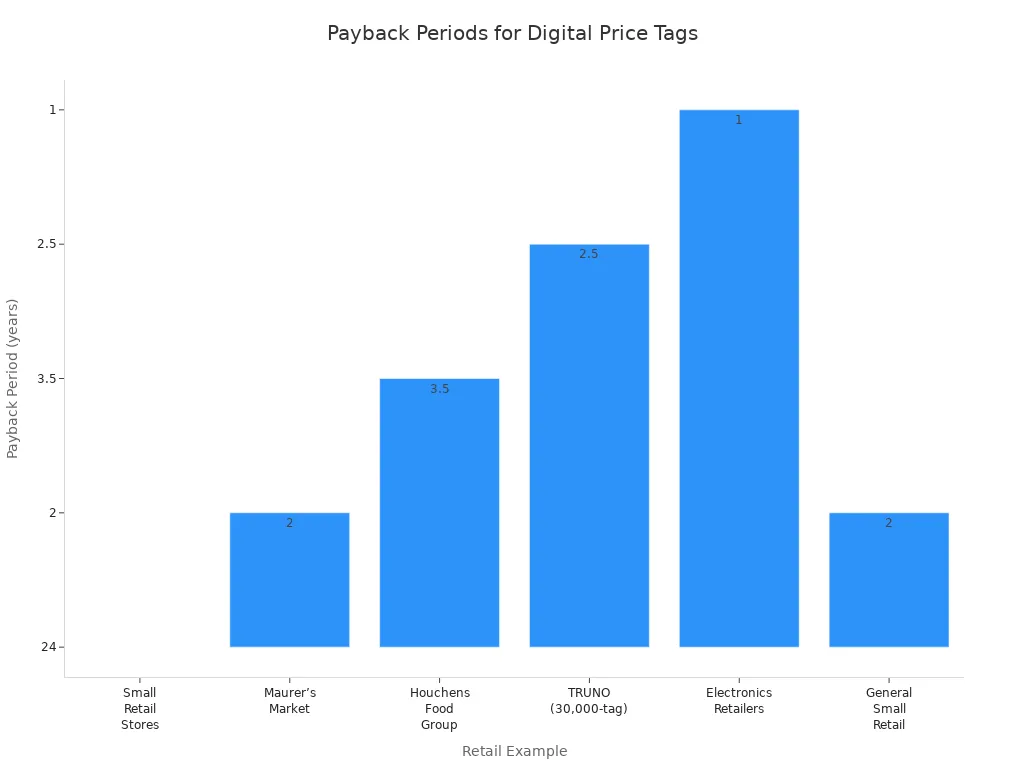
You can calculate the payback period for your investment in digital shelf labels by comparing your initial costs to annual savings and revenue gains. Consider labor savings, fewer pricing errors, and increased revenue from dynamic pricing. Many retailers recover their investment within 1 to 3 years.
| Retail Example | Payback Period | Key Methodological Points and Benefits Used in Calculation |
|---|---|---|
| Small Retail Stores | 12 to 36 months | Compare initial investment to annual savings and revenue gains; includes labor savings, fewer pricing errors, and operational efficiency improvements |
| Maurer’s Market | 1.5 to 2.5 years | Labor time reduced drastically, ~80% labor savings, fewer errors; payback period derived from labor cost reductions and efficiency gains |
| Houchens Food Group | ~3.5 years | Scaled labor and cost efficiencies across multiple store formats considered in payback period calculation |
| TRUNO (30,000-tag system) | 2 to 3 years (up to 1 year with AI pricing) | Large initial investment; payback period shortened by AI-driven dynamic pricing revenue increases |
| Electronics Retailers | Within 1 year | Rapid price updates and dynamic pricing increase revenue; payback period based on quick labor savings and revenue boosts |
Note: Use the ROI formula: ROI = (Total Return – Total Investment) / Total Investment × 100%. Monitor your results and adjust your calculations as your store benefits grow.
Is Investing in Digital Price Tags and Digital Shelf Labels Worth It?
Evaluating the Business Case for Increasing Customer Unit Price
Key Factors for Retail Decision-Makers
You need to consider several factors before making an investment in digital price tags. Start by conducting a technology audit to check your store’s digital infrastructure and network reliability. Assess if your staff can adapt to new workflows and if your current systems are compatible with digital shelf labels. Perform a cost-benefit analysis that weighs upfront costs—such as hardware, software, installation, and training—against long-term savings from reduced labor, improved pricing accuracy, and better customer satisfaction.
- Review vendor options for compatibility, scalability, support, and security.
- Plan a pilot program with clear goals like improving pricing accuracy or reducing manual labor.
- Measure pilot success using KPIs such as labor hours saved and customer satisfaction.
- Consider store size, product turnover, customer demographics, and whether your store is urban or rural.
- Manage risks like technical malfunctions, security issues, and compliance with data privacy rules.
- Align your investment with your brand’s goals and monitor metrics like sales uplift and customer retention after implementation.
Large retail chains often see faster ROI due to economies of scale, while small boutiques may face higher per-unit costs and slower returns. Urban stores usually benefit more from digital price tags because of better infrastructure and higher customer expectations for technology.
Comparing Digital Price Tags to Alternative Solutions
Digital price tags require a higher initial investment than traditional paper tags. Each electronic shelf label can cost between $5 and $20, with additional expenses for software and gateway hardware. However, you save on labor by eliminating manual price changes and gain from improved pricing accuracy and inventory management. Over time, these operational efficiencies can offset the upfront costs. Manual price tags avoid the initial expense but lack the agility and efficiency of digital solutions. Research shows that electronic shelf labels often support dynamic pricing for discounts and waste reduction, rather than directly increasing customer unit price. You gain more from operational improvements and customer engagement than from raising prices alone.
Future-Proofing Retail with Electronic Shelf Price Tags
Adapting to Changing Shopper Expectations
Digital price tags help you meet modern shopper demands for transparency, accuracy, and personalized experiences. You can synchronize prices across online and offline channels in real time, reducing errors and building trust. These systems support sustainability by cutting paper waste and energy use. You can also link digital shelf labels to loyalty programs, enabling personalized promotions that boost customer engagement.
- Real-time pricing updates keep your store competitive.
- Integration with omnichannel strategies ensures consistent pricing everywhere.
- Automation streamlines inventory and pricing management, allowing you to respond quickly to market changes.
Staying Competitive in a Digital Retail Landscape
You gain significant competitive advantages by adopting digital price tags. You reduce costs related to printing and labor, often cutting label management expenses by up to 50%. Instant price updates help you react to market shifts and competitor pricing. You improve customer satisfaction by ensuring accurate, up-to-date pricing and offering interactive promotions. Digital price tags also support sustainability goals, aligning your business with ESG principles.
By investing in digital price tags, you position your store for long-term success, operational efficiency, and a stronger connection with today’s tech-savvy shoppers.
Action Steps to Increase Customer Unit Price with Digital Price Tags
Getting Started with Digital Shelf Labels
Assessing Store Needs and Setting Goals
You should begin by carefully evaluating your store’s unique requirements. Start with a detailed floorplan and planogram to organize your shelf layout. This planning helps you identify high-traffic areas and prioritize where digital shelf labels will have the most impact. Consider your product assortment, pricing strategies, and promotional goals. Set clear objectives, such as reducing manual labor, improving pricing accuracy, or increasing average transaction value.
Tip: Consistency in labeling and strategic placement at eye level can maximize visibility and influence purchasing decisions.
Choosing the Right Technology Partner
Selecting the right technology partner is crucial for a successful rollout. Look for providers who offer modular and adaptable solutions that fit various shelf sizes. Ensure the system supports real-time updates and integrates with your existing inventory and POS platforms. Evaluate automation tools that streamline the conversion process and reduce implementation time by up to 40%. Choose partners who provide robust support, training, and future-ready features like interactive displays and smart shelf technologies.
Maximizing Impact on Customer Unit Price
Best Practices for Promotions and Bundling
To drive higher customer unit price, focus on clear and simple digital price tags that highlight essential information—price, unit pricing, and promotions. Use high-contrast displays and appropriate font sizes for easy reading. Separate standard pricing from promotional content by using enhanced displays for special offers. Integrate your shelf labels with inventory management systems to automate updates and reduce staff workload.
Leverage dynamic pricing algorithms to adjust prices in real time based on demand, competitor activity, and inventory levels. For example, retailers using dynamic pricing during peak seasons have seen profit margins rise by 25%. Machine learning models can analyze transaction data to identify demand patterns and optimize prices continuously.
Note: Prepare for future technology shifts by supporting 2D barcodes and tracking customer engagement with interactive features.
Monitoring, Testing, and Optimizing Results
Sustaining increased customer unit price requires ongoing monitoring and optimization. Use advanced tools to track system performance and receive automated alerts for quick issue resolution. Employ AI and automation to validate data, optimize pricing, and manage inventory replenishment in real time. Integrate your digital price tags with omnichannel strategies to ensure unified pricing across online and offline channels.
Regularly review analytics to understand how pricing changes affect customer behavior. Adjust your strategies based on these insights to maintain growth. Continuous staff training and engagement support operational excellence and help you adapt to evolving retail trends.
You gain a fast, effective way to increase customer unit price by adopting digital price tags.
- These tools enable dynamic pricing, real-time promotions, and strategic offers that boost customer engagement and spending.
- Automation reduces errors and labor, letting you focus on optimizing the customer experience.
The market for these solutions continues to grow, driven by demand for accurate pricing and smart technology. You position your business for future success and maintain a competitive edge by investing in digital price tags.
FAQ
What is the main benefit of digital price tags for retailers?
You gain the ability to update prices instantly across your store. This automation reduces labor costs, improves pricing accuracy, and enables dynamic promotions that increase customer unit price.
How do digital shelf labels integrate with existing retail systems?
You connect digital shelf labels to your POS and inventory systems. This integration ensures real-time synchronization of prices, promotions, and stock levels, keeping your pricing consistent and accurate.
Are digital price tags difficult to install and maintain?
You can install most digital price tags quickly using wireless technology. Maintenance remains minimal because these devices use long-lasting batteries and require only occasional software updates.
Can you use digital price tags for personalized promotions?
Yes. You can link digital price tags to loyalty programs and customer data. This connection allows you to display targeted discounts and offers directly at the shelf, increasing engagement and sales.
What is the typical ROI period for digital shelf label investments?
Most retailers see a return on investment within 1 to 3 years. You achieve this through labor savings, fewer pricing errors, and increased revenue from dynamic pricing strategies.
Do digital price tags support sustainability goals?
You reduce paper waste and energy consumption by switching to digital price tags. These devices use e-paper displays and require fewer resources than traditional paper tags.
How do digital price tags help prevent pricing errors?
You eliminate manual updates with automated, centralized price changes. This process ensures every shelf displays the correct price, reducing errors and improving customer trust.
Can you use digital price tags in all types of retail environments?
You can deploy digital price tags in grocery, electronics, apparel, and specialty stores. Flexible designs and integration options make them suitable for a wide range of retail formats.